


Add, Subtract, Divide, Multiply: MHSAA Not Alone
July 25, 2017
By Rob Kaminski
MHSAA benchmarks editor
This is the third part in a series on MHSAA tournament classification, past and present, that will be published over the next two weeks. This series originally ran in this spring's edition of MHSAA benchmarks.
As the MHSAA faces its most recent classification task with 8-Player Football, and opinions continue to swirl about as to the method, timeframe, location and other procedures, a look around the country provides plenty of company among state association brethren factoring variables into their own equations.
In the Pacific Northwest, the Oregon School Activities Association Football Playoffs are under public scrutiny as leadership ponders a five or six classification format beginning with the 2018-19 school year.
The OSAA has crowned six champions on the gridiron since 2006-07. Many of the state’s smaller schools would like to keep it that way, while larger schools lean toward a five-classification system, citing larger leagues, ease of travel and credibility to state championships as the advantages.
Still others would prefer more than six classes, pointing to safety issues and the opportunity to increase participation numbers as positives.
Moving southeast of Oregon, the Nevada Interscholastic Activities Association recently voted to hold serve on a classification proposal that was volleyed to the membership.
However, changes still could be forthcoming by as early as the 2018-19 season which would add a fifth classification in more populated southern Nevada while allowing northern schools to participate in four classifications. Such divisions could mean no state championship for the fifth class in southern Nevada.
Because of that, the NIAA wants equal numbers of schools in each classification on both ends of the state. Complicating the issue is the fact that the 24 largest schools in the state, by enrollment, are all in Clark County in Southern Nevada.
Across Nevada’s border into Arizona, charter schools are asking the Arizona Interscholastic Association to reconsider classification that was voted upon and approved in September 2015. That agreement called for the largest 33 percent of charter schools by enrollment to be placed in the state’s largest school classification, 3A, the middle 33 percent into 2A, and the smallest 33 percent into 1A.
Less than two years later the charter schools have had a change of heart and have asked to be considered the same as other Arizona public schools and be placed appropriately by enrollment beginning with the 2018-19 school year.
The situation in Arizona further illustrates how the public/private debate that all state associations have faced throughout existence now has the added dynamic of rapidly growing charter schools in today’s educational system, along with virtual school enrollment.
In the nation’s heartland, Nebraska has retooled its football classifications by using enrollment of boys students only in its schools rather than total enrollment. The Nebraska School Activities Association football-playing schools will kick off the 2018 season using this alignment.
Nebraska has three classes of 11-player football, with the smallest class divided in two, Class C-1 and C-2. The state also will have 8-player football for boys enrollments under 47, and the NSAA will sponsor a new 6-player tournament in 2018 for schools with 27 or fewer boys.
“This is a good proposal because some schools have a sizable imbalance between the number of boys and girls, and there’s a large gap (in enrollment) between the largest and smallest schools in Classes A and B,” NSAA executive director Jim Tenopir said. “I think this addresses both of those concerns.”
Swimmers in Georgia, meanwhile, will feel like they are moving with the current, rather than upstream in 2017-18, as the Georgia High School Association recently doubled the number of team championship events from two to four.
Swim enthusiasts can also count on longer days at the finals, as the top 30 finishers from the prelims will advance to the finals instead of 20, and all championship events will have three heats versus two.
Amid Decade of Dominance, Negaunee's Latest Finals Title Stands Out
By
John Vrancic
Special for MHSAA.com
September 29, 2022
KINGSFORD — Negaunee has been the measuring stick in Upper Peninsula girls tennis for the past decade.
The Miners showed why in earning their seventh U.P. Division 1 title in 10 years Wednesday with 19 points. They were followed by Marquette with 14, Escanaba 11, 2021 champion Ishpeming Westwood with eight, Gladstone three, Menominee one and Kingsford.
Negaunee won four flights on a sunny and seasonably cool day in Dickinson County.
“The U.P. Finals always require a gritty effort from all parts of your lineup,” said Negaunee coach Kyle Saari. “Coming into the season we had a lot of uncertainty in our lineup, but the girls answered the bell. This is one of the proudest titles in our program’s history. Our No. 2 and 3 doubles put together an outstanding effort. They went undefeated and didn’t lose a set all season. That’s a remarkable achievement within our program.”
Olivia Lunseth and Sage Juntti defeated Marquette’s Hosanna Brindle and Maija Parkkonen 7-5, 6-1 for the No. 2 title, and sophomores Kallen Schultz and Madelynn Peters took a 6-3, 6-1 decision from Marquette’s Eliina Brazeau and Nistha Gautum in No. 3.
 “I think everything went pretty well,” said Schultz, who won at No. 4 doubles a year ago. “We worked pretty well together and talked a lot on the court. It was chilly this morning, but we had good conditions this afternoon. I prefer to play at a fast pace and tried to place the ball more.”
This marked the first championship for Peters, who also enjoyed the milder conditions.
“Working with the weather conditions became a little easier as the day progressed,” she said.
“I was in and out of the varsity lineup last year. This was definitely different. It took a lot of hard work to get to this point. This will be a motivator for next year.”
Miners’ freshman Rheana Nelson topped Marquette’s Cecilia Jacuzzo 6-2, 6-1 for the No. 3 singles championship, and classmate Lilliana Saunders overcame a 5-2 deficit and other adversity late in the second set of a 6-2, 7-5 (7-6) triumph over Westwood’s Samantha Ruby at No. 4.
“This feels really good, but I had real bad cramping in my leg.” said Saunders. “I didn’t really know where we were in the standings. I felt I had to win for our team to win. After she went up 6-5, I just took it one point at a time. It feels great to win as a team.”
Nelson overcame numerous ups and downs by staying focused.
“I kept my focus throughout the season,” she added. “I approached this as just another match, and it kept me a little more calm. This is a good start to my high school career.”
Lyndsey Lake and Lexi Hammerstrom provided Marquette with its lone title in a 6-4, 6-2 defeat of Negaunee’s Paityn Brunette and Autumn Ring.
Escanaba junior Sophia Derkos earned her first U.P. Finals title by defeating Marquette’s Maia Miller 6-1, 6-1 in No. 1 singles.
“I knew where to place the ball and had my family here to watch,” said Derkos, who reached the No. 1 semifinals a year ago. “I worked on my game a lot more this year. I also worked on shots I didn’t have last year. It was real cold for the first match, then it warmed up and my muscles worked better this afternoon.”
Escanaba senior Delaney McIntyre and junior Natalie Williams enjoyed their moment in the winner’s circle following a 6-0, 1-6, 6-1 triumph over Negaunee’s Stella Harris and Madison Frustaglio at No. 1 doubles.
 A key moment for the Eskymos duo took place in the finale when Williams converted on a groundstroke to make it 4-1.
"That was a big play,” she said. “That was also a momentum builder. They’re good players. They didn’t give up.”
This was the first U.P. championship for McIntyre.
“This is really special,” she said. “I thought our team did well. We’ve gone back and forth with Marquette and Westwood all year.”
Sophomore Tia Schone became Gladstone’s first U.P. Finals champion in four years in a 6-2, 6-2 victory over Negaunee’s Aubrey Johnson at No. 2 singles.
An overhead shot helped Schone gain a 3-1 lead in the second set. Johnson then changed her strategy, electing to lob the ball over the net which at one point helped her come within 4-2.
“An Iron Mountain girl did that in a match (at Gladstone) two weeks ago,” said Schone, who made the semifinals at No. 3 singles last year. “It didn’t catch me off guard. It helped to see that before. I’m definitely a faster-pace player, but I needed that practice. I just had to be patient and kind of wait for her to make a mistake. This is definitely a big step after taking fourth last year. I knew what to expect this time.”
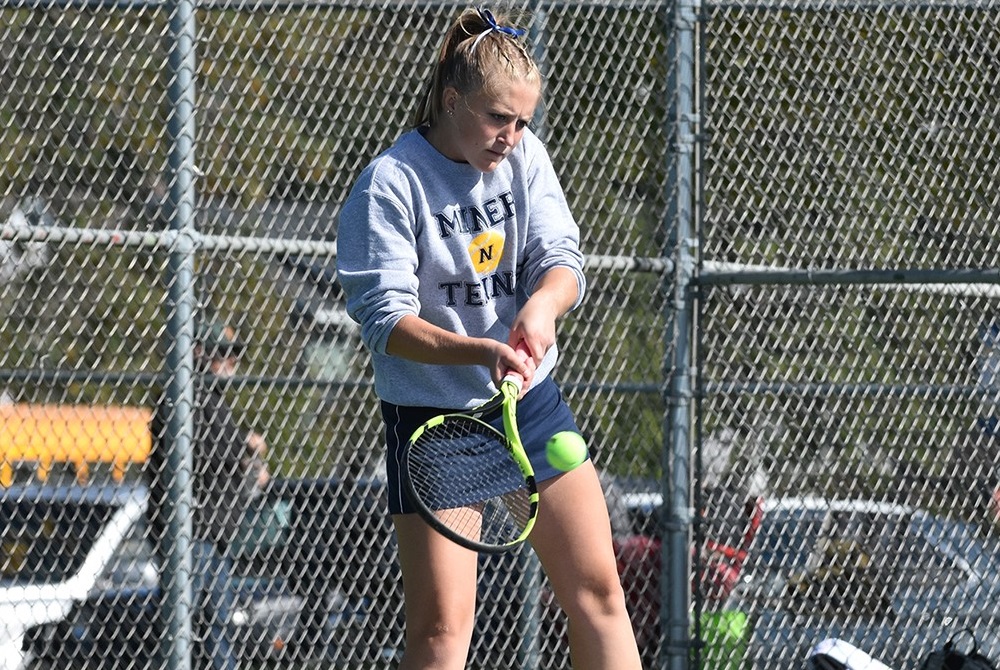
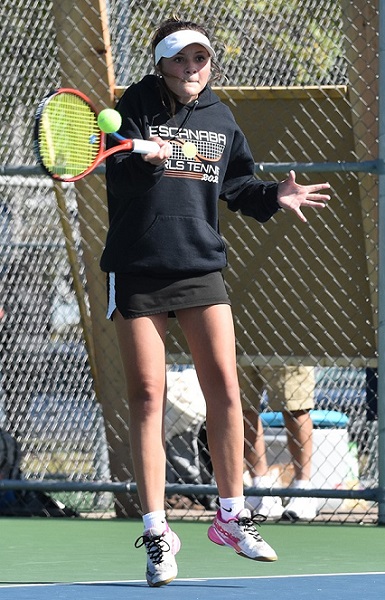
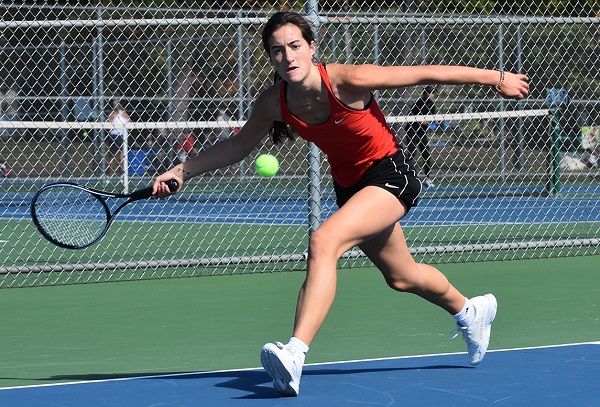
PHOTOS (Top) Negaunee’s Jordan Enright returns a volley during a No. 1 singles semifinal match Wednesday. (Middle) Escanaba’s Sophia Derkos follows through on a shot during the same No. 1 singles semifinal. (Below) Marquette’s Kaia Miller reaches to send back a volley during her No. 1 singles semifinal. (Photos by Dennis Mansfield.)