


Add, Subtract, Divide, Multiply: MHSAA Not Alone
July 25, 2017
By Rob Kaminski
MHSAA benchmarks editor
This is the third part in a series on MHSAA tournament classification, past and present, that will be published over the next two weeks. This series originally ran in this spring's edition of MHSAA benchmarks.
As the MHSAA faces its most recent classification task with 8-Player Football, and opinions continue to swirl about as to the method, timeframe, location and other procedures, a look around the country provides plenty of company among state association brethren factoring variables into their own equations.
In the Pacific Northwest, the Oregon School Activities Association Football Playoffs are under public scrutiny as leadership ponders a five or six classification format beginning with the 2018-19 school year.
The OSAA has crowned six champions on the gridiron since 2006-07. Many of the state’s smaller schools would like to keep it that way, while larger schools lean toward a five-classification system, citing larger leagues, ease of travel and credibility to state championships as the advantages.
Still others would prefer more than six classes, pointing to safety issues and the opportunity to increase participation numbers as positives.
Moving southeast of Oregon, the Nevada Interscholastic Activities Association recently voted to hold serve on a classification proposal that was volleyed to the membership.
However, changes still could be forthcoming by as early as the 2018-19 season which would add a fifth classification in more populated southern Nevada while allowing northern schools to participate in four classifications. Such divisions could mean no state championship for the fifth class in southern Nevada.
Because of that, the NIAA wants equal numbers of schools in each classification on both ends of the state. Complicating the issue is the fact that the 24 largest schools in the state, by enrollment, are all in Clark County in Southern Nevada.
Across Nevada’s border into Arizona, charter schools are asking the Arizona Interscholastic Association to reconsider classification that was voted upon and approved in September 2015. That agreement called for the largest 33 percent of charter schools by enrollment to be placed in the state’s largest school classification, 3A, the middle 33 percent into 2A, and the smallest 33 percent into 1A.
Less than two years later the charter schools have had a change of heart and have asked to be considered the same as other Arizona public schools and be placed appropriately by enrollment beginning with the 2018-19 school year.
The situation in Arizona further illustrates how the public/private debate that all state associations have faced throughout existence now has the added dynamic of rapidly growing charter schools in today’s educational system, along with virtual school enrollment.
In the nation’s heartland, Nebraska has retooled its football classifications by using enrollment of boys students only in its schools rather than total enrollment. The Nebraska School Activities Association football-playing schools will kick off the 2018 season using this alignment.
Nebraska has three classes of 11-player football, with the smallest class divided in two, Class C-1 and C-2. The state also will have 8-player football for boys enrollments under 47, and the NSAA will sponsor a new 6-player tournament in 2018 for schools with 27 or fewer boys.
“This is a good proposal because some schools have a sizable imbalance between the number of boys and girls, and there’s a large gap (in enrollment) between the largest and smallest schools in Classes A and B,” NSAA executive director Jim Tenopir said. “I think this addresses both of those concerns.”
Swimmers in Georgia, meanwhile, will feel like they are moving with the current, rather than upstream in 2017-18, as the Georgia High School Association recently doubled the number of team championship events from two to four.
Swim enthusiasts can also count on longer days at the finals, as the top 30 finishers from the prelims will advance to the finals instead of 20, and all championship events will have three heats versus two.
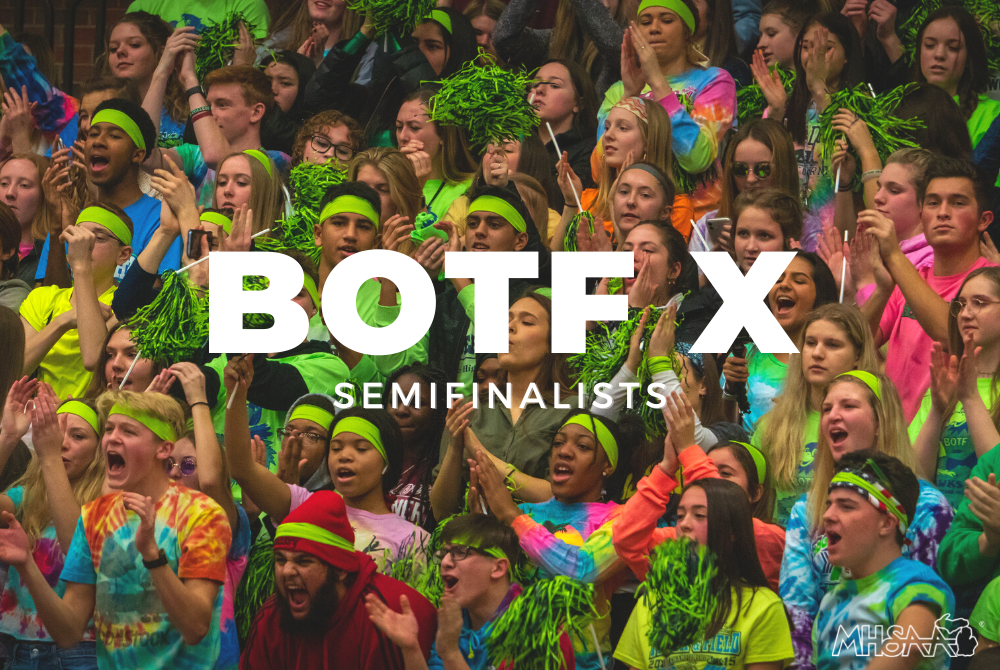
BOTF X: Challenges Await 9 Semifinalists from Record-Tying Field
By
Geoff Kimmerly
MHSAA.com senior editor
January 10, 2022
Congratulations, “Battle of the Fans X” semifinalists, for qualifying for this year’s “Challenge Round.” In doing so, you’ve already met and overcome a pair of significant challenges as you seek to show Michigan why your student section is the state’s best.
First, you’ve managed this despite COVID-19. Not much more explanation needed there.
Second, you’ve qualified from a record-tying number of applicants to advance and earn this opportunity.
Nine student cheering sections from MHSAA member schools have been selected from the first phase of BOTF X to take part in the “Challenge Round” as they vie for this year’s championship: Howell, Midland Dow and Traverse City West from Class A; Imlay City, Spring Lake and Yale from Class B; and Buchanan, North Muskegon and Petersburg Summerfield from Class C/D.
Battle of the Fans X, organized by MHSAA staff and its 16-member Student Advisory Council, kicked off by inviting schools to submit short videos, via TikTok, of their cheering sections in action by Jan. 8. The Advisory Council has selected nine semifinalists to accomplish a list of tasks showing off their sections over the next 12 days – and the Council will then select three finalists for MHSAA visits.
This year’s winner will be announced Feb. 18 and recognized March 25 during the MHSAA Boys Basketball Semifinals at Michigan State University’s Breslin Center.
Semifinalists are required to complete up to 20 BOTF challenges and submit documentation via TikTok by 11 p.m. on Jan. 22. Five mandatory challenges focus on contest criteria: positive sportsmanship, student body participation, school spirit, originality of cheers, organization of the group, student section leadership and overall fun.
The list of challenges allows semifinalists opportunities to show the unique characteristics that make their sections elite. The full list of challenges can be found on the MHSAA Website.
“With limited attendance at games last year, students have been excited to get back to fields and gyms this year to support their classmates,” said Andy Frushour, MHSAA director of brand management and advisor to the Student Advisory Council. “We know this pandemic isn’t yet over, and student sections haven’t taken their attendance for granted. Every game is special, and student sections are excited to continue participation in this contest.
“Over the next two weeks, we’ll learn a lot about what these student sections bring to every game night.”
The Student Advisory Council will select the finalists for announcement Jan. 24 on Second Half. MHSAA staff and Student Advisory Council members will visit all three finalists for home basketball games during the second half of this regular season, with coverage and video from those visits and the announcement of the winner all to be published on Second Half.
The winner will be selected by another Advisory Council vote based in part on support each section receives on the MHSAA’s social media sites. All social media postings regarding Battle of the Fans X should include the hashtag #MHSAABOTF2022. The MHSAA will share semifinalists’ challenge TikToks over the next two weeks. The MHSAA also will post from the three finalists visits on those channels.
A record-tying 27 schools applied for this year’s contest, including 14 schools for the first time to bring the total to 119 member schools that have applied for the contest at least once over its 10-year existence.
Buchanan and Traverse City West both have applied eight times and will compete in the semifinals for the fourth-straight competition. Buchanan was the BOTF champion in 2013, 2018 and 2020, and West won in 2016. North Muskegon is a semifinalist for the second time after winning the BOTF title in 2019.
Petersburg Summerfield advanced to the semis for the third-straight time, while Yale advanced past the first round for the third time (and first since 2016). Imlay City advanced for the first time after three previous attempts, and Howell, Spring Lake, and Midland Dow are all first-time applicants.
“We’re basically in the ‘Regional’ round now if you compare this competition to our other tournaments,” Frushour said. “This group of nine is just getting warmed up as they prepare to make a run at reaching the ‘state finals.’ We’re excited to see the creativity and positivity of the nine semifinalists.”
The other first-time applicants were Carsonville-Port Sanilac, Detroit Catholic Central, Freeland, Grosse Pointe North, Okemos, Plymouth Christian Academy, Portage Central, Sanford Meridian, Spring Lake, Troy and Utica Eisenhower.
Click to view all applications on TikTok.
The contest is sponsored in part by the United Dairy Industry of Michigan, which promotes Michigan's locally-produced dairy products and nutrition education. Rules plus links to past years’ coverage of the contest can be found on the MHSAA's BOTF page.
The Student Advisory Council is made up of eight seniors and eight juniors who each serve two-year terms. The Council acts as the voice of Michigan's student-athletes; it serves as a student sounding board for the MHSAA's Representative Council, assists in planning Sportsmanship Summits, Captains Clinics and other student leadership events; participates in a yearly focus group about the state of high school sports for Michigan State University's Institute for the Study of Youth Sports and assists with medal ceremonies at MHSAA championship events.
VIDEOS: Below, check out the videos from our visits to all of the first nine BOTF champions.