

Add, Subtract, Divide, Multiply: MHSAA Not Alone
July 25, 2017
By Rob Kaminski
MHSAA benchmarks editor
This is the third part in a series on MHSAA tournament classification, past and present, that will be published over the next two weeks. This series originally ran in this spring's edition of MHSAA benchmarks.
As the MHSAA faces its most recent classification task with 8-Player Football, and opinions continue to swirl about as to the method, timeframe, location and other procedures, a look around the country provides plenty of company among state association brethren factoring variables into their own equations.
In the Pacific Northwest, the Oregon School Activities Association Football Playoffs are under public scrutiny as leadership ponders a five or six classification format beginning with the 2018-19 school year.
The OSAA has crowned six champions on the gridiron since 2006-07. Many of the state’s smaller schools would like to keep it that way, while larger schools lean toward a five-classification system, citing larger leagues, ease of travel and credibility to state championships as the advantages.
Still others would prefer more than six classes, pointing to safety issues and the opportunity to increase participation numbers as positives.
Moving southeast of Oregon, the Nevada Interscholastic Activities Association recently voted to hold serve on a classification proposal that was volleyed to the membership.
However, changes still could be forthcoming by as early as the 2018-19 season which would add a fifth classification in more populated southern Nevada while allowing northern schools to participate in four classifications. Such divisions could mean no state championship for the fifth class in southern Nevada.
Because of that, the NIAA wants equal numbers of schools in each classification on both ends of the state. Complicating the issue is the fact that the 24 largest schools in the state, by enrollment, are all in Clark County in Southern Nevada.
Across Nevada’s border into Arizona, charter schools are asking the Arizona Interscholastic Association to reconsider classification that was voted upon and approved in September 2015. That agreement called for the largest 33 percent of charter schools by enrollment to be placed in the state’s largest school classification, 3A, the middle 33 percent into 2A, and the smallest 33 percent into 1A.
Less than two years later the charter schools have had a change of heart and have asked to be considered the same as other Arizona public schools and be placed appropriately by enrollment beginning with the 2018-19 school year.
The situation in Arizona further illustrates how the public/private debate that all state associations have faced throughout existence now has the added dynamic of rapidly growing charter schools in today’s educational system, along with virtual school enrollment.
In the nation’s heartland, Nebraska has retooled its football classifications by using enrollment of boys students only in its schools rather than total enrollment. The Nebraska School Activities Association football-playing schools will kick off the 2018 season using this alignment.
Nebraska has three classes of 11-player football, with the smallest class divided in two, Class C-1 and C-2. The state also will have 8-player football for boys enrollments under 47, and the NSAA will sponsor a new 6-player tournament in 2018 for schools with 27 or fewer boys.
“This is a good proposal because some schools have a sizable imbalance between the number of boys and girls, and there’s a large gap (in enrollment) between the largest and smallest schools in Classes A and B,” NSAA executive director Jim Tenopir said. “I think this addresses both of those concerns.”
Swimmers in Georgia, meanwhile, will feel like they are moving with the current, rather than upstream in 2017-18, as the Georgia High School Association recently doubled the number of team championship events from two to four.
Swim enthusiasts can also count on longer days at the finals, as the top 30 finishers from the prelims will advance to the finals instead of 20, and all championship events will have three heats versus two.
West Catholic Standout Quickly Leaves Lasting Impression
By
Geoff Kimmerly
MHSAA.com senior editor
August 18, 2021
Recent Grand Rapids West Catholic grad Jaye Guichelaar played only one season of high school softball in Michigan after her family moved here from Washington a year ago.
But she made a quick and lasting impact on the MHSAA record book.
Guichelaar tied for the eighth-highest single-season batting average at .700 and also made the record book with 70 hits over 30 games. Although a record book list isn’t kept for this statistic, it’s an achievement also worth noting: She didn’t strike out over 100 at bats.
Read on for more recent additions to the softball record listings.
Softball
Durand earned its first record book entry in this sport this season, hitting 61 doubles over 28 games. Madison Raley led the way with 12.
Vicksburg’s Audrie Dugan earned a spot in the records with eight RBI in a May 19 win over Centreville. She was 4 for 4 with a home run.
A pair of Midland Bullock Creek hitters reached the record book with home runs in their respective back-to-back at bats this spring. Senior Mattie Midkiff hit home runs in two straight at bats against St. Charles on April 30. Junior Sydney Borsenik did the same, with both of hers during the second inning, against Carrollton on May 1. Bullock Creek also was added for 69 doubles as a team over 39 games.
Port Huron’s Emma Trombly was perhaps known more for her basketball talents this school year, but she made the softball record book with a big day April 22 against Warren Cousino. Trombly tied for third on the single-game RBI list with 10 in a 23-11 win, going 4 for 6 at the plate and also scoring five runs. She’ll play basketball this upcoming season at Northwood.
LaNya Bates didn’t get to play her senior season at Grand Blanc because of COVID-19, but her hitting over her first three earned her a place on the career batting average list at .541, with 193 hits over 106 games from 2017-19. Teammates Kendall Klochack and Rebecca Oetting were sophomores in 2019 and added to the single-season doubles list for 22 and 18, respectively, that spring. Bates is continuing her career at Memphis, and Klochack signed with Purdue.
Kalamazoo Central’s Kearney Miller earned her school’s first individual record book entry in this sport with 17 doubles this season. Kalamazoo Central also made the team record book with 74 doubles over 33 games. Miller will continue her career at Albion College.
A pair of Caro hitters were added to the records for achievements this spring as well. Freshman Leah Daniels drove in six runs during an April 26 game and had 17 doubles over 38 games this season, while senior Kelsey Marcola also drove in six runs in a game, June 1 against Elkton-Pigeon-Bay Port Laker.
A pair of West Bloomfield juniors made the single-season home runs list this spring. Sydney Stapf drove 12 homers over 30 games, while Alma Tatem hit 10 over 28 games.
Chloe May had a memorable May 10 with three record book entries coming from her performance in Pickford’s 26-12 win over St. Ignace. The freshman hit three home runs total, including two in back-to-back at bats, and drove in seven runs.
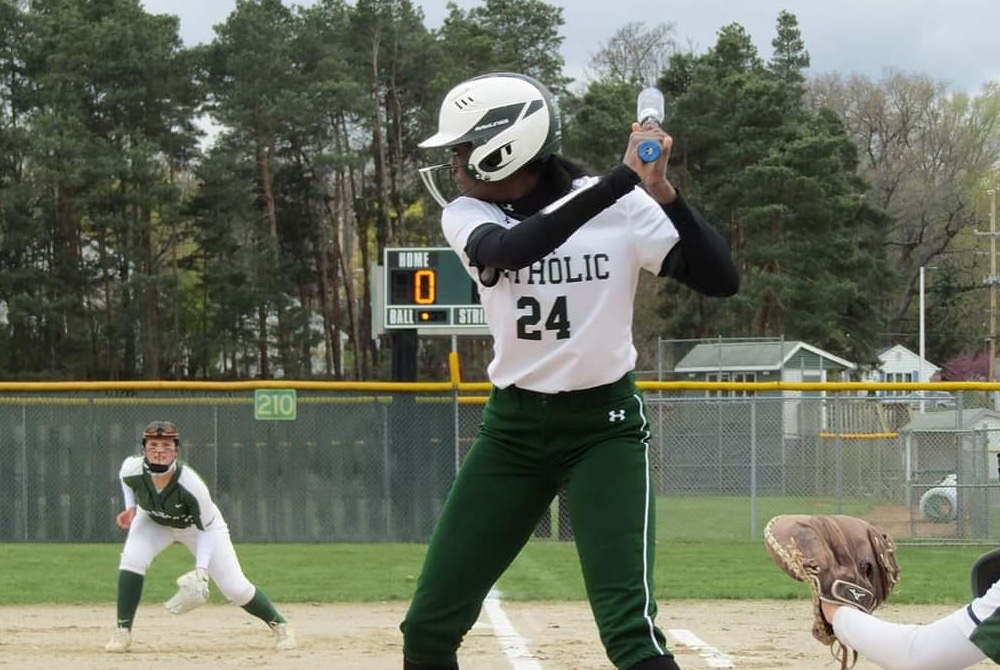
PHOTO: West Catholic’s Jaye Guichelaar stands in for a pitch during a game this spring. (Photo courtesy of the Grand Rapids West Catholic athletic program.)