


Add, Subtract, Divide, Multiply: MHSAA Not Alone
July 25, 2017
By Rob Kaminski
MHSAA benchmarks editor
This is the third part in a series on MHSAA tournament classification, past and present, that will be published over the next two weeks. This series originally ran in this spring's edition of MHSAA benchmarks.
As the MHSAA faces its most recent classification task with 8-Player Football, and opinions continue to swirl about as to the method, timeframe, location and other procedures, a look around the country provides plenty of company among state association brethren factoring variables into their own equations.
In the Pacific Northwest, the Oregon School Activities Association Football Playoffs are under public scrutiny as leadership ponders a five or six classification format beginning with the 2018-19 school year.
The OSAA has crowned six champions on the gridiron since 2006-07. Many of the state’s smaller schools would like to keep it that way, while larger schools lean toward a five-classification system, citing larger leagues, ease of travel and credibility to state championships as the advantages.
Still others would prefer more than six classes, pointing to safety issues and the opportunity to increase participation numbers as positives.
Moving southeast of Oregon, the Nevada Interscholastic Activities Association recently voted to hold serve on a classification proposal that was volleyed to the membership.
However, changes still could be forthcoming by as early as the 2018-19 season which would add a fifth classification in more populated southern Nevada while allowing northern schools to participate in four classifications. Such divisions could mean no state championship for the fifth class in southern Nevada.
Because of that, the NIAA wants equal numbers of schools in each classification on both ends of the state. Complicating the issue is the fact that the 24 largest schools in the state, by enrollment, are all in Clark County in Southern Nevada.
Across Nevada’s border into Arizona, charter schools are asking the Arizona Interscholastic Association to reconsider classification that was voted upon and approved in September 2015. That agreement called for the largest 33 percent of charter schools by enrollment to be placed in the state’s largest school classification, 3A, the middle 33 percent into 2A, and the smallest 33 percent into 1A.
Less than two years later the charter schools have had a change of heart and have asked to be considered the same as other Arizona public schools and be placed appropriately by enrollment beginning with the 2018-19 school year.
The situation in Arizona further illustrates how the public/private debate that all state associations have faced throughout existence now has the added dynamic of rapidly growing charter schools in today’s educational system, along with virtual school enrollment.
In the nation’s heartland, Nebraska has retooled its football classifications by using enrollment of boys students only in its schools rather than total enrollment. The Nebraska School Activities Association football-playing schools will kick off the 2018 season using this alignment.
Nebraska has three classes of 11-player football, with the smallest class divided in two, Class C-1 and C-2. The state also will have 8-player football for boys enrollments under 47, and the NSAA will sponsor a new 6-player tournament in 2018 for schools with 27 or fewer boys.
“This is a good proposal because some schools have a sizable imbalance between the number of boys and girls, and there’s a large gap (in enrollment) between the largest and smallest schools in Classes A and B,” NSAA executive director Jim Tenopir said. “I think this addresses both of those concerns.”
Swimmers in Georgia, meanwhile, will feel like they are moving with the current, rather than upstream in 2017-18, as the Georgia High School Association recently doubled the number of team championship events from two to four.
Swim enthusiasts can also count on longer days at the finals, as the top 30 finishers from the prelims will advance to the finals instead of 20, and all championship events will have three heats versus two.
Ontonagon Girls Hit Fastest Stride at Championship Time
By
John Vrancic
Special for MHSAA.com
June 6, 2021
KINGSFORD — A season of steady improvement paid off for the Ontonagon girls track & field team Saturday as the Gladiators earned their first Upper Peninsula Division 3 Finals title in five years with 73 points.
They were followed by Rudyard with 64 and Stephenson with 54½.
“It was great,” said coach Brian Amos. “It was one of those seasons which was full of surprises. The girls just kept getting better. Surprisingly, in our first meet on a cold and rainy day in Ironwood (Kraemer Invitational), they started looking smooth. Their performance speaks for itself.”
Sophomore Lilly McIntyre won the 100-meter dash in a personal-best 13.7 seconds and classmate Makennah Uotila took long jump with a personal-best leap of 16 feet on a hot and humid day.
 “I had a pretty good start in the 100,” said McIntyre. “The warm weather helped. I didn’t have to spend so much time getting warmed up.
“This is a big confidence builder. We had the best handoffs we had all year (in the 800 relay).
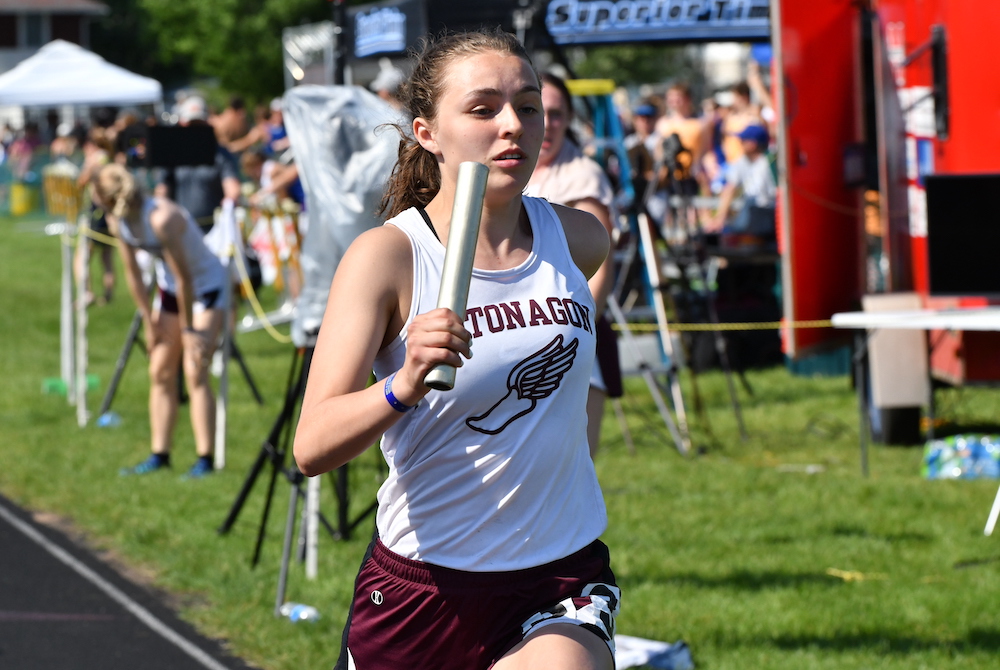
The Gladiators won that race in one minute, 55.25 seconds and the 1,600 relay (4:33.36).
Uotila added runner-up finishes in the 400 and 800 with personal-best times of 1:04.41 and 2:32.81, respectively.
“Those are tough races, especially with short recovery times in between,” she said. “I just try to pace myself for all events. Sixteen feet in long jump was my goal all season. I’m very excited.”
Rudyard sophomore Tristin Smith took the 400 (1:04) and was runner-up in the 1,600 (5:40.69).
“I try to start fast and stride it out,” said Smith. “It’s really good to have this competition, and it feels great to work hard all year and take a first up here. I had the second-fastest qualifying time. I knew I had a chance.”
Emma Bogacki added a first for the Bulldogs in discus (100-5).
Stephenson’s lone first came in pole vault where Daisy Grinsteiner cleared nine feet.
Mid Peninsula senior Daisy Englund won the 800 in a season-best 2:30.75 and was runner-up in the 100 (13.93).
“It’s such a hot day, and we never had competition like this,” said Englund, who will run at Ferris State next season. “I didn’t want to get boxed in. With 200 meters to go, I knew I had to kick it in. It was a relief to win the 800.”
 Junior teammate Landry Koski, seeded eighth going into the 1,600, came from behind to win in a season-best 5:39.89, followed by Smith, Bessemer sophomore Natalie Stone (5:42.82) and Ewen-Trout Creek senior Elise Besonen (5:44.82).
“This is my favorite race,” she said. “I knew I had to beat two girls to place. I knew about Gwen Kangas (of Chassell), but I didn’t know about the girl from Bessemer. When I saw they were in the 5:40s, I knew I had to pick it up. After the first 800 I felt I had a chance, and with the Rudyard girl right next to me (during the final lap), I knew I had to kick it in.”
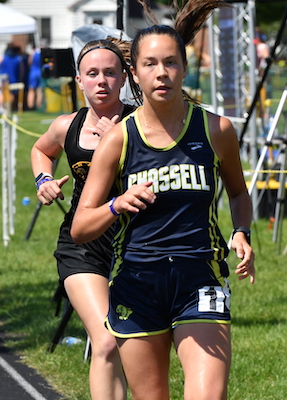
Kangas anchored the winning 3,200 relay, which was clocked in 11:09.64, and won the open 3,200 (12:58.8) followed by Besonen (13:14.38) and Koski (13:22.85).
“I just stayed positive,” she said. “Doing cross country helps quite a bit with all that running and conditioning. It’s just a matter of making sure you’re hydrated. We knew it was coming. You just have to prepare for this.”
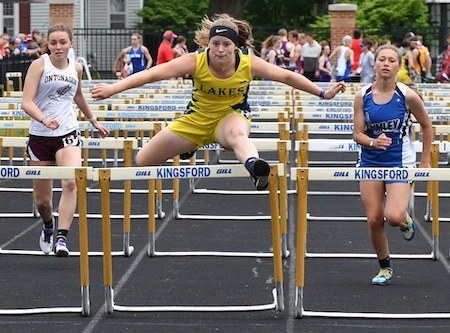
Lake Linden-Hubbell took the 400 relay (54.7), edging Brimley by three tenths of a second, and freshman Abi Codere won the 100 hurdles in a personal-best 17.16.
“I think I had a good start,” said Codere. “It felt like my form was good. This is a big confidence builder and a good learning experience. I never expected this, but after one of our home meets, our coach told me I may have a chance.”
Pickford junior Lucy Bennin took the 200 (28.66), edging North Dickinson junior Ashton Hord by 11 hundredths of a second, and Lizzie Storey captured the 300 hurdles (51.59).
“I had a pretty good start in the 200 and really kicked it in at the end,” said Bennin. “I poured a glass of water on myself before the start, and it felt real good. That gave me a little bit of a cool down before the race. After looking at the forecast, we knew it’d be hot and it helped me prepare mentally.”
Ellie Delene provided Baraga with a first in high jump (4-11) and Jaylyne Lindemann won shot put (32-8), tossing an inch further than Republic-Michigamme’s Leah McCracken.
PHOTOS: (Top) Ontonagon's Nicole Lukkari anchors the 1,600 relay Saturday. (Middle) Chassell's Gwen Kangas, right, is followed by Ewen-Trout Creek's Elise Besonen in the 3,200. (Below) Lake Linden-Hubbell's Abi Codere, middle, wins the 100 hurdles. (Photos by Cara Kamps. Click to see more at RunMichigan.com.)