


Add, Subtract, Divide, Multiply: MHSAA Not Alone
July 25, 2017
By Rob Kaminski
MHSAA benchmarks editor
This is the third part in a series on MHSAA tournament classification, past and present, that will be published over the next two weeks. This series originally ran in this spring's edition of MHSAA benchmarks.
As the MHSAA faces its most recent classification task with 8-Player Football, and opinions continue to swirl about as to the method, timeframe, location and other procedures, a look around the country provides plenty of company among state association brethren factoring variables into their own equations.
In the Pacific Northwest, the Oregon School Activities Association Football Playoffs are under public scrutiny as leadership ponders a five or six classification format beginning with the 2018-19 school year.
The OSAA has crowned six champions on the gridiron since 2006-07. Many of the state’s smaller schools would like to keep it that way, while larger schools lean toward a five-classification system, citing larger leagues, ease of travel and credibility to state championships as the advantages.
Still others would prefer more than six classes, pointing to safety issues and the opportunity to increase participation numbers as positives.
Moving southeast of Oregon, the Nevada Interscholastic Activities Association recently voted to hold serve on a classification proposal that was volleyed to the membership.
However, changes still could be forthcoming by as early as the 2018-19 season which would add a fifth classification in more populated southern Nevada while allowing northern schools to participate in four classifications. Such divisions could mean no state championship for the fifth class in southern Nevada.
Because of that, the NIAA wants equal numbers of schools in each classification on both ends of the state. Complicating the issue is the fact that the 24 largest schools in the state, by enrollment, are all in Clark County in Southern Nevada.
Across Nevada’s border into Arizona, charter schools are asking the Arizona Interscholastic Association to reconsider classification that was voted upon and approved in September 2015. That agreement called for the largest 33 percent of charter schools by enrollment to be placed in the state’s largest school classification, 3A, the middle 33 percent into 2A, and the smallest 33 percent into 1A.
Less than two years later the charter schools have had a change of heart and have asked to be considered the same as other Arizona public schools and be placed appropriately by enrollment beginning with the 2018-19 school year.
The situation in Arizona further illustrates how the public/private debate that all state associations have faced throughout existence now has the added dynamic of rapidly growing charter schools in today’s educational system, along with virtual school enrollment.
In the nation’s heartland, Nebraska has retooled its football classifications by using enrollment of boys students only in its schools rather than total enrollment. The Nebraska School Activities Association football-playing schools will kick off the 2018 season using this alignment.
Nebraska has three classes of 11-player football, with the smallest class divided in two, Class C-1 and C-2. The state also will have 8-player football for boys enrollments under 47, and the NSAA will sponsor a new 6-player tournament in 2018 for schools with 27 or fewer boys.
“This is a good proposal because some schools have a sizable imbalance between the number of boys and girls, and there’s a large gap (in enrollment) between the largest and smallest schools in Classes A and B,” NSAA executive director Jim Tenopir said. “I think this addresses both of those concerns.”
Swimmers in Georgia, meanwhile, will feel like they are moving with the current, rather than upstream in 2017-18, as the Georgia High School Association recently doubled the number of team championship events from two to four.
Swim enthusiasts can also count on longer days at the finals, as the top 30 finishers from the prelims will advance to the finals instead of 20, and all championship events will have three heats versus two.
Standout Juniors Pace Portland's Historic Finish
By
Perry A. Farrell
Special for MHSAA.com
April 9, 2021
EAST LANSING – Through almost three quarters Friday, only three Portland players had scored in the Division 2 girls basketball championship game.
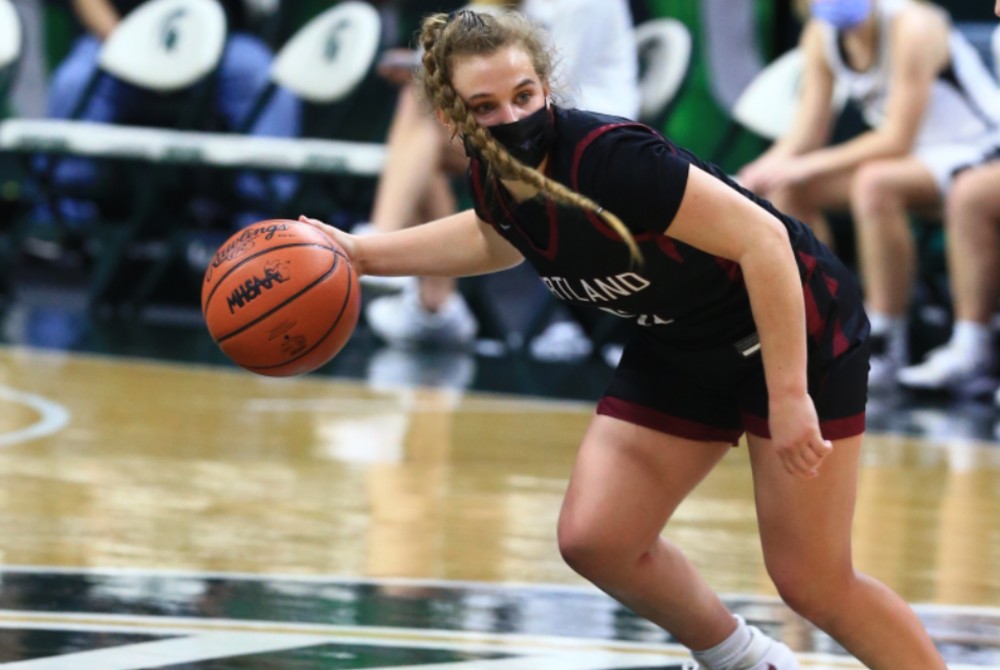
But the work of juniors Alivia Densmore, Ava Guilford and Ashley Bower was enough to carry the offense as the Raiders (20-2) racked up a 52-32 victory over Newaygo at the Breslin Center.
Bower led Portland with 20 points, while Guilford and Densmore chipped in 12 each. Earlier this season, Bower went over 1,000 points for her career and set the school scoring record.
“This whole season has been fun,’’ she said.
Friday’s Final matched a Raiders team making its first championship game appearance and a Newaygo team playing for its first title since 1985. It also was a rematch from Feb. 24, when Portland defeated Newaygo 38-33.
Portland coach Jason Haid recalled Friday how his team had a cancellation during the season and “we wanted to find a team that would test us. Newaygo came down during the middle of the week.
“Having played them helped. The number one thing we had on our minds going into this game was defense and defending ball screens. We know everything they were going to do would come off ball screens. The Longs (sisters Jaylee and Jaxi) are tough, and we knew we had to get out on them.’’
The Raiders trio combined for 40 points through three quarters as Portland built a 42-25 lead against the offensively-struggling Lions (21-2), who didn’t have a player reach double figures scoring.
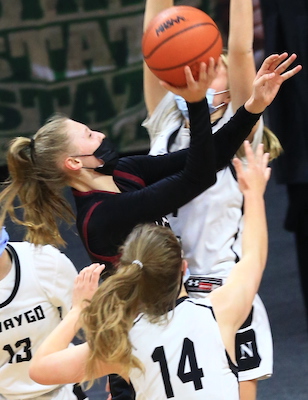 Portland increased its advantage to 21, 48-27, on two free throws from Ava Gruber with 5:54 to play.
“It wasn’t our night,’’ Newaygo coach Nate Thomasma said. “They took us out of a lot of things we wanted to do. It wasn’t for a lack of effort. That was the sum of the story.’’
After Bower scored the first four points of the game, the Lions went on an 8-0 run. But Densmore hit a floater in the lane as the first quarter ended to give the Raiders a 9-8 lead. Neither team shot better than 23 percent from the field over the first eight minutes.
Portland started hitting an offensive stride and outscored Newago 9-3 to open up an 18-11 lead during the second quarter. Densmore, along with Bower and Guilford, combined for all 18 points.
Densmore, just like she did in the first quarter, hit a buzzer beater to send the Raiders to the locker room with a 20-12 cushion.
Starting the second half, the Raiders got a triple from Guilford – the team’s sparkplug – a three-point play from Bower and another triple from Guilford to push the lead to 29-12.
Said Guilford: “My teammates were able to find me. Ashley is always unselfish, and it was important for us to stay confident and relaxed.’’
Newaygo got offensive life when senior guard Anna Brummel hit consecutive 3-pointers and Jaylee Long added a third to trim the deficit to 35-24 with 3:11 to play in the third quarter. But the Lions would get no closer.
Junior forward Emmerson Goodin led Newaygo with eight points and nine rebounds, and Jaylee Long and Brummel also both scored eight. Jaxi Long had seven rebounds and four assists.
Bower was 8 of 16 from the field and also had four assists. Densmore hit 6 of 11 shots and had three blocked shots. Portland finished the game making 42 percent of its shots from the field, while Newaygo connected on just 21 percent of its attempts.
PHOTOS: (Top) Portland’s Alivia Densmore works for an opening during Friday’s Division 2 Final at Breslin Center. (Middle) The Raiders' Ashley Bower makes a move at the rim with Newaygo players walling her off. (Click for more from Hockey Weekly Action Photos.)