


Add, Subtract, Divide, Multiply: MHSAA Not Alone
July 25, 2017
By Rob Kaminski
MHSAA benchmarks editor
This is the third part in a series on MHSAA tournament classification, past and present, that will be published over the next two weeks. This series originally ran in this spring's edition of MHSAA benchmarks.
As the MHSAA faces its most recent classification task with 8-Player Football, and opinions continue to swirl about as to the method, timeframe, location and other procedures, a look around the country provides plenty of company among state association brethren factoring variables into their own equations.
In the Pacific Northwest, the Oregon School Activities Association Football Playoffs are under public scrutiny as leadership ponders a five or six classification format beginning with the 2018-19 school year.
The OSAA has crowned six champions on the gridiron since 2006-07. Many of the state’s smaller schools would like to keep it that way, while larger schools lean toward a five-classification system, citing larger leagues, ease of travel and credibility to state championships as the advantages.
Still others would prefer more than six classes, pointing to safety issues and the opportunity to increase participation numbers as positives.
Moving southeast of Oregon, the Nevada Interscholastic Activities Association recently voted to hold serve on a classification proposal that was volleyed to the membership.
However, changes still could be forthcoming by as early as the 2018-19 season which would add a fifth classification in more populated southern Nevada while allowing northern schools to participate in four classifications. Such divisions could mean no state championship for the fifth class in southern Nevada.
Because of that, the NIAA wants equal numbers of schools in each classification on both ends of the state. Complicating the issue is the fact that the 24 largest schools in the state, by enrollment, are all in Clark County in Southern Nevada.
Across Nevada’s border into Arizona, charter schools are asking the Arizona Interscholastic Association to reconsider classification that was voted upon and approved in September 2015. That agreement called for the largest 33 percent of charter schools by enrollment to be placed in the state’s largest school classification, 3A, the middle 33 percent into 2A, and the smallest 33 percent into 1A.
Less than two years later the charter schools have had a change of heart and have asked to be considered the same as other Arizona public schools and be placed appropriately by enrollment beginning with the 2018-19 school year.
The situation in Arizona further illustrates how the public/private debate that all state associations have faced throughout existence now has the added dynamic of rapidly growing charter schools in today’s educational system, along with virtual school enrollment.
In the nation’s heartland, Nebraska has retooled its football classifications by using enrollment of boys students only in its schools rather than total enrollment. The Nebraska School Activities Association football-playing schools will kick off the 2018 season using this alignment.
Nebraska has three classes of 11-player football, with the smallest class divided in two, Class C-1 and C-2. The state also will have 8-player football for boys enrollments under 47, and the NSAA will sponsor a new 6-player tournament in 2018 for schools with 27 or fewer boys.
“This is a good proposal because some schools have a sizable imbalance between the number of boys and girls, and there’s a large gap (in enrollment) between the largest and smallest schools in Classes A and B,” NSAA executive director Jim Tenopir said. “I think this addresses both of those concerns.”
Swimmers in Georgia, meanwhile, will feel like they are moving with the current, rather than upstream in 2017-18, as the Georgia High School Association recently doubled the number of team championship events from two to four.
Swim enthusiasts can also count on longer days at the finals, as the top 30 finishers from the prelims will advance to the finals instead of 20, and all championship events will have three heats versus two.
Shamrocks Complete Long-Awaited Repeat Run
By
Tim Robinson
Special for MHSAA.com
March 27, 2021
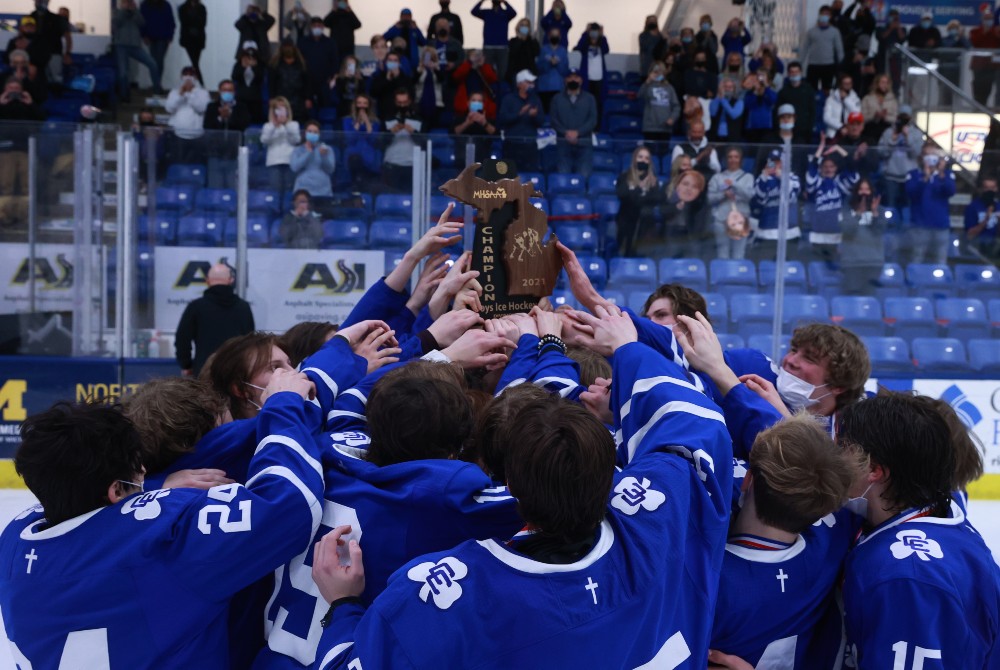
PLYMOUTH – It took two years, but Detroit Catholic Central finally was able to conclude its repeat hockey championship run Saturday.
The Shamrocks (18-1) did so by beating first-time finalist Rockford 5-1 at USA Hockey Arena.
"This was truly a program win," said coach Brandon Kaleniecki, who led DCC to a title for the third time in his six years as Shamrocks coach. "We found a way through."
He wasn't just blowing smoke. The Catholic Central varsity was sidelined last week due to the coronavirus, but the junior varsity stepped up to the challenge beating Berkley and Troy before the varsity was cleared to return for the Quarterfinal.
The Shamrocks also swallowed the bitterness of the sudden end of last season due to the virus.
"We wanted to win it for last year's seniors," co-captain Brenden Cwiek said.
"I was on the team that won in 2019, and it was the most fun team I ever played on in hockey," co-captain Nick Borchardt said. "This year is like the end of the perfect story."
The ending got off to a good start, with DCC scoring twice on special teams
Brennan Sass got the scoring started with a power-play goal at the 7:43 mark. A little over a minute and a half later, William Shields stole a puck during a Rockford power play and scored a shorthanded goal to make it 2-0.
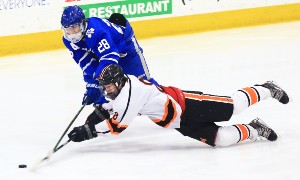
The Shamrocks scored two more in the second period, by Bret Beale and Ryan Wartuck to make it 4-0. Rockford's Carson Korte scored early in the third period to get the Rams back in range, but Kaden Hemme scored late in the third to put it away.
"I think we got a little too comfortable," Kaleniecki said of Korte's goal. "It was a good reminder of how we need to play.”
Rockford (15-6-1) became only the third school from the west side of the Lower Peninsula to reach the Division 1 Final, following Grandville (2015) and East Kentwood (2005).
"They're deep," Rockford coach C.J Pobur said. "There's not many public schools, if any, that can go four lines deep. We thought that 5-on-5 our group was ready to go, but their execution on special teams was exceptional tonight."
The Rams' run to Plymouth was fueled in part by a core of teammates who grew up playing together. Some of the players have been together nearly a decade. That cohesion, along with the addition of Korte and Owen DeVries this year from travel hockey, lifted Rockford to the best finish in school history.
Rockford and Division 2 runner-up Byron Center represented the west side of the state.
"I think it's a great area,” said Pobur, who like Kaleniecki is a Detroit Catholic Central graduate. "I think there's great hockey over there, but it's just not as big. You don't have as many big players. You might have two or three strong programs (on the west side), but they have 10 or 15 on the east side."
While they didn't get the result they hoped for, the Rams went home with heads held high.
"It wasn't a great result," DeVries said. " I think everyone in our locker room can say we gave it (our) all, and that's really all we ask for."
PHOTOS: (Top) Detroit Catholic Central celebrates its Division 1 championship Saturday at USA Hockey Arena. (Middle) DCC's Bret Beale (28) and Rockford's Owen DeVries work for possession. (Click for more from Hockey Weekly Action Photos.)