


Add, Subtract, Divide, Multiply: MHSAA Not Alone
July 25, 2017
By Rob Kaminski
MHSAA benchmarks editor
This is the third part in a series on MHSAA tournament classification, past and present, that will be published over the next two weeks. This series originally ran in this spring's edition of MHSAA benchmarks.
As the MHSAA faces its most recent classification task with 8-Player Football, and opinions continue to swirl about as to the method, timeframe, location and other procedures, a look around the country provides plenty of company among state association brethren factoring variables into their own equations.
In the Pacific Northwest, the Oregon School Activities Association Football Playoffs are under public scrutiny as leadership ponders a five or six classification format beginning with the 2018-19 school year.
The OSAA has crowned six champions on the gridiron since 2006-07. Many of the state’s smaller schools would like to keep it that way, while larger schools lean toward a five-classification system, citing larger leagues, ease of travel and credibility to state championships as the advantages.
Still others would prefer more than six classes, pointing to safety issues and the opportunity to increase participation numbers as positives.
Moving southeast of Oregon, the Nevada Interscholastic Activities Association recently voted to hold serve on a classification proposal that was volleyed to the membership.
However, changes still could be forthcoming by as early as the 2018-19 season which would add a fifth classification in more populated southern Nevada while allowing northern schools to participate in four classifications. Such divisions could mean no state championship for the fifth class in southern Nevada.
Because of that, the NIAA wants equal numbers of schools in each classification on both ends of the state. Complicating the issue is the fact that the 24 largest schools in the state, by enrollment, are all in Clark County in Southern Nevada.
Across Nevada’s border into Arizona, charter schools are asking the Arizona Interscholastic Association to reconsider classification that was voted upon and approved in September 2015. That agreement called for the largest 33 percent of charter schools by enrollment to be placed in the state’s largest school classification, 3A, the middle 33 percent into 2A, and the smallest 33 percent into 1A.
Less than two years later the charter schools have had a change of heart and have asked to be considered the same as other Arizona public schools and be placed appropriately by enrollment beginning with the 2018-19 school year.
The situation in Arizona further illustrates how the public/private debate that all state associations have faced throughout existence now has the added dynamic of rapidly growing charter schools in today’s educational system, along with virtual school enrollment.
In the nation’s heartland, Nebraska has retooled its football classifications by using enrollment of boys students only in its schools rather than total enrollment. The Nebraska School Activities Association football-playing schools will kick off the 2018 season using this alignment.
Nebraska has three classes of 11-player football, with the smallest class divided in two, Class C-1 and C-2. The state also will have 8-player football for boys enrollments under 47, and the NSAA will sponsor a new 6-player tournament in 2018 for schools with 27 or fewer boys.
“This is a good proposal because some schools have a sizable imbalance between the number of boys and girls, and there’s a large gap (in enrollment) between the largest and smallest schools in Classes A and B,” NSAA executive director Jim Tenopir said. “I think this addresses both of those concerns.”
Swimmers in Georgia, meanwhile, will feel like they are moving with the current, rather than upstream in 2017-18, as the Georgia High School Association recently doubled the number of team championship events from two to four.
Swim enthusiasts can also count on longer days at the finals, as the top 30 finishers from the prelims will advance to the finals instead of 20, and all championship events will have three heats versus two.
Diving & Depth Help Deliver EGR's Latest Finals Win
By
Dan D'Addona
Special for Second Half
March 27, 2021
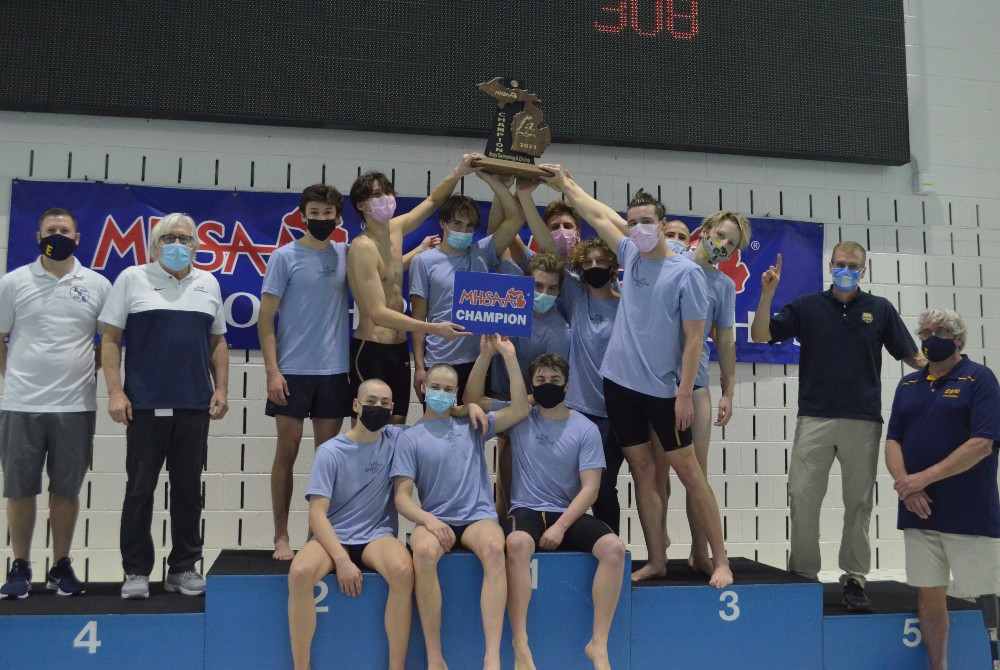
HOLLAND — The East Grand Rapids boys swimming & diving team was devastated when last year’s MHSAA Finals were canceled.
The Pioneers were poised to win and immediately set out on a mission to claim the Lower Peninsula Division 3 title this season.
East Grand Rapids won Saturday’s meet with 308 points despite not winning any swimming events.
Of course, diving was another story.
EGR started strong on Friday, going 1-2 in diving with Charley Bayer winning with 490 points, just ahead of teammate Billy Kirchgessner (472.90). Chelsea’s Mitch Brown was third (450.05).
“Everything started flowing together, and it all worked out in the meet for us,” Bayer said. “That is our biggest advantage. Having a teammate that good can push you, and we pushed each other. It is a blessing to be part of a program like this. This team win is the most important in a long time because we wanted a big win last year and it didn’t happen. This was a redemption win.”
The Pioneers earned their record 26th Finals win with their depth and relays.
In the 200-yard freestyle relay, East Grand Rapids finished second in 1:26.89 with Will Laham, Max Jung, Kenny Pontius and Logan McCahill posting the runner-up finish.
“Last year was traumatic. We had a lot of kids work so hard and we had a good chance to win it. This year, just getting to get to the meet was a plus, but to win it without taking any swimming firsts spoke well for the group,” EGR coach Butch Briggs said. “Diving got us 37 points, and you can’t do much better than that. It just got everyone pumped up.”
 Holland Christian finished second with 218.5 points. Bloomfield Hills Cranbrook Kingswood was third (194), Spring Lake was fourth (196) and Mason was fifth (162).
Holland Christian senior Colin Kalkman won the title in the 100 freestyle, finishing in 45.72. He used a strong finish to pull ahead of runner-up Jacob Ryan (45.92) of Detroit Country Day. Trenton’s Spencer Boling-Hamer was third (47.24).
Kalkman then won the 100 backstroke in 50.96, holding off Pinckney’s Tyler Ray (51.09) and East Grand Rapids’ McCahill (51.45).
The Maroons also won the 400 freestyle relay with Joey Grasman, Christian Hoeksema, Blake Assink and Kalkman touching first in 3:09.58. Spring Lake (3:09.73) was second, followed by Mason (3:10.67).
“That was fantastic to win the final relay. They did what they had to do,” Holland Christian coach Todd Smeenge said. “I am happy for all the seniors, and Colin had a great meet. I am so happy for him. It was satisfying to see that work pay off. We scored about what we thought, but East Grand Rapids ate up all kinds of points.”
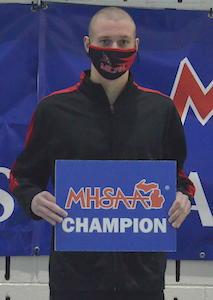
The fastest race of the meet was the 100 breaststroke, where the top three finishers bettered the previous Division 3 record. Milan’s Andrew Dobrzanski won the event in 54.67, followed by Cranbrook Kingswood’s Ethan Schwab (55.46) and Otsego’s Owen Stedner (55.85).
Dobrzanski also won the 200 IM in 1:50.07, a dominating performance that beat the field by nearly four seconds. Grand Rapids Christian’s Jacob Haaksma was second (1:53..94), followed by McCahill (1:55.17).
Dobrzanski was named Swimmer of the Meet .
“It means a lot. I was shocked when I saw my name up there,” Dobrzanski said. “The breaststroke was amazing with all of the competition.”
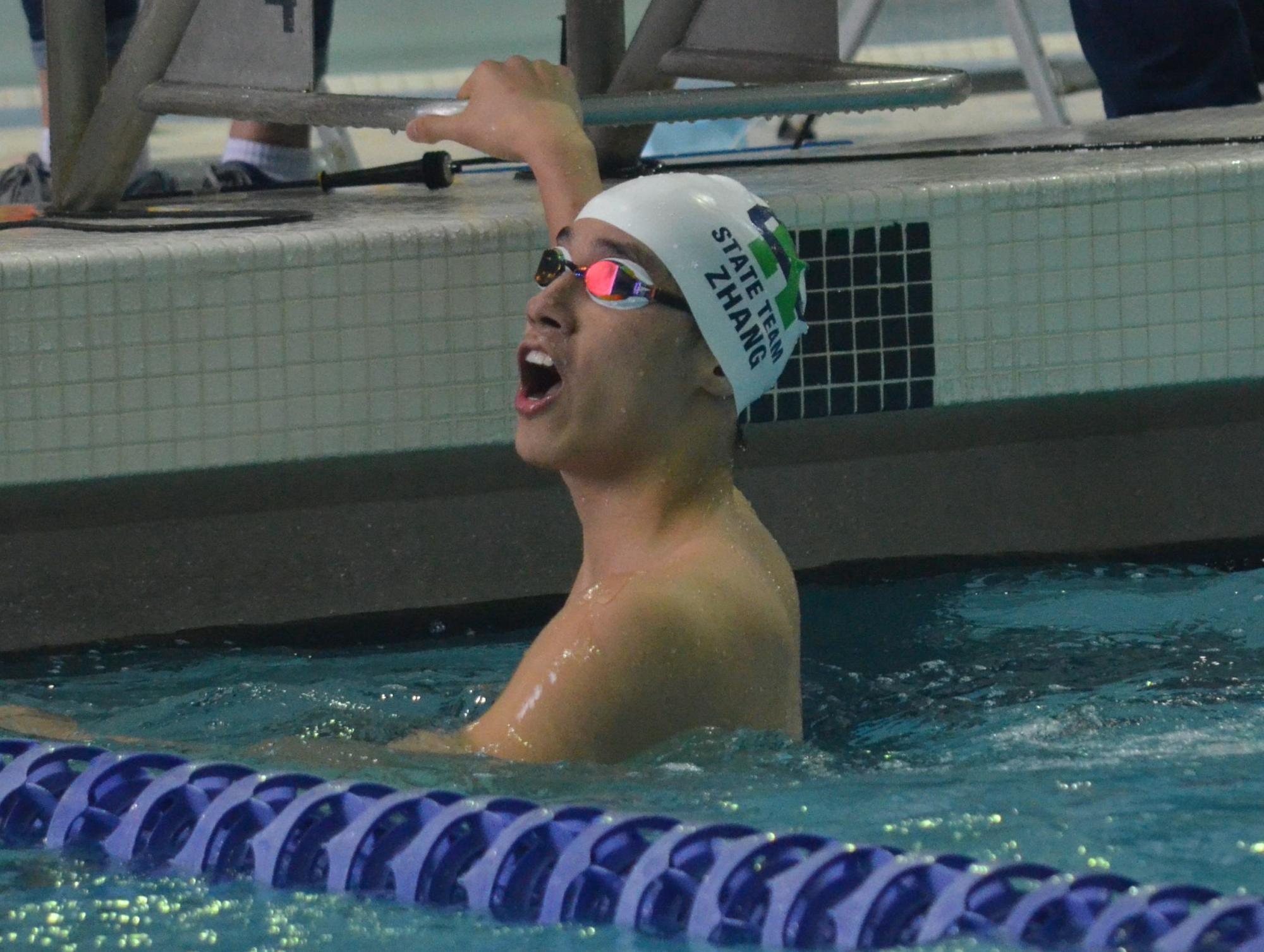
Cranbrook Kingswood won the 200 medley relay in 1:34.97 with Colin Zexter, Ethan Schwab, Josh Zexter and Andrew Zhang. Spring Lake was second (1:35.51), followed by East Grand Rapids (1:37.63).
Trenton’s Spencer Boling-Hamer won the 200 freestyle in 1:42.21, ahead of Grasman (1:42.40) and Mason’s Jonas Cantrell (1:42.49).
Detroit Country Day’s Ryan dropped nearly half a second from his seed time to win the 50 freestyle in 20.58, holding off Spring Lake’s Charles Brown (20.71) and Mason’s Gabe Williams (21.68) in an extremely fast race.
Pinckney’s Ray was the winner in the 100 butterfly, going 49.23 to hold off Spring Lake’s Brown (49.80) and Mason’s Liam Boomer (50.48).
Cantrell won the 500 freestyle in 4:27.58, ahead of Cranbrook Kingswood’s Schwab (4:35.14) and Pontiac Notre Dame Prep’s Griffin Gushman (4:41.64).
Mason’s Williams, Tommy Hebert, Boomer and Cantrell won the 200 freestyle relay in 1:26.52, ahead of East Grand Rapids (1:26.89) and Grand Rapids Christian (1:27.13).
PHOTOS: (Top) East Grand Rapids celebrates its team championship Saturday at Holland Aquatic Center. (Middle) Milan’s Andrew Dobrzanski won the breaststroke and 200 IM. (Below) Cranbrook’s Andrew Zhang looks up at the clock after a race. (Click for photos by Dan D’Addona.)