


Add, Subtract, Divide, Multiply: MHSAA Not Alone
July 25, 2017
By Rob Kaminski
MHSAA benchmarks editor
This is the third part in a series on MHSAA tournament classification, past and present, that will be published over the next two weeks. This series originally ran in this spring's edition of MHSAA benchmarks.
As the MHSAA faces its most recent classification task with 8-Player Football, and opinions continue to swirl about as to the method, timeframe, location and other procedures, a look around the country provides plenty of company among state association brethren factoring variables into their own equations.
In the Pacific Northwest, the Oregon School Activities Association Football Playoffs are under public scrutiny as leadership ponders a five or six classification format beginning with the 2018-19 school year.
The OSAA has crowned six champions on the gridiron since 2006-07. Many of the state’s smaller schools would like to keep it that way, while larger schools lean toward a five-classification system, citing larger leagues, ease of travel and credibility to state championships as the advantages.
Still others would prefer more than six classes, pointing to safety issues and the opportunity to increase participation numbers as positives.
Moving southeast of Oregon, the Nevada Interscholastic Activities Association recently voted to hold serve on a classification proposal that was volleyed to the membership.
However, changes still could be forthcoming by as early as the 2018-19 season which would add a fifth classification in more populated southern Nevada while allowing northern schools to participate in four classifications. Such divisions could mean no state championship for the fifth class in southern Nevada.
Because of that, the NIAA wants equal numbers of schools in each classification on both ends of the state. Complicating the issue is the fact that the 24 largest schools in the state, by enrollment, are all in Clark County in Southern Nevada.
Across Nevada’s border into Arizona, charter schools are asking the Arizona Interscholastic Association to reconsider classification that was voted upon and approved in September 2015. That agreement called for the largest 33 percent of charter schools by enrollment to be placed in the state’s largest school classification, 3A, the middle 33 percent into 2A, and the smallest 33 percent into 1A.
Less than two years later the charter schools have had a change of heart and have asked to be considered the same as other Arizona public schools and be placed appropriately by enrollment beginning with the 2018-19 school year.
The situation in Arizona further illustrates how the public/private debate that all state associations have faced throughout existence now has the added dynamic of rapidly growing charter schools in today’s educational system, along with virtual school enrollment.
In the nation’s heartland, Nebraska has retooled its football classifications by using enrollment of boys students only in its schools rather than total enrollment. The Nebraska School Activities Association football-playing schools will kick off the 2018 season using this alignment.
Nebraska has three classes of 11-player football, with the smallest class divided in two, Class C-1 and C-2. The state also will have 8-player football for boys enrollments under 47, and the NSAA will sponsor a new 6-player tournament in 2018 for schools with 27 or fewer boys.
“This is a good proposal because some schools have a sizable imbalance between the number of boys and girls, and there’s a large gap (in enrollment) between the largest and smallest schools in Classes A and B,” NSAA executive director Jim Tenopir said. “I think this addresses both of those concerns.”
Swimmers in Georgia, meanwhile, will feel like they are moving with the current, rather than upstream in 2017-18, as the Georgia High School Association recently doubled the number of team championship events from two to four.
Swim enthusiasts can also count on longer days at the finals, as the top 30 finishers from the prelims will advance to the finals instead of 20, and all championship events will have three heats versus two.
Kearsley Aims to Begin Next Title Streak
By
Paul Costanzo
Special for MHSAA.com
February 4, 2021
Reigning Division 2 girls bowling singles champion Megan Timm doesn’t have to go far to find a high level of competition and keep herself sharp.

The Flint Kearsley senior just has to go to practice.
“We’re each other’s biggest competition, for sure,” Timm said. “You always want to beat whoever you’re with, and it’s made us want to work harder when we have that friendly competition. Our challenge matches are pretty much formatted like state was, so getting that competitive atmosphere outside of tournaments is a good way to prepare you for those competitions.”
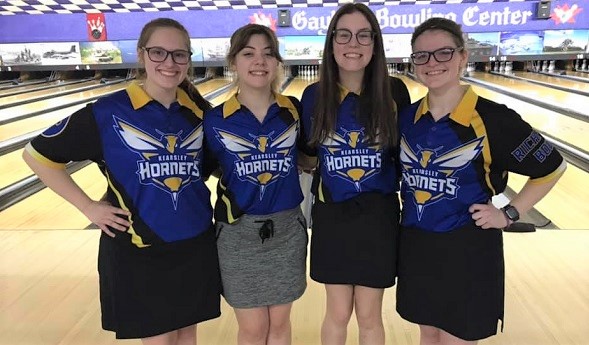
Timm is one of four returning individual Finals qualifiers for the Hornets this season, joining classmates Allison Eible, Allison Robbins and Emilea Sturk. They form the core of a Kearsley team looking to get back to the top of the division after having its six-year run of Finals team titles snapped a year ago.
Having to be at their best just to maintain their desired spot in the lineup is a good way to prepare.
“It’s intense,” Robbins said. “It’s crazy because it’s been this way since our sophomore year. We were all taught to bowl together when we’re in a team setting, and we do that when we’re bowling Bakers and bowling singles (within a team match). But obviously, when we’re bowling singles tournaments, we’re also bowling against each other.”
A year ago, Timm and Eible advanced to the match-play portion of the Finals, with Timm going on to win after earning the 15th of 16 qualifying spots. She became the third individual champion in the program’s history, finishing off on a high note what had been a disappointing weekend for Kearsley.
The day prior, Kearsley lost in the semifinals of the Team Finals against eventual champion Mason. While a run to the state Final Four may count as an accomplishment for most programs, the Kearsley girls were devastated, as they had won the previous six titles, and seven of the last eight. It was also the final match for coach Rob Ploof, who was retiring after leading the program to all of those titles.
 “It was an exhausting day,” Sturk said. “There was just a lot going on. When we started to lose, I think we just kind of felt like we had already lost it. We just couldn’t get back. It was weird, because we always come back. There was a lot of pressure, especially with it being (Ploof’s) last year. We wanted to win so bad for him, and we wanted to keep the streak alive, of course. The pressure just really got us.”
Coach Kevin Shute, who previously coached at Dryden and was the JV coach at Kearsley a year ago, made sure to talk through that Finals disappointment with the team.
“They tried too hard,” he said. “They tried a little too hard there. They were reflecting back and looking at it, telling me all of the things they would have done differently. I think those four girls for sure are definitely hungry.”
The disappointment quickly turned to motivation.
“I think after last season, we were really disappointed with our finish,” Eible said. “And seeing we are seniors, we are more determined than ever to finish our last season out on top and add to our accomplishments. We have all worked so hard to be where we are today, and I’m so proud to call these girls not only my teammates but my family.”
The Hornets had an early test of not only their ability, but their resolve, as they opened their season this past Saturday against Swartz Creek. After falling behind 12-7, they rallied for a 17-13 victory, extending their regular-season match win streak to 132.
Maintaining a decade-long streak could add more pressure, but it’s something the Hornets have become used to carrying.
“Sometimes, but to be honest, I don’t ever really feel (the pressure),” Sturk said. “I’m just focused on bowling and focused on uplifting my team if we’re doing bad. I try to keep my attitude up and keep everybody’s attitude up. We go into a match never expecting to lose. We try to go into a match with as much confidence as possible, because we can’t -- basically we can’t lose because of the streak. It feels like, if we lose, that would be the weirdest feeling.”
Joining the core four seniors on varsity this season are fellow senior Rhyan Langdon-Yaklin, junior Lydia Boggs and sophomore Sara Ritchie. There’s also a strong contingent of bowlers just outside the top seven who continue to push for their own opportunities.
“Our seventh and eighth bowlers could probably start on any varsity team,” Shute said. “It’s always nice to have depth, especially since this year we’re going to lose five seniors, and next year is going to look a lot different.”
While it may look different, the goal for the Hornets is that it will look familiar for the program, in that they’ll be pursuing a repeat Finals championship.
“Winning a state title is just a feeling like no other,” Timm said. “The girls I looked up to when I was younger started a legacy, and I’d really like to leave another legacy.”
 Paul Costanzo served as a sportswriter at The Port Huron Times Herald from 2006-15, including three years as lead sportswriter, and prior to that as sports editor at the Hillsdale Daily News from 2005-06. He can be reached at [email protected] with story ideas for Genesee, Lapeer, St. Clair, Sanilac, Huron, Tuscola, Saginaw, Bay, Arenac, Midland and Gladwin counties.
PHOTOS: (Top) From left to right, now-seniors Allison Eible, Allison Robbins, Emilea Sturk and Megan Timm led Kearsley as well during last season’s Regional. (Middle) Eible begins a frame during competition. (Photos courtesy of the Flint Kearsley girls bowling program.)