


Add, Subtract, Divide, Multiply: MHSAA Not Alone
July 25, 2017
By Rob Kaminski
MHSAA benchmarks editor
This is the third part in a series on MHSAA tournament classification, past and present, that will be published over the next two weeks. This series originally ran in this spring's edition of MHSAA benchmarks.
As the MHSAA faces its most recent classification task with 8-Player Football, and opinions continue to swirl about as to the method, timeframe, location and other procedures, a look around the country provides plenty of company among state association brethren factoring variables into their own equations.
In the Pacific Northwest, the Oregon School Activities Association Football Playoffs are under public scrutiny as leadership ponders a five or six classification format beginning with the 2018-19 school year.
The OSAA has crowned six champions on the gridiron since 2006-07. Many of the state’s smaller schools would like to keep it that way, while larger schools lean toward a five-classification system, citing larger leagues, ease of travel and credibility to state championships as the advantages.
Still others would prefer more than six classes, pointing to safety issues and the opportunity to increase participation numbers as positives.
Moving southeast of Oregon, the Nevada Interscholastic Activities Association recently voted to hold serve on a classification proposal that was volleyed to the membership.
However, changes still could be forthcoming by as early as the 2018-19 season which would add a fifth classification in more populated southern Nevada while allowing northern schools to participate in four classifications. Such divisions could mean no state championship for the fifth class in southern Nevada.
Because of that, the NIAA wants equal numbers of schools in each classification on both ends of the state. Complicating the issue is the fact that the 24 largest schools in the state, by enrollment, are all in Clark County in Southern Nevada.
Across Nevada’s border into Arizona, charter schools are asking the Arizona Interscholastic Association to reconsider classification that was voted upon and approved in September 2015. That agreement called for the largest 33 percent of charter schools by enrollment to be placed in the state’s largest school classification, 3A, the middle 33 percent into 2A, and the smallest 33 percent into 1A.
Less than two years later the charter schools have had a change of heart and have asked to be considered the same as other Arizona public schools and be placed appropriately by enrollment beginning with the 2018-19 school year.
The situation in Arizona further illustrates how the public/private debate that all state associations have faced throughout existence now has the added dynamic of rapidly growing charter schools in today’s educational system, along with virtual school enrollment.
In the nation’s heartland, Nebraska has retooled its football classifications by using enrollment of boys students only in its schools rather than total enrollment. The Nebraska School Activities Association football-playing schools will kick off the 2018 season using this alignment.
Nebraska has three classes of 11-player football, with the smallest class divided in two, Class C-1 and C-2. The state also will have 8-player football for boys enrollments under 47, and the NSAA will sponsor a new 6-player tournament in 2018 for schools with 27 or fewer boys.
“This is a good proposal because some schools have a sizable imbalance between the number of boys and girls, and there’s a large gap (in enrollment) between the largest and smallest schools in Classes A and B,” NSAA executive director Jim Tenopir said. “I think this addresses both of those concerns.”
Swimmers in Georgia, meanwhile, will feel like they are moving with the current, rather than upstream in 2017-18, as the Georgia High School Association recently doubled the number of team championship events from two to four.
Swim enthusiasts can also count on longer days at the finals, as the top 30 finishers from the prelims will advance to the finals instead of 20, and all championship events will have three heats versus two.
Mom's Memory Inspires C-F All-Stater
January 9, 2021
By Doug Donnelly
Special for Second Half
MONTGOMERY – Jocelynn Nicholls was first drawn to volleyball in grade school.
Over the years, the Camden-Frontier senior has made the transition from being a wild swinging middle-schooler to an apprehensive freshman on the varsity to an all-state volleyball player headed to Trine University to play the sport she loves.
“I fell in love with volleyball when I was in the fourth grade,” she said. “I’ve played basketball and softball, but nothing feels like volleyball.”
It wasn’t always easy for Nicholls, who has overcome the loss of her mother Amy Nicholls during her sophomore season to become a tower of strength for the Redskins.
“She’s been through a lot, but she’s a tough kid and is going to make something of herself,” said Camden-Frontier coach Dawn Follis.
Nicholls’ mom was diagnosed with ovarian cancer in the early part of 2018. By volleyball season that year, her mom had become very ill, enough that Nicholls missed a match when her mom went to the hospital. That season, her mom lost her battle; she died on a game day.
Nicholls had asked her mom earlier that day if she should play.
“I said to her ‘What do you want me to do?’,” said Nicholls, who was 15 at the time. “She squeezed my hand and told me to go. She couldn’t talk, so we had a way to communicate through squeezing my hand. She wanted me to play.”
About halfway through the match against Pittsford, Nicholls felt something she had never experienced before – a feeling, almost like a change in her body.
“My aunt was at the game watching me,” she said. “She even noticed the change in me. I got home after the game, and I figured out the news.”
Her mom, an English professor and dean of the Jannen School of Arts and Sciences at Trine University in nearby Angola, Ind., had passed away.
Nicholls turned to volleyball to help her through. Using her mom as her strength, she didn’t miss another match. Volleyball has always been a big part of her life.
“I’ve come a long way since my freshman year,” she said. “Being pulled up to the varsity was a huge thing. It was a great opportunity for me to grow as a player. It really opened my eyes.”
After that season on the varsity, she started playing club volleyball, first at a club in Hillsdale, then at Team Pineapple Volleyball Club in Angola, which is less than a half hour from her home.
"Once I started playing for other teams, I started playing up, against older girls,” she said. “When I was a freshman I was playing against a bunch of seniors.”
Follis and the Redskins have built a small-school powerhouse in south central Michigan, just north of the Michigan-Indiana state line. Nicholls helped Camden-Frontier to a school-record 40 wins that sophomore season and they won 36 matches and the school’s first Regional crown in 2019. This fall’s was another outstanding season for the Redskins, who went 25-3 and won a fourth-straight District title. Over Nicholls’ four varsity seasons, Camden-Frontier won more than 100 matches.
 Nicholls had a great season in 2020, earning first-team all-state honors from the Michigan Interscholastic Volleyball Coaches Association. Playing about half the matches the Redskins typically play in a season, she recorded 395 kills, averaging 4.34 per set, and accumulated 141 digs. Two of her teammates, junior Dakota Sigler and senior Heather Shaw, made the all-state honorable mention list. (Camden-Frontier fell 3-2 to Lansing Christian in a Regional Semifinal on Nov. 10; Lansing Christian will play in the Quarterfinals on Tuesday.)
Follis said Nicholls knows how to use her height to her advantage.
“She’s very tall and very athletic and aggressive,” Follis said. “She’s worked really hard on her game. When she was in middle school, she was tall and had this wild swing. She played all of the time, and it shows.”
Nicholls stands 6-foot tall. She had 70 blocks and block assists this season.
“I’ve always been really tall,” she said. “I think by the fifth grade I was taller than any boy in my class.
“I always knew I was tall and that would benefit me, but I knew that wasn’t going to be enough. I worked hard to increase my vertical. I put in a lot of time. I definitely try and use that to my advantage."
Follis said Nicholls did use her height to her advantage, something not all tall players do.
“She’s a hitter, and she really jumps well,” said Follis. “In high school she has the ability to change the game with her hitting. She’s a game-changer.”
At the Camden-Frontier matches over the past couple of years, there was typically a large contingent of aunts, uncles, grandparents, and cousins watching Nicholls and her teammates play. That is one of the reasons she chose Trine – her family will be able to see her play.
“I want to be close to my family,” she said. “I’d rather be 20 minutes away than 12 hours away. Family is a big deal for me.”
Nicholls said she loves to hang out with family and friends but doesn’t have time for a lot of other interests outside of sports. She likes to stay busy, no matter what sports season it is. Right now, she is lifting and running on nice days and staying ready for the upcoming basketball season. She’s been on the varsity softball team since her freshman season as well.
“I am fulltime, 100-percent motivated to focus on my game,” she said.
At Trine she plans on majoring in exercise science with the hopes of going into physical therapy or something in the athletic field.
“I want to be there for my mom,” she said. “It’s a big opportunity that I will even get to play there. That’s where I wanted to be.”
Trine is a big part of the Nicholls family. Not only was her mom a professor at the school, but she also graduated from Trine. Her dad Scott and brother Mason also went to Trine. Jocelynn started going there at a young age and impressed the volleyball coach years ago.
“When I was a freshman, I went there for a camp and the coach told me if I continued to work hard, I would get a (scholarship) offer,” she recalled.
Losing her mother a couple of years ago, Nicholls said, completely changed her outlook on life.
“It provided me an opportunity to grow,” she said. “It makes me want to give 100 percent all of the time and not take anything for granted. You are not promised tomorrow.”
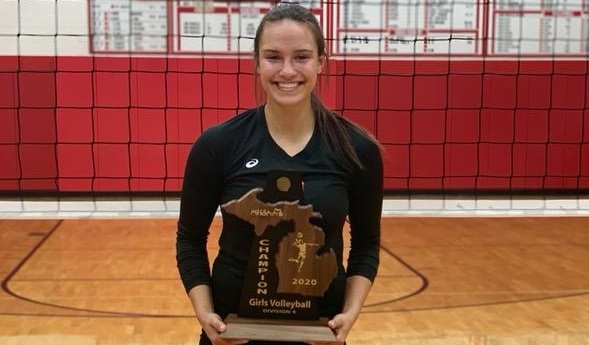
PHOTOS: (Top) Camden-Frontier’s Jocelynn Nicholls holds up her team’s District title trophy from this season. (Middle) Nicholls serves during a match this fall. (Photos by Doug Donnelly.)