

Add, Subtract, Divide, Multiply: MHSAA Not Alone
July 25, 2017
By Rob Kaminski
MHSAA benchmarks editor
This is the third part in a series on MHSAA tournament classification, past and present, that will be published over the next two weeks. This series originally ran in this spring's edition of MHSAA benchmarks.
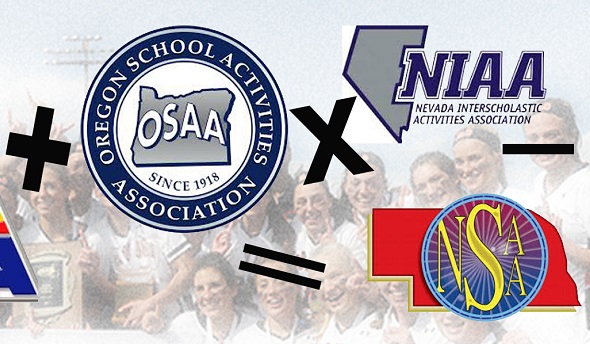
As the MHSAA faces its most recent classification task with 8-Player Football, and opinions continue to swirl about as to the method, timeframe, location and other procedures, a look around the country provides plenty of company among state association brethren factoring variables into their own equations.
In the Pacific Northwest, the Oregon School Activities Association Football Playoffs are under public scrutiny as leadership ponders a five or six classification format beginning with the 2018-19 school year.
The OSAA has crowned six champions on the gridiron since 2006-07. Many of the state’s smaller schools would like to keep it that way, while larger schools lean toward a five-classification system, citing larger leagues, ease of travel and credibility to state championships as the advantages.
Still others would prefer more than six classes, pointing to safety issues and the opportunity to increase participation numbers as positives.
Moving southeast of Oregon, the Nevada Interscholastic Activities Association recently voted to hold serve on a classification proposal that was volleyed to the membership.
However, changes still could be forthcoming by as early as the 2018-19 season which would add a fifth classification in more populated southern Nevada while allowing northern schools to participate in four classifications. Such divisions could mean no state championship for the fifth class in southern Nevada.
Because of that, the NIAA wants equal numbers of schools in each classification on both ends of the state. Complicating the issue is the fact that the 24 largest schools in the state, by enrollment, are all in Clark County in Southern Nevada.
Across Nevada’s border into Arizona, charter schools are asking the Arizona Interscholastic Association to reconsider classification that was voted upon and approved in September 2015. That agreement called for the largest 33 percent of charter schools by enrollment to be placed in the state’s largest school classification, 3A, the middle 33 percent into 2A, and the smallest 33 percent into 1A.
Less than two years later the charter schools have had a change of heart and have asked to be considered the same as other Arizona public schools and be placed appropriately by enrollment beginning with the 2018-19 school year.
The situation in Arizona further illustrates how the public/private debate that all state associations have faced throughout existence now has the added dynamic of rapidly growing charter schools in today’s educational system, along with virtual school enrollment.
In the nation’s heartland, Nebraska has retooled its football classifications by using enrollment of boys students only in its schools rather than total enrollment. The Nebraska School Activities Association football-playing schools will kick off the 2018 season using this alignment.
Nebraska has three classes of 11-player football, with the smallest class divided in two, Class C-1 and C-2. The state also will have 8-player football for boys enrollments under 47, and the NSAA will sponsor a new 6-player tournament in 2018 for schools with 27 or fewer boys.
“This is a good proposal because some schools have a sizable imbalance between the number of boys and girls, and there’s a large gap (in enrollment) between the largest and smallest schools in Classes A and B,” NSAA executive director Jim Tenopir said. “I think this addresses both of those concerns.”
Swimmers in Georgia, meanwhile, will feel like they are moving with the current, rather than upstream in 2017-18, as the Georgia High School Association recently doubled the number of team championship events from two to four.
Swim enthusiasts can also count on longer days at the finals, as the top 30 finishers from the prelims will advance to the finals instead of 20, and all championship events will have three heats versus two.
Mercy Stands Tall at Net, Makes Big Blocks Pay Off in Championship Win
By
Paul Costanzo
Special for MHSAA.com
November 22, 2025
BATTLE CREEK – Farmington Hills Mercy looked to be on its way to a sweep Saturday in the Division 1 Volleyball Final at Kellogg Arena.
So when Bloomfield Hills erased a nine-point deficit in the third set, extending the match and delaying the Silly String celebration, the Marlins were on the wrong side of a massive momentum swing.
They were also incredibly calm.
“I feel like our message was not to worry,” Mercy senior Ella Andrews said. “We were down in the Semifinals two sets and came back and reverse swept them, so I feel like our message was just to stay calm. We can trust ourselves. We’ve been working for this all season, we just have to rely on each other and feel confident in ourselves to get back and score those points to win the set.”
Mercy got back to its game in the fourth set, and put itself back on top of the state with a 25-18, 25-20, 23-25, 25-20 victory against Bloomfield Hills.
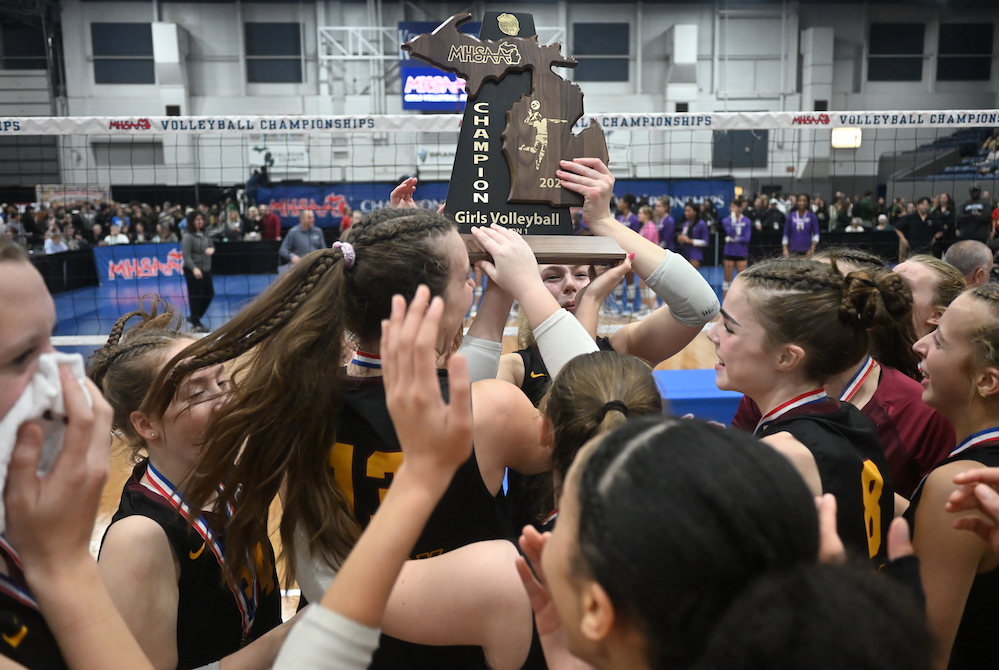
The win gives the Marlins their third Finals title and second in three years. And, for the second time since 2023, they doused their coach Loretta Vogel with water and Silly String.
“I’m going in there to talk to everybody in the locker room, and I just get drenched,” Vogel said. “It’s definitely becoming a custom here.”
Mercy entered the fourth Final in program history with a simple, yet difficult gameplan: Slow Bloomfield Hills star Kayla Nwabueze. The Harvard-bound outside hitter did manage a match-high 24 kills, but the Marlins’ long, talented front line made it as difficult on her as possible.
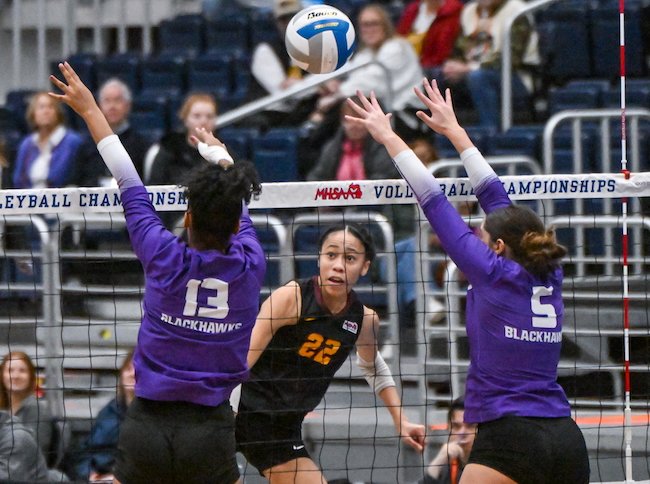 “Our plan was to shut down Kayla,” said Vogel, who puts Nwabueze among the best hitters she’s seen in her 49 years coaching. “Put big blocks up, make them change to something else. That worked for us. I thought the girls really got up there and put four hands in front of her. There was one time we triple-blocked. So, I think changing something up like that, giving her a different view, had an impact on her. For any hitter, that would have an impact.”
Nwabueze got some backup from sophomore Allison Stakoe, who had 20 kills and played a massive role in the third set comeback.
But Nwabueze admitted it was tough to try and navigate the Mercy blockers.
“I would say it was really frustrating,” she said. “I knew they were going to come out and try to stop me, so I just had the mentality of don’t let that happen. I feel like I got into a rut a couple times. That’s what they tried to do, to stop the player that caused the most damage, and it was smart on their part. I really tried hard to try to get past that block. It was a really big block, though.”
McKenzie and Ella Andrews led the way on that block, with Ella finishing the match with two solo blocks and five assists, and McKenzie tallying six block assists. They had a ton of help, too. Kaelyn Easton had five block assists, Saniya Tucker had four, and both Cree Hollier and Kate Kalczynski had two.
Mercy’s attack was just as varied.
Kalczynski led the way with 16 kills, including the final one on match point, while Ella Andrews had 13, Hollier had 12 and McKenzie Andrews had seven.
That distribution was thanks to their freshman setter Easton, who had 43 assists in the Final and more than 100 over the final two matches.
“Definitely just seeing open spots where the blockers were,” Easton said. “I know in this game, the middles were open a lot, were scoring a lot, especially in the last set, and the coaches were just like, ‘Get them the ball. Just get them the ball and make them score.’ Also, the outsides, they opened up the middles a lot, so really, really appreciative to all of them. I could just not do it without the passes. The passes were really, really good this weekend.”
Maya Zarow led Mercy (42-5-3) with 24 digs, while Kalczynski had 12 and Easton 11.
Bloomfield Hills (43-8-1) setter Brynn Wilcox finished the day with 42 assists. Alyssa Moir led the defense with 20 digs, while Stakoe added 14, Nwabueze had 13 and Julia Colosimo had 10.
This weekend marked the first time the Black Hawks had advanced to the Semifinals.
“I’m just really proud of our team,” Wilcox said. “Even though we may have faced some ups and downs throughout the season, we kind of leaned on each other. It’s probably one of the greatest – I’ve had the most fun of my life.”
PHOTOS (Top) Farmington Hills Mercy players raise their championship trophy Saturday afternoon at Kellogg Arena. (Middle) Mercy’s Cree Hollier (22) attempts a kill as Bloomfield Hills’ Suri Ewing (13) and Charlotte Elowsky elevate to try and block it.