


Add, Subtract, Divide, Multiply: MHSAA Not Alone
July 25, 2017
By Rob Kaminski
MHSAA benchmarks editor
This is the third part in a series on MHSAA tournament classification, past and present, that will be published over the next two weeks. This series originally ran in this spring's edition of MHSAA benchmarks.
As the MHSAA faces its most recent classification task with 8-Player Football, and opinions continue to swirl about as to the method, timeframe, location and other procedures, a look around the country provides plenty of company among state association brethren factoring variables into their own equations.
In the Pacific Northwest, the Oregon School Activities Association Football Playoffs are under public scrutiny as leadership ponders a five or six classification format beginning with the 2018-19 school year.
The OSAA has crowned six champions on the gridiron since 2006-07. Many of the state’s smaller schools would like to keep it that way, while larger schools lean toward a five-classification system, citing larger leagues, ease of travel and credibility to state championships as the advantages.
Still others would prefer more than six classes, pointing to safety issues and the opportunity to increase participation numbers as positives.
Moving southeast of Oregon, the Nevada Interscholastic Activities Association recently voted to hold serve on a classification proposal that was volleyed to the membership.
However, changes still could be forthcoming by as early as the 2018-19 season which would add a fifth classification in more populated southern Nevada while allowing northern schools to participate in four classifications. Such divisions could mean no state championship for the fifth class in southern Nevada.
Because of that, the NIAA wants equal numbers of schools in each classification on both ends of the state. Complicating the issue is the fact that the 24 largest schools in the state, by enrollment, are all in Clark County in Southern Nevada.
Across Nevada’s border into Arizona, charter schools are asking the Arizona Interscholastic Association to reconsider classification that was voted upon and approved in September 2015. That agreement called for the largest 33 percent of charter schools by enrollment to be placed in the state’s largest school classification, 3A, the middle 33 percent into 2A, and the smallest 33 percent into 1A.
Less than two years later the charter schools have had a change of heart and have asked to be considered the same as other Arizona public schools and be placed appropriately by enrollment beginning with the 2018-19 school year.
The situation in Arizona further illustrates how the public/private debate that all state associations have faced throughout existence now has the added dynamic of rapidly growing charter schools in today’s educational system, along with virtual school enrollment.
In the nation’s heartland, Nebraska has retooled its football classifications by using enrollment of boys students only in its schools rather than total enrollment. The Nebraska School Activities Association football-playing schools will kick off the 2018 season using this alignment.
Nebraska has three classes of 11-player football, with the smallest class divided in two, Class C-1 and C-2. The state also will have 8-player football for boys enrollments under 47, and the NSAA will sponsor a new 6-player tournament in 2018 for schools with 27 or fewer boys.
“This is a good proposal because some schools have a sizable imbalance between the number of boys and girls, and there’s a large gap (in enrollment) between the largest and smallest schools in Classes A and B,” NSAA executive director Jim Tenopir said. “I think this addresses both of those concerns.”
Swimmers in Georgia, meanwhile, will feel like they are moving with the current, rather than upstream in 2017-18, as the Georgia High School Association recently doubled the number of team championship events from two to four.
Swim enthusiasts can also count on longer days at the finals, as the top 30 finishers from the prelims will advance to the finals instead of 20, and all championship events will have three heats versus two.
Story in Photos: 2025 Volleyball Division 1 & 4 Semifinals
By
Geoff Kimmerly
MHSAA.com senior editor
November 20, 2025
BATTLE CREEK – The first day of these MHSAA Girls Volleyball Semifinals saw three of four matches go five sets over 10 hours at Kellogg Arena, with the dramatic moments starting early and ending when the final point hit the floor.
All of the excitement set up Saturday's Division 1 and 4 championship matches, and possibilities for first-time champions in both – but with highly-ranked contenders hoping to stand in the way of those aspirations.
Saturday’s first two title matches will see the following face off:
10 a.m. – Division 4 – Fowler (35-8-2) vs. Mendon (38-6-1)
Noon – Division 1 – Farmington Hills Mercy (41-5-3) vs. Bloomfield Hills (43-6-1)
Mendon is seeking its first Finals championship since 2019, and Fowler its first in program history. They finished Nos. 1 and 2, respectively, in the final regular-season coaches poll.
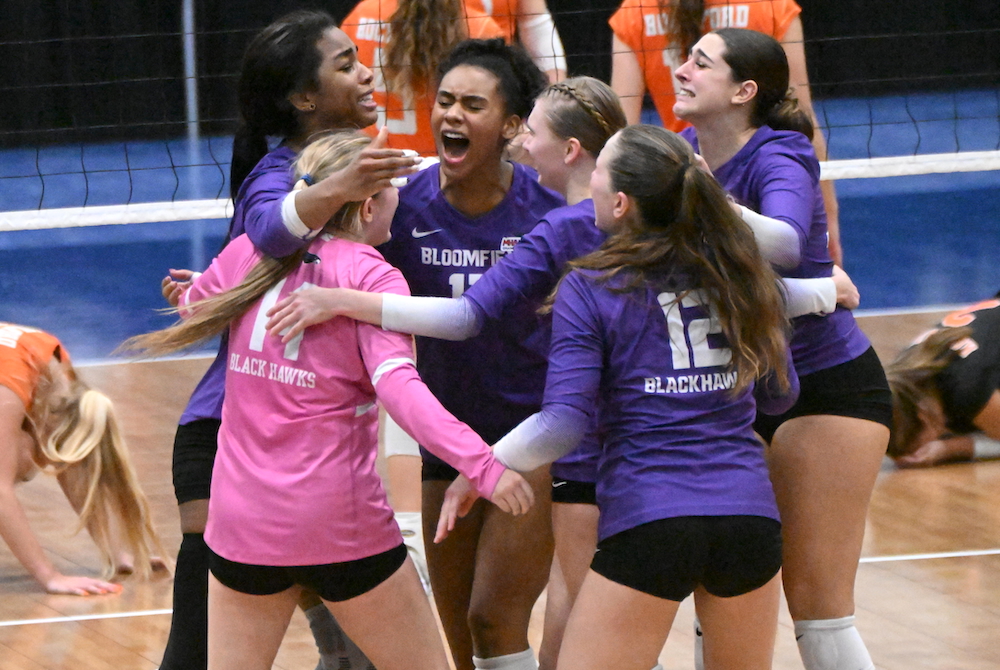
Mercy, No. 3 in the final Division 1 rankings, most recently won the Division 1 title in 2023. No. 2 Bloomfield Hills has never won a Finals title – but ended an incredible run by top-ranked Rockford on Thursday to earn the opportunity.
Division 2 and 3 Semifinals will be played Friday. Click here for more.
Hockey Weekly Action Photos captured the following from Thursday’s action.
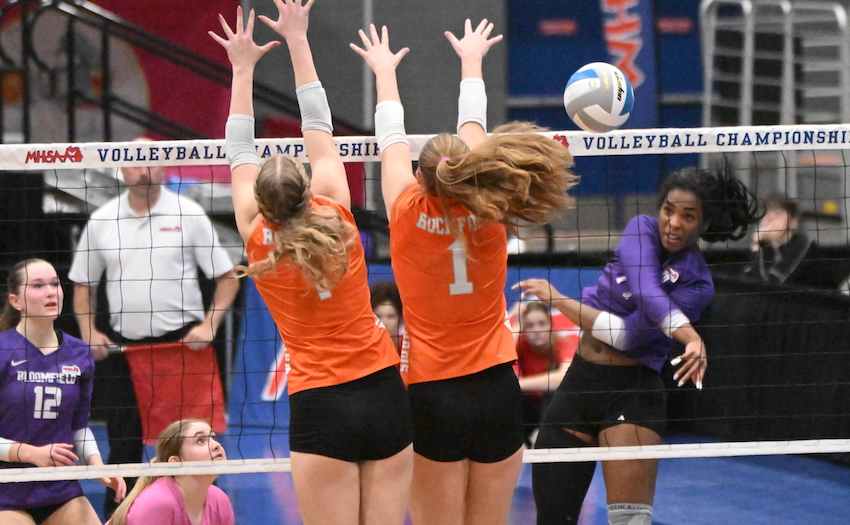
Bloomfield Hills senior Kayla Nwabueze (far right) sends a kill attempt into a Rockford block during the Black Hawks' 25-19, 22-25, 21-25, 25-22, 15-13 win over Rockford. Nwabueze finished with 43 kills, which are tied for second-most for a single match during the MHSAA Semifinals or Finals since the start of the rally scoring era in 2004-05.
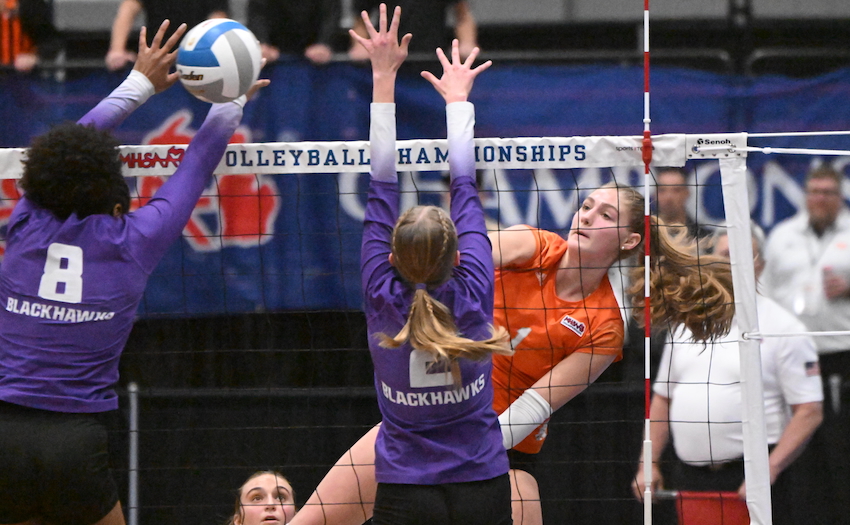
Rockford senior Liv Hosford (1) sends a kill attempt into the block of Bloomfield Hills junior Brynn Wilcox (2) and freshman Emily Nwabueze (8). Hosford had 23 kills for the Rams, who finished 46-2-1.
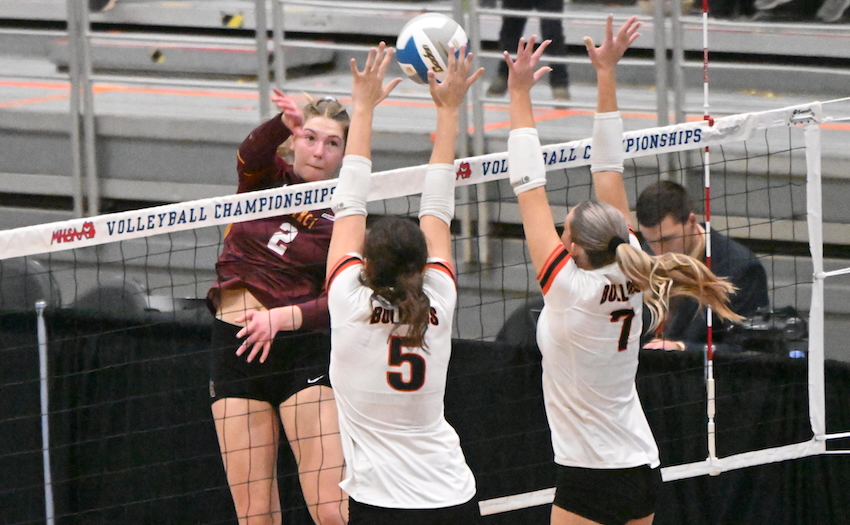
Farmington Hills Mercy junior Kate Kalcynski (2) attempts to slam a kill past Byron Center senior Lainey VanTol (5) and junior Cara Crittendon during the Marlins’ 25-27, 24-26, 25-16, 25-17, 16-14 victory. Kalcynski totaled 30 kills and 21 digs.
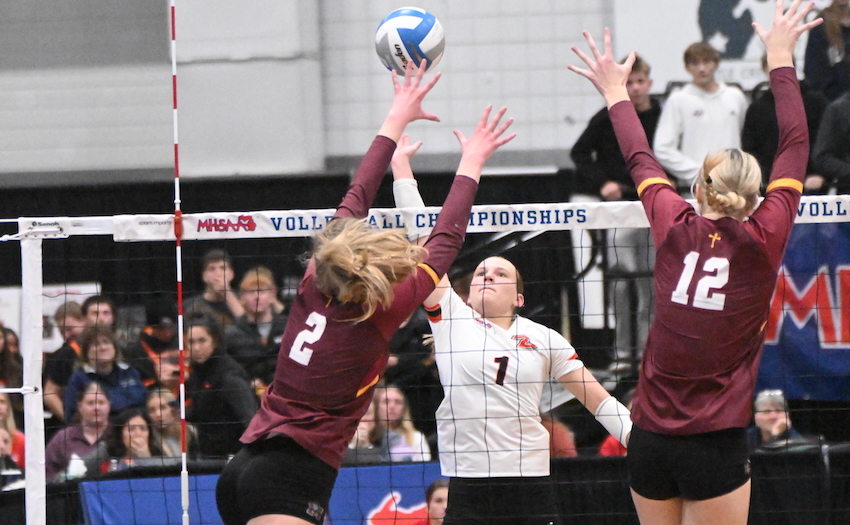
Byron Center junior Caitlin Hartson (1) attempts to get a kill over the Mercy block of Kalczynski and sophomore McKenzie Andrews (12). Hartson finished with 16 kills as the Bulldogs ended their season 37-6-2.
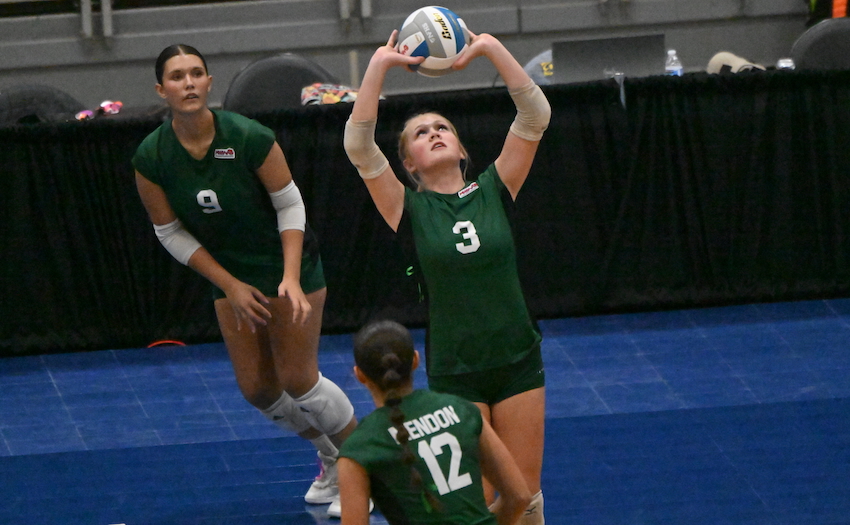
Mendon junior Karyssa Holtz (3) sets as teammates Cienna Nightingale (9) and Sabrina Monroy make their moves toward the net. Holtz finished with 40 assists, Nightingale had six kills and Monroy had four in Mendon’s 25-18, 25-22, 27-25 win.
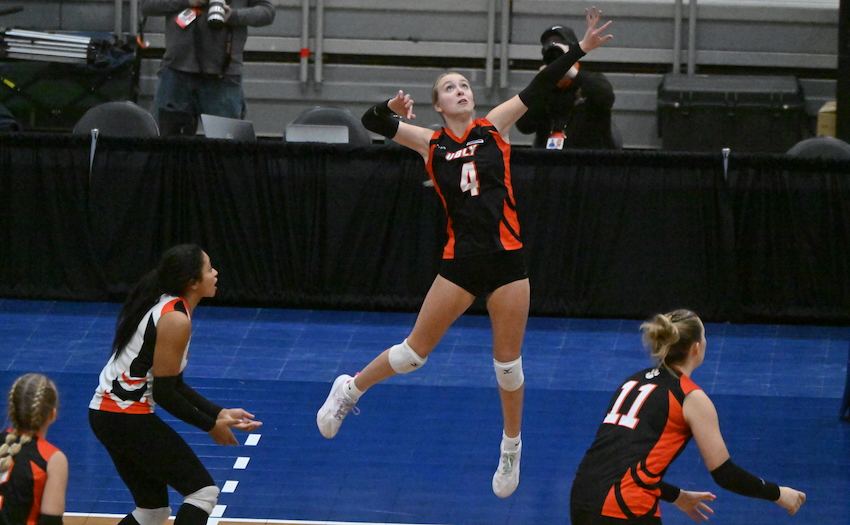
Ubly senior Sophi Heleski (4) elevates for a kill attempt. She finished with three kills and four digs for the Bearcats (30-11-4).
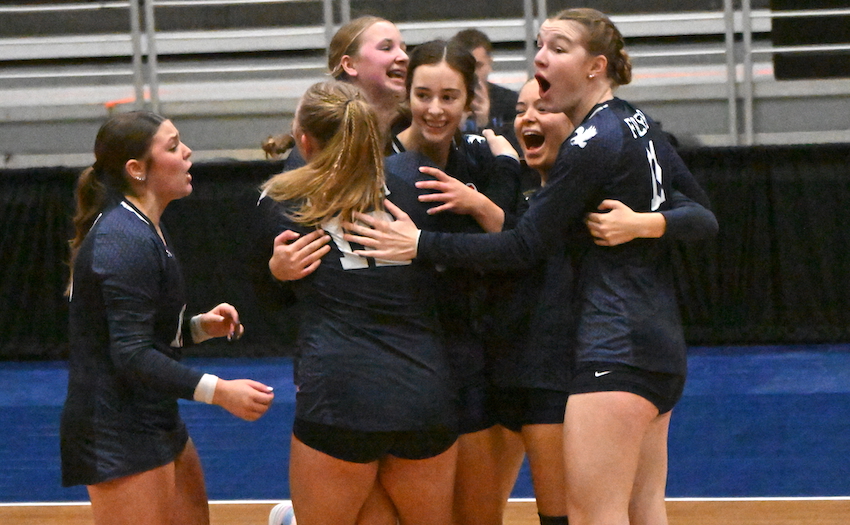
Fowler players celebrate their 26-24, 30-28, 20-25, 19-25, 15-8 win over Crystal Falls Forest Park in the day’s first match.
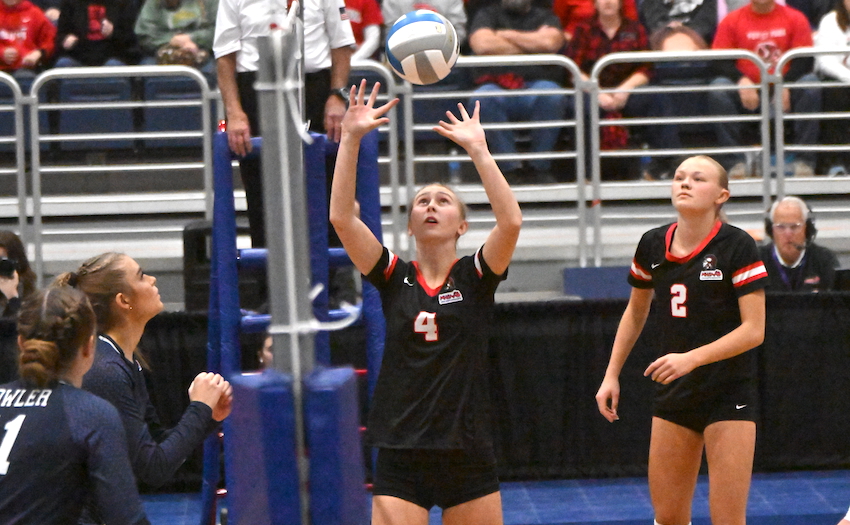
Forest Park junior Vienna Price (4) sets with senior Elsie Williams (2) ready for the next attack. Price had 17 assists and Williams had 32. The Trojans finished this season 42-2.
TOP PHOTO Bloomfield Hills players celebrate their five-set comeback win over Rockford on Thursday at Kellogg Arena.