

Add, Subtract, Divide, Multiply: MHSAA Not Alone
July 25, 2017
By Rob Kaminski
MHSAA benchmarks editor
This is the third part in a series on MHSAA tournament classification, past and present, that will be published over the next two weeks. This series originally ran in this spring's edition of MHSAA benchmarks.
As the MHSAA faces its most recent classification task with 8-Player Football, and opinions continue to swirl about as to the method, timeframe, location and other procedures, a look around the country provides plenty of company among state association brethren factoring variables into their own equations.
In the Pacific Northwest, the Oregon School Activities Association Football Playoffs are under public scrutiny as leadership ponders a five or six classification format beginning with the 2018-19 school year.
The OSAA has crowned six champions on the gridiron since 2006-07. Many of the state’s smaller schools would like to keep it that way, while larger schools lean toward a five-classification system, citing larger leagues, ease of travel and credibility to state championships as the advantages.
Still others would prefer more than six classes, pointing to safety issues and the opportunity to increase participation numbers as positives.
Moving southeast of Oregon, the Nevada Interscholastic Activities Association recently voted to hold serve on a classification proposal that was volleyed to the membership.
However, changes still could be forthcoming by as early as the 2018-19 season which would add a fifth classification in more populated southern Nevada while allowing northern schools to participate in four classifications. Such divisions could mean no state championship for the fifth class in southern Nevada.
Because of that, the NIAA wants equal numbers of schools in each classification on both ends of the state. Complicating the issue is the fact that the 24 largest schools in the state, by enrollment, are all in Clark County in Southern Nevada.
Across Nevada’s border into Arizona, charter schools are asking the Arizona Interscholastic Association to reconsider classification that was voted upon and approved in September 2015. That agreement called for the largest 33 percent of charter schools by enrollment to be placed in the state’s largest school classification, 3A, the middle 33 percent into 2A, and the smallest 33 percent into 1A.
Less than two years later the charter schools have had a change of heart and have asked to be considered the same as other Arizona public schools and be placed appropriately by enrollment beginning with the 2018-19 school year.
The situation in Arizona further illustrates how the public/private debate that all state associations have faced throughout existence now has the added dynamic of rapidly growing charter schools in today’s educational system, along with virtual school enrollment.
In the nation’s heartland, Nebraska has retooled its football classifications by using enrollment of boys students only in its schools rather than total enrollment. The Nebraska School Activities Association football-playing schools will kick off the 2018 season using this alignment.
Nebraska has three classes of 11-player football, with the smallest class divided in two, Class C-1 and C-2. The state also will have 8-player football for boys enrollments under 47, and the NSAA will sponsor a new 6-player tournament in 2018 for schools with 27 or fewer boys.
“This is a good proposal because some schools have a sizable imbalance between the number of boys and girls, and there’s a large gap (in enrollment) between the largest and smallest schools in Classes A and B,” NSAA executive director Jim Tenopir said. “I think this addresses both of those concerns.”
Swimmers in Georgia, meanwhile, will feel like they are moving with the current, rather than upstream in 2017-18, as the Georgia High School Association recently doubled the number of team championship events from two to four.
Swim enthusiasts can also count on longer days at the finals, as the top 30 finishers from the prelims will advance to the finals instead of 20, and all championship events will have three heats versus two.
Grand Blanc Takes 'Total Team Effort' to Championship Level with SVL Title Clincher
By
Paul Costanzo
Special for MHSAA.com
November 12, 2025
Needing a “total team effort” was much more than generic coach speak this past week for the Grand Blanc girls swimming & diving team.
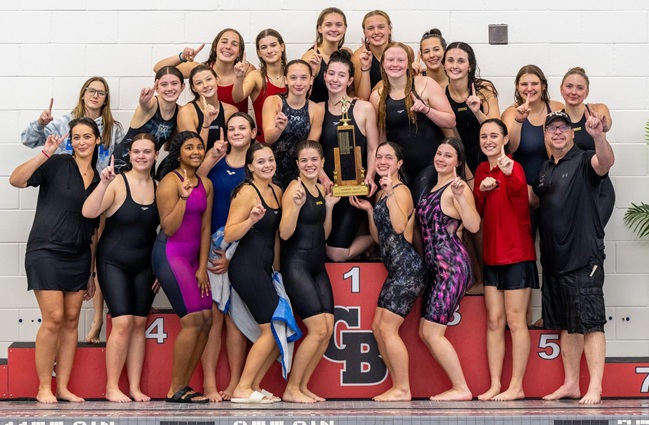
 Twenty-one athletes scored at the Saginaw Valley League Championships, helping the Bobcats edge Midland Dow and claim the program’s first league title since 2020.
“I definitely think that’s what sets us apart from other teams – we have so many amazing swimmers,” Grand Blanc senior Riley McLeman said. “If we had two people in the championship heat, and so did Dow, we also had two people in the B and C finals, where they had none. Everyone played a role in this. Every single person on our team was important, and that was amazing to see.”
Quality depth has driven the Bobcats all season, and in the SVL meet, it was the difference as they overcame Dow placing the individual winner in eight of the meet’s 12 events. Grand Blanc did win two events and placed second in nine, but pulled away with its depth.
“We knew early on in the season that we were keeping a really great senior class and had a lot of great swimmers returning, and also that we were getting a great freshman class,” Grand Blanc coach Katherine Kuhn said. “We had our sights set on winning leagues, and we knew we had that depth and that speed. And they had to show out. It wasn’t just, ‘We have this depth, we’re good.’ They still had to really show out at the meet, and they did.”
 The SVL meet scores all the way through 24 places, adding importance to the B and C finals.
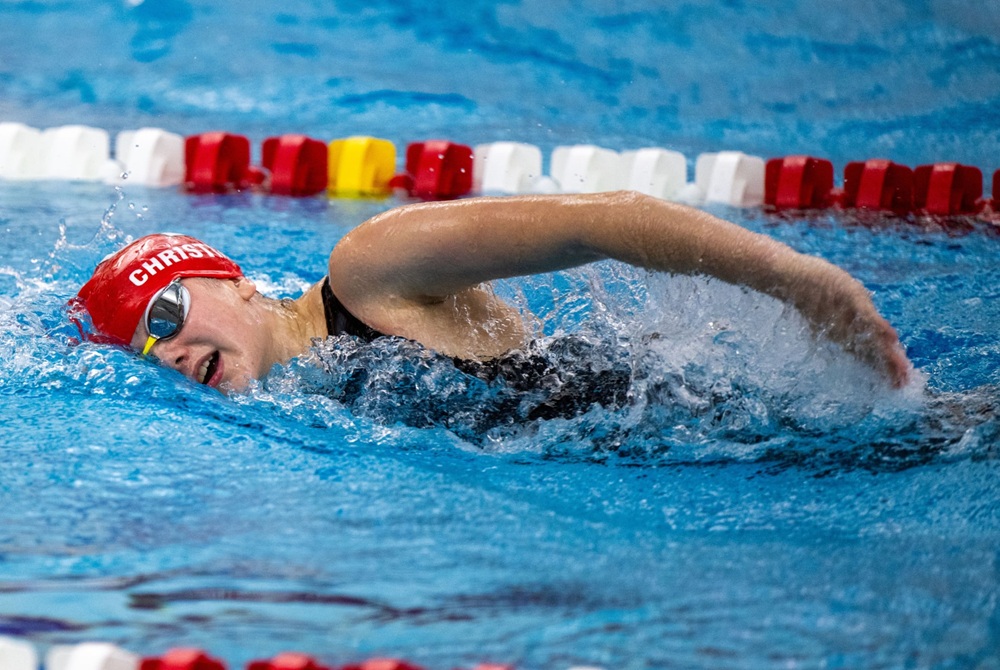
So, for a swimmer like freshman Ava Christian, her personal-best times in the 200 and 500-yard freestyle races were for more than just pride as she contributed to the Grand Blanc cause with 33 points – all earned in B finals.
“There was kind of some pressure, but it was a good pressure,” Christian said. “Even people that weren’t scoring as highly still had a chance to make a difference. It put pressure on everyone, not just the top swimmers. I really feel like it shows how well we can work together and support each other.”
The top swimmers did their job, as well. Rory Grzymkowksi won the 100 backstroke, while Mallory Shaver, Norah Grosso, Peyton Folks and Sydney Folks won the 400 free relay. Shaver was second in the 200 and 500 freestyles, while McLeman was second in the 100 breaststroke and 200 individual medley and Lila Brocker was second in the 100 backstroke. The 200 free and 200 medley relays also placed second.
Just as fun for that group of standouts was cheering on their teammates in those B and C finals, knowing how much they meant.
“It was great,” McLeman said. “Especially watching some of these freshmen that I didn’t know too well before the season, and even some of my best friends I’ve been swimming with for years getting to compete at a high level and having these amazing breakthrough races. It really got us hyped up and excited for our races.”
While building its depth, Grand Blanc has also been getting stronger at the top. Eight swimmers will be competing at the Lower Peninsula Division 1 Finals on Nov. 21 and 22 at Oakland University. McLeman, Shaver, Sydney Folks, Grzymkowski and Brocker all have qualified in individual events, while Cameron Folks, Peyton Folks and Grosso will swim on relays. Diver Chloe Borton has a chance to make it nine qualifiers, as she will compete at her event Regional on Thursday.
It’s a number Kuhn said she hasn’t seen in her five years (three as an assistant, two as head coach) with the varsity program.
 The goal for the Bobcats is to get as many athletes as possible to the final day of the season, something Shaver was able to do a year ago as a sophomore.
“There are some first-time people, and some people that know what to expect, but I definitely will share with the freshmen that they have to take it in and not let the stress take over, because they’ve trained for this,” Shaver said. “I think we have some talented girls that have been able to put in the work and want to represent Grand Blanc in a good way and just show off our talents.”
If the trend of this season holds, expect the Bobcats to reach that goal, as they’ve reached every one to this point.
McLeman said Kuhn broke the season into chunks for the team:
Win the Genesee County meet. Check.
Defeat Dow in a dual. Check.
Win the SVL. Check.
“It’s just been great; it’s been the most amazing season I’ve been part of,” McLeman said. “I could not ask for a better way to finish up my Grand Blanc swim career, to watch me and my best friends accomplish something we’ve worked for since our freshman year.”
 Paul Costanzo served as a sportswriter at The Port Huron Times Herald from 2006-15, including three years as lead sportswriter, and prior to that as sports editor at the Hillsdale Daily News from 2005-06. He can be reached at [email protected] with story ideas for Genesee, Lapeer, St. Clair, Sanilac, Huron, Tuscola, Saginaw, Bay, Arenac, Midland and Gladwin counties.
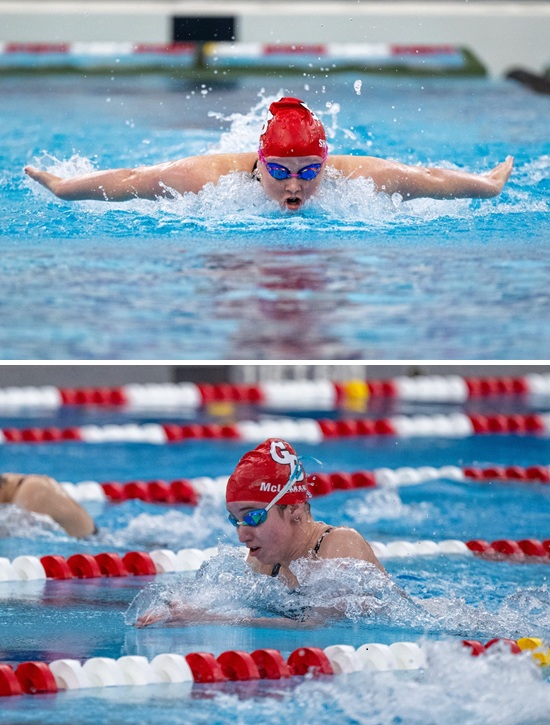
PHOTOS (Top) Grand Blanc’s Ava Christian swims a freestyle race this season. (Middle) The Bobcats stand for a trophy photo after clinching the Saginaw Valley League championship. (Below) Mallory Shaver, top, swims the butterfly and Riley McLeman swims the breaststroke. (Photos courtesy of the Grand Blanc girls swimming & diving program.)