

Add, Subtract, Divide, Multiply: MHSAA Not Alone
July 25, 2017
By Rob Kaminski
MHSAA benchmarks editor
This is the third part in a series on MHSAA tournament classification, past and present, that will be published over the next two weeks. This series originally ran in this spring's edition of MHSAA benchmarks.
As the MHSAA faces its most recent classification task with 8-Player Football, and opinions continue to swirl about as to the method, timeframe, location and other procedures, a look around the country provides plenty of company among state association brethren factoring variables into their own equations.
In the Pacific Northwest, the Oregon School Activities Association Football Playoffs are under public scrutiny as leadership ponders a five or six classification format beginning with the 2018-19 school year.
The OSAA has crowned six champions on the gridiron since 2006-07. Many of the state’s smaller schools would like to keep it that way, while larger schools lean toward a five-classification system, citing larger leagues, ease of travel and credibility to state championships as the advantages.
Still others would prefer more than six classes, pointing to safety issues and the opportunity to increase participation numbers as positives.
Moving southeast of Oregon, the Nevada Interscholastic Activities Association recently voted to hold serve on a classification proposal that was volleyed to the membership.
However, changes still could be forthcoming by as early as the 2018-19 season which would add a fifth classification in more populated southern Nevada while allowing northern schools to participate in four classifications. Such divisions could mean no state championship for the fifth class in southern Nevada.
Because of that, the NIAA wants equal numbers of schools in each classification on both ends of the state. Complicating the issue is the fact that the 24 largest schools in the state, by enrollment, are all in Clark County in Southern Nevada.
Across Nevada’s border into Arizona, charter schools are asking the Arizona Interscholastic Association to reconsider classification that was voted upon and approved in September 2015. That agreement called for the largest 33 percent of charter schools by enrollment to be placed in the state’s largest school classification, 3A, the middle 33 percent into 2A, and the smallest 33 percent into 1A.
Less than two years later the charter schools have had a change of heart and have asked to be considered the same as other Arizona public schools and be placed appropriately by enrollment beginning with the 2018-19 school year.
The situation in Arizona further illustrates how the public/private debate that all state associations have faced throughout existence now has the added dynamic of rapidly growing charter schools in today’s educational system, along with virtual school enrollment.
In the nation’s heartland, Nebraska has retooled its football classifications by using enrollment of boys students only in its schools rather than total enrollment. The Nebraska School Activities Association football-playing schools will kick off the 2018 season using this alignment.
Nebraska has three classes of 11-player football, with the smallest class divided in two, Class C-1 and C-2. The state also will have 8-player football for boys enrollments under 47, and the NSAA will sponsor a new 6-player tournament in 2018 for schools with 27 or fewer boys.
“This is a good proposal because some schools have a sizable imbalance between the number of boys and girls, and there’s a large gap (in enrollment) between the largest and smallest schools in Classes A and B,” NSAA executive director Jim Tenopir said. “I think this addresses both of those concerns.”
Swimmers in Georgia, meanwhile, will feel like they are moving with the current, rather than upstream in 2017-18, as the Georgia High School Association recently doubled the number of team championship events from two to four.
Swim enthusiasts can also count on longer days at the finals, as the top 30 finishers from the prelims will advance to the finals instead of 20, and all championship events will have three heats versus two.
Block Party: 2025 Girls Volleyball District Preview
By
Geoff Kimmerly
MHSAA.com senior editor
November 3, 2025
Nearly 700 high school varsity volleyball teams will begin their marches toward MHSAA championships over the next three days, beginning a final three-week run that will conclude Nov. 22 at Battle Creek’s Kellogg Arena.
District tournaments start tonight with 178 matches. Links to interactive brackets for all four divisions plus information on purchasing tickets is available on the Girls Volleyball page, and a list version of tonight’s slate is posted on the Scores page – with green TV icons linked to broadcasts on the NFHS Network.
Below is a look at a few last regular-season results of note and glances at three Districts in each division that especially pop off the page. Records, results and schedules below are those posted for teams on MHSAA.com, and rankings reflect polls posted by the Michigan Interscholastic Volleyball Coaches Association.
Week in Review
The countdown of last week’s five most intriguing results:
1. Kingsley d. Traverse City St. Francis (25-20, 25-21) This was the most notable result from the annual ABCD quad, as Kingsley (50-4-1) is ranked No. 3 in Division 3 and St. Francis is No. 8 (28-16-0).
2. Coldwater d. Mendon (2-25, 25-22, 22-25, 25-22, 15-3) The Cardinals (22-17-5) head into Division 1 District play off avenging a loss from 11 days prior to the Division 4 top-ranked Hornets (32-6-1).
3. Marshall d. Edwardsburg (25-23, 25-21, 15-25, 25-15) Honorable mention Marshall (31-11-5) got a nice boost heading into Division 2 District play, adding a second win this season over the No. 9 Eddies (28-8-0).
4. Adrian Madison d. Concord (23-25, 26-24, 25-15) The Trojans (34-14-2) came back after losing the first set to add a second win this season (plus a draw) against the Division 4 No. 6 Yellow Jackets (26-10-3).
5. Lowell d. Battle Creek Harper Creek (25-14, 25-15) The Division 1 No. 8 Red Arrows (35-8-3) also swept Mattawan and Caledonia at their regular-season ending quad, but with this matchup with the Division 2 honorable mention Beavers (27-21-1) perhaps most notable from the final tune-up.
Districts at a Glance
These could be among our most competitive brackets. Host sites are in bold, and top two seeds at each are noted.
DIVISION 1
Cadillac
#1 Cadillac (34-7-1), #2 Mount Pleasant (26-9-1), Midland (25-8-4), Midland Dow (21-13-5), Bay City Western (20-16-4).
All five of these teams have winning records, with Big North Conference co-champion Cadillac holding down the top seed and potentially looking for a chance to avenge after seeing last season end against Mount Pleasant in a District Semifinal. Those two met only once this regular season, a 2-1 Mount Pleasant win at the Flint Powers Catholic Tournament. The Oilers also won their division of the Saginaw Valley League and went a combined 6-0 against the other three SVL teams in this week’s field.
Northville
#1 South Lyon East (37-7-1), #2 South Lyon (33-9-0), Northville (19-13-0), Salem (12-11-0), Canton (7-17-0), Plymouth (8-26-0).
South Lyon East has won its last 11 matches, is the only team in the state to defeat top-ranked Rockford, has a pair of wins over rival South Lyon and defeated Northville in their lone meeting as well. But South Lyon will certainly be prepared to challenge its rival one more time and has won nine of its last 10 matches with a victory over Clarkston during that run. And don’t count out Northville – last season’s Division 1 champion – which has seen several of the state’s best and did defeat East in last year’s District Final.
Troy Athens
#1 Bloomfield Hills Marian (43-5-0), #2 Bloomfield Hills (37-6-1), Troy Athens (21-6-1), Bloomfield Hills Cranbrook Kingswood (10-11-3), Birmingham Seaholm (12-22-2), Troy (1-29-0).
Marian and Bloomfield Hills High have hovered among the top-ranked teams in the state all season, with the Black Hawks holding a 2-1 match advantage as Marian won their first meeting Sept. 4 but Bloomfield Hills claimed the next two including in a three-set comeback Oct. 25. Marian made the Division 1 Semifinals last season and has won District championships nine straight seasons. Host Athens has enjoyed a notable six-win jump from a year ago and won 11 of its last 12 matches.
DIVISION 2
Adrian
#1 Tecumseh (51-2-0), #2 Adrian Madison (34-14-2), Chelsea (32-11-2), Brooklyn Columbia Central (23-16-0), Adrian (15-21-1), Michigan Center (14-23-2).
Last season’s Division 2 runner-up Tecumseh has certainly earned its way to the top seed this week with its only losses this season to Division 3 top-ranked Roscommon and Division 1 No. 6 Grand Rapids Forest Hills Northern. Tecumseh also has two wins apiece over Chelsea, Columbia Central, Adrian and Madison, and Chelsea and Madison could meet Wednesday to set up one last rematch. Madison defeated Chelsea in three sets during the Sept. 20 Onsted Tournament.
Caro
#1 North Branch (32-8-0), #2 Imlay City (33-9-0), Yale (23-24-1), Croswell-Lexington (25-24-0), Caro (1-20-0).
A District Final matchup between North Branch and Imlay City would be the third meeting in three weeks between the Blue Water Area Conference rivals, with North Branch winning during the league schedule Oct. 21 and again in the league tournament four days later, both in three-set sweeps. The Broncos are ranked No. 2 and Imlay City No. 7 statewide in Division 2, and if they meet once more it will be with North Branch’s 20-year District title streak on the line.
Saginaw Swan Valley
#1 Essexville Garber (39-13-3), #2 Saginaw Swan Valley (22-13-1), Freeland (24-15-2), Carrollton (31-2-2), Bay City John Glenn (10-18-1), Bridgeport (1-13-0).
Garber is the top seed after reaching the Division 2 Semifinals a year ago and taking Tecumseh to a fifth set in Battle Creek. But no matter which opponent the Dukes might face if they reach the District Final this week, they’ll surely be cautious. Garber defeated Swan Valley in four sets two weeks ago, but fell to Freeland in five in their league meeting Sept. 24. And Carrollton definitely is intriguing with its only losses to Division 3 No. 9 Saginaw Valley Lutheran and a strong Breckenridge team.4
DIVISION 3
Elkton-Pigeon-Bay Port Laker
#1 Cass City (22-8-2), #2 Elkton-Pigeon-Bay Port Laker (19-14-3), Bad Axe (26-14-0), Unionville-Sebewaing (16-15-4), Harbor Beach (15-17-3).
Although Cass City is a combined 7-0 this season against Laker, Bad Axe and USA, there is potential for some shaking up in this bracket as those opponents all are familiar with each other. Cass City won two matches against Laker, both in four sets, and Laker has two wins in three matches against Bad Axe, both victories coming in five sets. Laker and Bad Axe could meet Wednesday with another opportunity to see Cass City on the line – but Harbor Beach and USA have made enough noise during the season to make this unpredictable.
Monroe St. Mary Catholic Central
#1 Monroe St. Mary Catholic Central (20-4-1), #2 Clinton (31-5-1), Ottawa Lake Whiteford (20-12-0), Erie Mason (13-13-3), Blissfield (8-28-1), Ypsilanti Arbor Prep (7-9-1).
Monroe St. Mary Catholic Central is the reigning Division 3 champion and again has seen its share of top competition from multiple divisions. The Kestrels are coming off a loss to league rival Flat Rock, and Clinton – which made the Regional Finals a year ago – will try to jump into the mix with 11 wins over its last 13 matches and losses as well to some of the best in Divisions 2 and 4 including Tecumseh and Mendon. Whiteford also recently tested itself against several larger opponents, going 3-3 at the Belleville Invitational on Oct. 18.
Morley Stanwood
#1 Morley Stanwood (26-12-0), #2 Kent City (31-7-2), White Cloud (16-16-0), Lakeview (14-13-3), Blanchard Montabella (3-26-1).
Host Morley Stanwood and Kent City met three times during the regular season, splitting league matchups with Kent City winning the first, Morley Stanwood the second, but then Kent City coming back to win the third at the Central State Activities Association Tournament – and after losing the first set. That turnaround may provide Kent City with nice momentum if they meet again, although the Eagles did go 2-2 in matches last week. White Cloud lost twice to both this fall, but did take a set off Kent City in their second meeting Oct. 14.
DIVISION 4
Non-Traditional (top line of bracket hosts)
#1 Hancock (24-4-2), #2 Lake Linden-Hubbell (24-5-0), Baraga (21-10-0), Dollar Bay (19-11-0), Chassell (13-11-0), L’Anse (8-19-0).
Hancock burst back on the scene by making last season’s Division 4 Semifinals, and while it would be easy to look ahead to a potential Regional matchup next week with Crystal Falls Forest Park, the Bulldogs have to be cautious this week to make that happen. They’ve seen Lake Linden-Hubbell twice, winning both times in four sets, and Baraga and Dollar Bay have impressed as well – Baraga nearly flipping its record from a year ago. Lake Linden-Hubbell closed the regular season with a sweep of Dollar Bay, but Dollar Bay won their previous meeting in five and should present quite a challenge if it advances to Wednesday.
Bear Lake
#1 Onekama (32-9-3), #2 Suttons Bay (23-2-0), Leland (12-27-1), Frankfort (15-17-2), Bear Lake (16-23-0), Lake Leelanau St. Mary (4-26-3).
Onekama is a combined 11-2-1 over its last 14 matches and 5-0 this season against teams in this bracket as the Portagers seek a sixth-straight District title. They played Suttons Bay to a five-set win on Sept. 25, taking the first two and losing the next pair before winning the decider. Suttons Bay’s only other loss this season came to Division 3 contender Traverse city St. Francis, and the Norsemen defeated both possible Wednesday opponents Leland and St. Mary in a quad Oct. 23.
Hillsdale Will Carleton Academy
#1 Hillsdale Academy (21-11-1), #2 Concord (26-10-3), Hillsdale Will Carleton Academy (18-7-3), Pittsford (13-12-0).
The bracket also is filled with teams with winning records, with Hillsdale Academy an honorable mention and Concord ranked No. 6 in the most recent coaches poll. Hillsdale Academy has lost four of its last six matches, but those defeats came to Division 2 or 3 teams, or top-ranked Mendon, and Colts have wins in lone matches against Concord and Pittsford. Concord went 2-2 to close the regular season, but also with losses to Division 2 and 3 teams. Will Carleton and Pittsford have split a pair of meetings over the last three weeks.
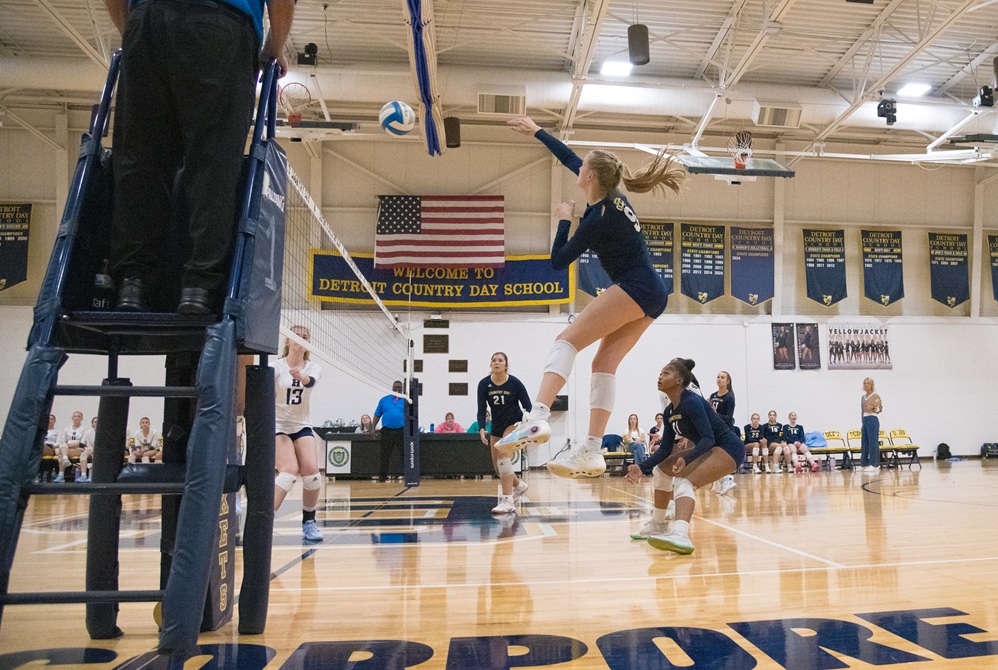
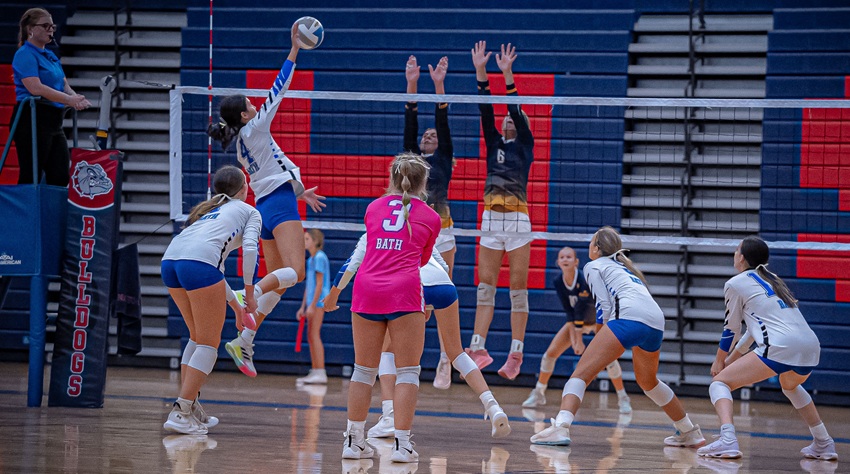
PHOTOS (Top) Detroit Country Day hosts Hartland on Oct. 9. (Middle) Bath faces Brooklyn Columbia Central during the Mason Invitational on Sept. 13. (Country Day/Hartland photo by TCP-Photography. Bath/Ovid-Elsie photo by Click by Christine McCallister.)