


Add, Subtract, Divide, Multiply: MHSAA Not Alone
July 25, 2017
By Rob Kaminski
MHSAA benchmarks editor
This is the third part in a series on MHSAA tournament classification, past and present, that will be published over the next two weeks. This series originally ran in this spring's edition of MHSAA benchmarks.
As the MHSAA faces its most recent classification task with 8-Player Football, and opinions continue to swirl about as to the method, timeframe, location and other procedures, a look around the country provides plenty of company among state association brethren factoring variables into their own equations.
In the Pacific Northwest, the Oregon School Activities Association Football Playoffs are under public scrutiny as leadership ponders a five or six classification format beginning with the 2018-19 school year.
The OSAA has crowned six champions on the gridiron since 2006-07. Many of the state’s smaller schools would like to keep it that way, while larger schools lean toward a five-classification system, citing larger leagues, ease of travel and credibility to state championships as the advantages.
Still others would prefer more than six classes, pointing to safety issues and the opportunity to increase participation numbers as positives.
Moving southeast of Oregon, the Nevada Interscholastic Activities Association recently voted to hold serve on a classification proposal that was volleyed to the membership.
However, changes still could be forthcoming by as early as the 2018-19 season which would add a fifth classification in more populated southern Nevada while allowing northern schools to participate in four classifications. Such divisions could mean no state championship for the fifth class in southern Nevada.
Because of that, the NIAA wants equal numbers of schools in each classification on both ends of the state. Complicating the issue is the fact that the 24 largest schools in the state, by enrollment, are all in Clark County in Southern Nevada.
Across Nevada’s border into Arizona, charter schools are asking the Arizona Interscholastic Association to reconsider classification that was voted upon and approved in September 2015. That agreement called for the largest 33 percent of charter schools by enrollment to be placed in the state’s largest school classification, 3A, the middle 33 percent into 2A, and the smallest 33 percent into 1A.
Less than two years later the charter schools have had a change of heart and have asked to be considered the same as other Arizona public schools and be placed appropriately by enrollment beginning with the 2018-19 school year.
The situation in Arizona further illustrates how the public/private debate that all state associations have faced throughout existence now has the added dynamic of rapidly growing charter schools in today’s educational system, along with virtual school enrollment.
In the nation’s heartland, Nebraska has retooled its football classifications by using enrollment of boys students only in its schools rather than total enrollment. The Nebraska School Activities Association football-playing schools will kick off the 2018 season using this alignment.
Nebraska has three classes of 11-player football, with the smallest class divided in two, Class C-1 and C-2. The state also will have 8-player football for boys enrollments under 47, and the NSAA will sponsor a new 6-player tournament in 2018 for schools with 27 or fewer boys.
“This is a good proposal because some schools have a sizable imbalance between the number of boys and girls, and there’s a large gap (in enrollment) between the largest and smallest schools in Classes A and B,” NSAA executive director Jim Tenopir said. “I think this addresses both of those concerns.”
Swimmers in Georgia, meanwhile, will feel like they are moving with the current, rather than upstream in 2017-18, as the Georgia High School Association recently doubled the number of team championship events from two to four.
Swim enthusiasts can also count on longer days at the finals, as the top 30 finishers from the prelims will advance to the finals instead of 20, and all championship events will have three heats versus two.
Preview: Stage Set for Several Storylines Featuring Past Champs, New Stars
By
Geoff Kimmerly
MHSAA.com senior editor
October 31, 2025
Three returning champions to Saturday’s Lower Peninsula Boys Cross Country Finals are hoping to add to title streaks that already have extended over multiple seasons.
But none of those three is considered the favorite in its respective race – and with only one 2024 individual winner back as well, title opportunities abound at one of the MHSAA’s largest championship events.
At least two contenders hope they’ll be celebrating like it’s the 1950s again – they’re seeking first championships in more than 70 years. Division 4 favorite Maple City Glen Lake is hoping to climb the MIS stage as a team champion for the first time.
See below for several team and individual contenders. The "season bests" list referred to frequently is a ranking list of every runner's best time this season, maintained by Athletic.net. The first boys race, in Division 4, begins at 10:50 a.m.; click here for the full schedule and ticket information.
Additionally, all eight races Saturday at MIS will be streamed live and viewable with subscription on the NFHS Network: Divisions 1 & 2 | Divisions 3 & 4.
Division 1
Reigning champion: Northville
2024 runner-up: Saline
2025 top-ranked: 1. Ann Arbor Pioneer, 2. Northville, 3. Kalamazoo Central.
Northville can become the sixth program in Lower Peninsula history to win a fourth-straight Finals championship – and the first since Dexter won the last of a five consecutive in 2006. Four runners return from last year’s lineup including ninth-place senior Ben Hartigan and 10th-place junior Brandon Cloud. But the rankings call for Pioneer to move up from 14th last season to claim a first team championship since 2017. Five Pioneers are back from last season’s lineup, including eighth-place senior Beckett Crooks – who has run the second-fastest top time (14:48.2) in the state regardless of peninsula or division – and junior Kamari Ronfeldt, who was fourth as a freshman in 2023, wasn’t able to finish last season’s race but enters this one with the top time statewide of 14:47.9. A Kalamazoo Central championship would make for incredible headlines; the Maroon Giants have a Lower Peninsula-record 11 Finals titles in this sport but with their most recent won in 1954. They finished fourth last season and return their top four racers from that lineup, with junior Samuel Baker back after finishing 14th individually and senior Andrew Wright posting the third-fastest top time in Division 1 this fall.
Individuals: A total of 12 of last season’s top 20 placers will return this weekend, led by Canton senior Aiden Pengelly, who finished runner-up a year ago and just 6½ seconds off the lead. Milford senior Kyle O’Rourke also returns after finishing third and just a second behind Pengelly. Joining those two and the others noted above from the 2024 top 20 are Grand Haven juniors Luka Hammond (fifth) and Aron Gal (19th), Howell junior Jack MacGregor (sixth), Kalamazoo Loy Norrix senior Jackson Lam (12th), Utica senior Harper Wesley (15th) and Saline junior Jacob Szalay (16th).
Division 2
Reigning champion: Allendale
2024 runner-up: Ada Forest Hills Eastern
2025 top-ranked: 1. Flint Powers Catholic, 2. Alma, 3. East Grand Rapids.
West Michigan teams have claimed this division three years in a row, and 2022 champ East Grand Rapids is among those expected to be in the mix again. Flint Powers is seeking its first team title since 1999, which would be an incredible story as well as the Chargers sent only two individual qualifiers to the Finals a year ago. Senior Bryce Gross (20th) and sophomore Lennox Naswell (32nd) are both headed back this weekend, and Naswell has run the fourth-fastest top time in the division. Alma is seeking to make a jump from fifth last fall to win what would be a first team title since 1952. Five of the Panthers’ top six from last season will run again, including 14th-place senior Thomas Larson, whose fastest time this fall ranks sixth just behind that of junior teammate Ezekiel Baltierra. East Grand Rapids finished third last year without a senior and the entire lineup is back, paced by fifth-place senior Jonah Workman. Parma Western, ranked No. 5, has a pair of top-20 placers from last year back in senior Edison Lopeman (eighth) and junior Ryan Good (17th), and reigning champion Allendale is ranked No. 13 but also has two top finishers back in junior Mason Hill (ninth) and senior Ronnie Silveira (15th).
Individuals: Workman was the only finisher among the top seven last season who didn’t graduate, and he’ll be considered among favorites along with Whitehall junior Robert Jazwinski III, who has won all of his races this fall, has the fastest time in the Division 2 (14:56.6, with Workman second on the top time list at 14:58.8), and placed third in Division 3 for Hart in 2023. In addition to Workman and the others mentioned above, also back from last year’s top 20 are Adrian senior Moises Salazar Jr. (11th) and Ada Forest Hills Eastern junior Steven Zawacki (18th).
Division 3
Reigning champion: Traverse City St. Francis
2024 runner-up: Saugatuck
2025 top-ranked: 1. Jackson Lumen Christi, 2. Charlevoix, 3. Lansing Catholic.
St. Francis graduated six of its seven runners from last season and will enter this weekend unranked as it races for a third-straight Finals team title. Lumen Christi graduated its top two from last year’s fourth-place team but returns the other five runners as it seeks a first championship since 2012. Charlevoix is running for its first Finals win since finishing a streak of five straight in 1991, and after finishing 14th a year ago with only one senior. Five of the Rayders’ top six runners from that lineup are back, led by ninth-place junior Hunter Eaton – who has the fastest time in Division 3 this season at 15:22.4. Lansing Catholic’s most recent title came in 2015, and the Cougars placed ninth a year ago also with only one senior. They bring back their top three from that lineup and five racers total.
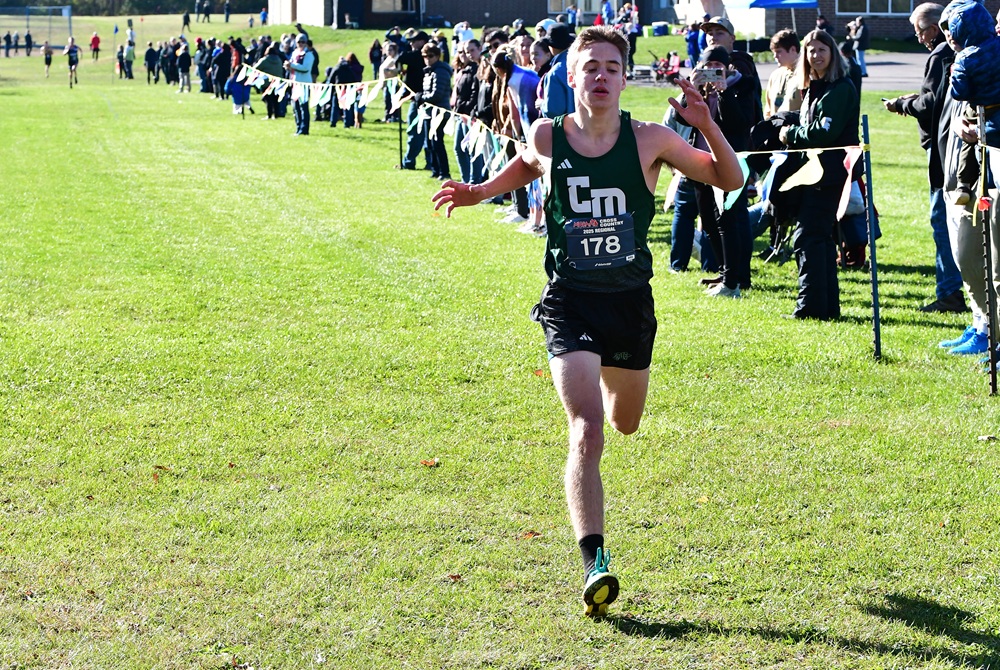
Individuals: Central Montcalm senior Gage Hoffman was the only non-senior among last year’s top four, finishing third, and he has the third-fastest top time in Division 3 this season. Joining him and Eaton back from last year’s top 10 are Jonesville junior Caleb Blonde (fifth), Ithaca senior Landen Styka (sixth) and Flat Rock senior Jacob Stanislawski (eighth). Junior William Ready (11th) is the only St. Francis runner returning. Manton senior Robert Dykhouse (12th), Monroe St. Mary Catholic Central sophomore Christian Craanen (14th), Flat Rock senior Lucas Taraszkiewicz (18th) and Caro junior Luke Herron (20th) also placed among the top 20 last fall, and Rochester Hills Lutheran Northwest sophomore Nole Lorenzen was 21st and has the second-fastest top time (15:24.5) in the division this season.
Division 4
Reigning champion: Hillsdale Academy
2024 runner-up: Holland Calvary
2025 top-ranked: 1. Maple City Glen Lake, 2. Holland Calvary, 3. Hillsdale Academy.
Hillsdale Academy has finished first and Holland Calvary second the last two seasons, and they’re expected to be in the mix again. But Glen Lake is the favorite this time as it pursues a first Finals championship. The Lakers finished third last year and return their second through fifth runners, led by 18th-place junior Abraham Feeney, plus have one of the top freshmen in Spencer McNitt. Holland Calvary ran all sophomores in 2024 to its second-straight runner-up finish, and five are back including Noah Schipper (23rd) and Christian Getz (29th). Hillsdale Academy graduated just two runners after last season and has four runners back including fourth-place senior Grayson Rorick.
Individuals: This field is loaded, with 13 of last year’s top 20 back including the top four placers. Now-senior Marek Butkiewicz is the reigning champion after clinching last year’s race 15 seconds ahead of the field. Royal Oak Shrine Catholic senior Abenezar Cerone is the reigning runner-up, while Three Oaks River Valley senior Landon Rogers was third and Hillsdale Academy’s Rorick fourth. Petoskey St. Michael senior Cody Bradley (seventh), Whitmore Lake senior Landen Livingston (10th), Mesick juniors Kyle Redman (13th) and Ty Redman (20th), Hackett senior Sean Siems (14th), Riverview Gabriel Richard junior Jacob Ferdubinski (15th), Harbor Beach senior Brody Karg (16th), Glen Lake’s Feeney (18th) and Brown City senior Carson Burgess (19th) also are back from the top 20. Butkiewicz (14:59.4) and Cerone (15:25.0) rank first and second, respectively, on the Division 4 top times list.
PHOTO Central Montcalm’s Gage Hoffman crosses the finish line first Saturday at his Division 3 Regional at Bath. (Photo by John Johnson.)