

Add, Subtract, Divide, Multiply: MHSAA Not Alone
July 25, 2017
By Rob Kaminski
MHSAA benchmarks editor
This is the third part in a series on MHSAA tournament classification, past and present, that will be published over the next two weeks. This series originally ran in this spring's edition of MHSAA benchmarks.
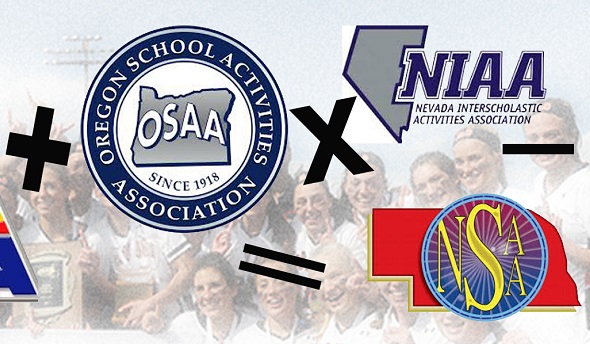
As the MHSAA faces its most recent classification task with 8-Player Football, and opinions continue to swirl about as to the method, timeframe, location and other procedures, a look around the country provides plenty of company among state association brethren factoring variables into their own equations.
In the Pacific Northwest, the Oregon School Activities Association Football Playoffs are under public scrutiny as leadership ponders a five or six classification format beginning with the 2018-19 school year.
The OSAA has crowned six champions on the gridiron since 2006-07. Many of the state’s smaller schools would like to keep it that way, while larger schools lean toward a five-classification system, citing larger leagues, ease of travel and credibility to state championships as the advantages.
Still others would prefer more than six classes, pointing to safety issues and the opportunity to increase participation numbers as positives.
Moving southeast of Oregon, the Nevada Interscholastic Activities Association recently voted to hold serve on a classification proposal that was volleyed to the membership.
However, changes still could be forthcoming by as early as the 2018-19 season which would add a fifth classification in more populated southern Nevada while allowing northern schools to participate in four classifications. Such divisions could mean no state championship for the fifth class in southern Nevada.
Because of that, the NIAA wants equal numbers of schools in each classification on both ends of the state. Complicating the issue is the fact that the 24 largest schools in the state, by enrollment, are all in Clark County in Southern Nevada.
Across Nevada’s border into Arizona, charter schools are asking the Arizona Interscholastic Association to reconsider classification that was voted upon and approved in September 2015. That agreement called for the largest 33 percent of charter schools by enrollment to be placed in the state’s largest school classification, 3A, the middle 33 percent into 2A, and the smallest 33 percent into 1A.
Less than two years later the charter schools have had a change of heart and have asked to be considered the same as other Arizona public schools and be placed appropriately by enrollment beginning with the 2018-19 school year.
The situation in Arizona further illustrates how the public/private debate that all state associations have faced throughout existence now has the added dynamic of rapidly growing charter schools in today’s educational system, along with virtual school enrollment.
In the nation’s heartland, Nebraska has retooled its football classifications by using enrollment of boys students only in its schools rather than total enrollment. The Nebraska School Activities Association football-playing schools will kick off the 2018 season using this alignment.
Nebraska has three classes of 11-player football, with the smallest class divided in two, Class C-1 and C-2. The state also will have 8-player football for boys enrollments under 47, and the NSAA will sponsor a new 6-player tournament in 2018 for schools with 27 or fewer boys.
“This is a good proposal because some schools have a sizable imbalance between the number of boys and girls, and there’s a large gap (in enrollment) between the largest and smallest schools in Classes A and B,” NSAA executive director Jim Tenopir said. “I think this addresses both of those concerns.”
Swimmers in Georgia, meanwhile, will feel like they are moving with the current, rather than upstream in 2017-18, as the Georgia High School Association recently doubled the number of team championship events from two to four.
Swim enthusiasts can also count on longer days at the finals, as the top 30 finishers from the prelims will advance to the finals instead of 20, and all championship events will have three heats versus two.
1st & Goal: 2025 Week 8 Preview
By
Geoff Kimmerly
MHSAA.com senior editor
October 16, 2025
A sense of urgency builds throughout the football regular season – and we’re right on schedule again this fall, although we might be reaching the peak even a little early with another week of games still to play.
 Week 8 has it all – a pair of matchups featuring undefeated teams with league titles on the line, several more winner-take-all championship showdowns, and of course plenty of games that could decide who’s in and who’s home when playoff brackets are plugged in Oct. 26.
In addition to following scores on the MHSAA Scores page and watching games on the NFHS Network, you’ll also want to keep a close eye this weekend on the Playoff Point Summary page as it will give you a real-time look at which teams are still in the hunt to continue playing in November.
Bay & Thumb
Davison at Grand Blanc WATCH
Grand Blanc took back the upper hand in this rivalry last season with a 55-49 win after Davison swept regular-season and playoff matchups in 2022 and 2023. These two easily could face off in the postseason again next month as well, but first this meeting will end either with Grand Blanc winning the Saginaw Valley League South outright or Davison claiming a share with one more league game to play. Neither has had a league game closer than 21 points this fall.
Keep an eye on these FRIDAY Harrison (6-1) at Gladwin (4-3), Elkton-Pigeon-Bay Port Laker (6-1) at Harbor Beach (7-0) WATCH, Freeland (6-1) at Frankenmuth (6-1) WATCH. SATURDAY Fenton (5-2) at Goodrich (7-0) WATCH.
Greater Detroit
Detroit Martin Luther King (5-2) vs. Detroit Cass Tech (7-0) at Ford Field WATCH
This will be the sixth season in a row these two will meet for a second time in a city championship game, and two of the last three seasons the series has ended in a split. Cass Tech won the first meeting this fall 27-22 in Week 4. That game was played over two days, with Cass Tech taking a 27-0 lead into the stoppage in the middle of the third quarter but King scoring all 22 points when the teams reconvened the following day.
Keep an eye on these FRIDAY Farmington (6-1) at Clarkston (6-1) WATCH, Grand Ledge (6-1) at Detroit Catholic Central (7-0), Detroit Pershing (5-2) vs. Detroit Denby (5-2) at Ford Field WATCH, Detroit Edison (6-1) at Ecorse (6-1).
Mid-Michigan
Howell (6-1) at Brighton (6-1) WATCH
For the second season in a row, these two will meet in the final week of Kensington Lakes Activities Association West play to decide some portion of the league championship. A year ago, Howell won 36-14 to finish an outright title, and then defeated the Bulldogs again 35-33 in a Division 1 District Final. This time, Brighton is undefeated in league play and Howell has a loss – but with the possibility of a Highlanders’ victory creating a three-way shared championship between these two and Northville.
Keep an eye on these FRIDAY Ithaca (6-1) at Fowler (5-2) WATCH, New Lothrop (5-2) at Ovid-Elsie (5-2), Charlotte (4-3) at Portland (7-0), Midland (4-3) at Mount Pleasant (7-0) WATCH.
Northern Lower Peninsula
Jackson Lumen Christi (4-3) at Traverse City St. Francis (6-1), Saturday
St. Francis is coming off its only loss, 63-38 to reigning Division 5 champion Pontiac Notre Dame Prep a week ago – but that also followed a pair of close wins that resulted in the Gladiators winning the Northern Michigan Football Conference Legends championship. Things obviously don’t get easier this week in this preview of a possible Division 6 playoff showdown. The reigning Division 6 champion Titans do have a win over Notre Dame Prep, 54-34 back in Week 2, and went on to share the Catholic High School League AA title.
Keep an eye on these FRIDAY Boyne City (5-2) at Charlevoix (7-0) WATCH, Sanford Meridian (5-2) at Ogemaw Heights (6-1) WATCH, Kingsley (5-2) at Kalkaska (5-2) WATCH, Beal City (7-0) at LeRoy Pine River (5-2).
Southeast & Border
Macomb Lutheran North (7-0) at Ann Arbor Father Gabriel Richard (7-0)
There are multiple league championship deciders in the southeastern part of the state this week, but this is one of only two matchups statewide of undefeated teams. The winner claims the CHSL Intersectional 1 title outright, with Lutheran North seeking to finish a third-straight perfect run through the league and FGR seeking its first perfect league run since 2009. The Mustangs have given up only 48 points this season, but might see its greatest challenge from a Fighting Irish offense that has scored at least 42 points in every game and at least 50 in six.
Keep an eye on these FRIDAY Monroe St. Mary Catholic Central (6-1) at Monroe Jefferson (7-0), Ypsilanti Lincoln (6-1) at Chelsea (6-1) WATCH, Temperance Bedford (4-3) at Saline (6-1) WATCH, Napoleon (5-2) at Michigan Center (7-0) WATCH.
Southwest Corridor
White Pigeon (6-1) at Decatur (5-2)
Although White Pigeon’s loss to Bronson last week took a bit of the punch out of this matchup, it’s still packed with possibilities. A Decatur win would give the Raiders an outright Southwest 10 Conference title, while a White Pigeon victory would create a three-way share among them. The Chiefs have won the last two meetings, including 14-6 a year ago, and had given up only 12 points over their first six games before allowing 32 to Bronson. Decatur defeated Bronson in Week 2, 26-20 in double overtime.
Keep an eye on these FRIDAY Hastings (5-2) at Coldwater (6-1) WATCH, Williamston (7-0) at Dowagiac (5-2) WATCH, Paw Paw (4-3) at Three Rivers (4-3) WATCH, Edwardsburg (6-1) at Vicksburg (4-3) WATCH.
Upper Peninsula
Menominee (7-0) at Kingsford (6-1) WATCH
This matchup has title implications in the Western Peninsula Athletic Conference Copper for the third season in a row, and is a winner-take-all for the second straight. Kingsford has won 18 straight league games, including 14-12 over Menominee a year ago, and the Flivvers’ only loss this season was 21-18 to Escanaba in their season opener. The Maroons haven’t played a game closer than 10 points this season and is seeking its first win over Kingsford since 2022.
Keep an eye on these FRIDAY West Iron County (3-3) at Bark River-Harris (5-1) WATCH, Gladstone (3-4) at Calumet (5-2) WATCH, Negaunee (4-3) at Houghton (2-5).
West Michigan
Grand Rapids Catholic Central (7-0) at Grand Rapids Northview (5-2)
Northview can’t catch Grand Rapids Catholic Central in the Ottawa-Kent Conference Black. But the Wildcats can break up the Cougars’ perfect season and prevent them from claiming the league title outright. Catholic Central claimed a share last week against Holland Christian and sits a game ahead of East Grand Rapids after winning their Week 4 meeting 10-7. Northview won last year’s matchup 12-3 on the way to claiming the O-K Black title outright, and bounced back from two midseason losses with a win over Grand Rapids Ottawa Hills last week.
Keep an eye on these FRIDAY Hudsonville Unity Christian (7-0) at Grand Rapids South Christian (4-3) WATCH, East Kentwood (5-2) at Grandville (4-3), Howard City Tri County (5-2) at Kent City (7-0) WATCH, Wyoming Kelloggsville (5-2) at Wyoming Godwin Heights (6-1).
8-Player
Merrill (6-1) at Blanchard Montabella (7-0) WATCH
Montabella has enjoyed some of its most consistent success the last two seasons and carries a 10-game league winning streak into this winner-take-all for the Mid-State Activities Conference Blue title. To repeat, the Mustangs must go through Merrill, which gave them their closest league game in 2024, a 20-12 win. The Vandals are seeking their first league championship since 2022 and could also see Montabella in the Division 1 playoffs.
Keep an eye on these FRIDAY Powers North Central (5-2) at Gogebic (7-0) WATCH, Waldron (5-2) at Pittsford (6-1) WATCH, Climax-Scotts (6-1) at Mendon (7-0) WATCH, Bridgman (6-1) at New Buffalo (7-0).
MHSAA.com's weekly “1st & Goal” previews and reviews are powered by MI Student Aid, a division within the Department of Lifelong Education, Advancement, and Potential (MiLEAP). MI Student Aid encourages students to pursue postsecondary education by providing access to student financial resources and information. MI Student Aid administers the state’s scholarship and grant programs that help make college Accessible, Affordable and Attainable for you. Click to connect with MI Student Aid and find more information on Facebook and Twitter @mistudentaid.
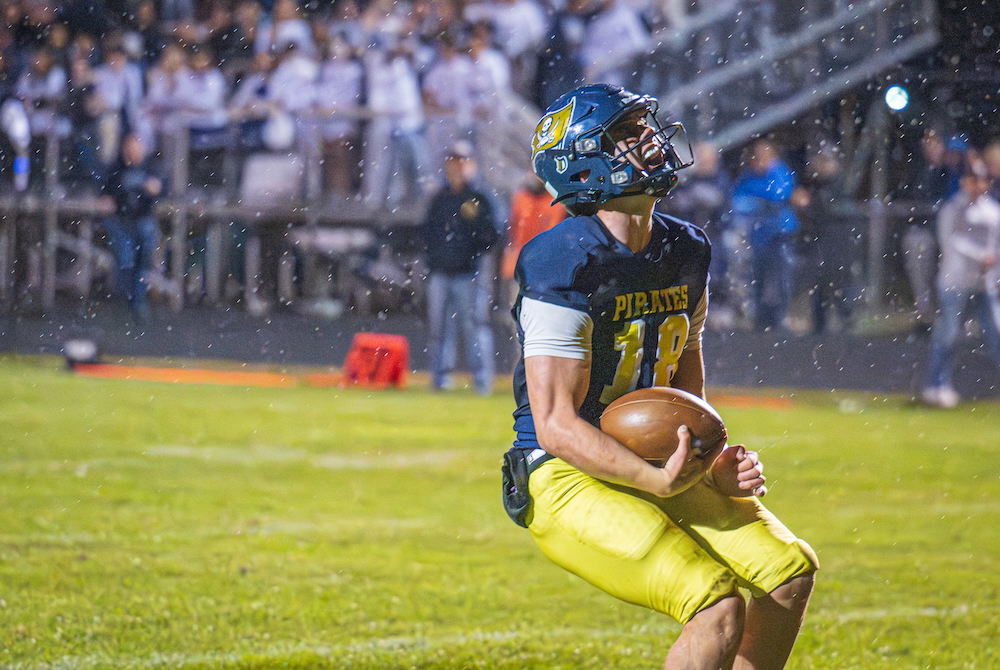
PHOTO As the rain falls, Pewamo-Westphalia's Ty Thelen celebrates a score during his team's win last week over Fowler. (Photo by Jim Pivarnik.)