


Add, Subtract, Divide, Multiply: MHSAA Not Alone
July 25, 2017
By Rob Kaminski
MHSAA benchmarks editor
This is the third part in a series on MHSAA tournament classification, past and present, that will be published over the next two weeks. This series originally ran in this spring's edition of MHSAA benchmarks.
As the MHSAA faces its most recent classification task with 8-Player Football, and opinions continue to swirl about as to the method, timeframe, location and other procedures, a look around the country provides plenty of company among state association brethren factoring variables into their own equations.
In the Pacific Northwest, the Oregon School Activities Association Football Playoffs are under public scrutiny as leadership ponders a five or six classification format beginning with the 2018-19 school year.
The OSAA has crowned six champions on the gridiron since 2006-07. Many of the state’s smaller schools would like to keep it that way, while larger schools lean toward a five-classification system, citing larger leagues, ease of travel and credibility to state championships as the advantages.
Still others would prefer more than six classes, pointing to safety issues and the opportunity to increase participation numbers as positives.
Moving southeast of Oregon, the Nevada Interscholastic Activities Association recently voted to hold serve on a classification proposal that was volleyed to the membership.
However, changes still could be forthcoming by as early as the 2018-19 season which would add a fifth classification in more populated southern Nevada while allowing northern schools to participate in four classifications. Such divisions could mean no state championship for the fifth class in southern Nevada.
Because of that, the NIAA wants equal numbers of schools in each classification on both ends of the state. Complicating the issue is the fact that the 24 largest schools in the state, by enrollment, are all in Clark County in Southern Nevada.
Across Nevada’s border into Arizona, charter schools are asking the Arizona Interscholastic Association to reconsider classification that was voted upon and approved in September 2015. That agreement called for the largest 33 percent of charter schools by enrollment to be placed in the state’s largest school classification, 3A, the middle 33 percent into 2A, and the smallest 33 percent into 1A.
Less than two years later the charter schools have had a change of heart and have asked to be considered the same as other Arizona public schools and be placed appropriately by enrollment beginning with the 2018-19 school year.
The situation in Arizona further illustrates how the public/private debate that all state associations have faced throughout existence now has the added dynamic of rapidly growing charter schools in today’s educational system, along with virtual school enrollment.
In the nation’s heartland, Nebraska has retooled its football classifications by using enrollment of boys students only in its schools rather than total enrollment. The Nebraska School Activities Association football-playing schools will kick off the 2018 season using this alignment.
Nebraska has three classes of 11-player football, with the smallest class divided in two, Class C-1 and C-2. The state also will have 8-player football for boys enrollments under 47, and the NSAA will sponsor a new 6-player tournament in 2018 for schools with 27 or fewer boys.
“This is a good proposal because some schools have a sizable imbalance between the number of boys and girls, and there’s a large gap (in enrollment) between the largest and smallest schools in Classes A and B,” NSAA executive director Jim Tenopir said. “I think this addresses both of those concerns.”
Swimmers in Georgia, meanwhile, will feel like they are moving with the current, rather than upstream in 2017-18, as the Georgia High School Association recently doubled the number of team championship events from two to four.
Swim enthusiasts can also count on longer days at the finals, as the top 30 finishers from the prelims will advance to the finals instead of 20, and all championship events will have three heats versus two.
As Race Times Fall, Centreville Sophomore's Profile Rises, Goals Grow
By
Scott Hassinger
Special for MHSAA.com
October 14, 2025
CENTREVILLE – Will Hulin reported to his first high school cross country practice last fall as a freshman at Centreville without logging any summer mileage.
 Hulin's lack of preseason training wasn't his choice though.
"My left knee became inflamed, and there was a bunch of liquid in it so I wasn't able to run the entire summer,” he said. “They removed the liquid, and I was cleared to start running the day before our first practice. I went into the season without any miles under my belt."
Despite the late start in his training, it didn't take Hulin long to work himself into shape – and he blossomed into the Bulldogs' top runner with rapid success.
Hulin ended his freshman cross country season as a 2024 Lower Peninsula Division 3 Finals qualifier at Michigan International Speedway in Brooklyn, where he achieved a then personal-best time of 16:56.1 – good enough for 83rd place.
Also a guard on the Bulldogs' basketball team, Hulin additionally competes in track & field. Last spring he was part of Centreville's Finals-qualifying 3200-meter relay team. He also competes in the 1,600, 800 and 3,200-meter races.
"I missed going to state in the 1,600 by a half second,” Hulin said. “My success in track last spring helped get me prepared for my sophomore season in cross country. The sprints we do in basketball practice, I feel, make me a strong sprinter at the end of my track and cross country races.”
Hulin spent most of June attending open gyms and lifting weights for basketball. He increased his daily mileage base and attended a summer running camp at Grand Valley State University a few weeks before the start of this cross country season.
 "At the cross country camp we had our toughest workouts of the day at 6 a.m. every morning. After breakfast, lunch and some free time we'd do further training in the afternoon,” he said. “It was a lot of fun. We had guest speakers come in and talk to us about nutrition, proper running shoes and mechanics to help improve us as runners. I found the nutrition part most beneficial because I learned what kind of food you need to have in your body before and after a run."
Will's parents, Shawn and Kim Hulin, are both former runners who later coached track & field in Centreville at the high school and middle school levels.
"I was always at practice with them every day when I was younger, so running was kind of born into me," Hulin said.
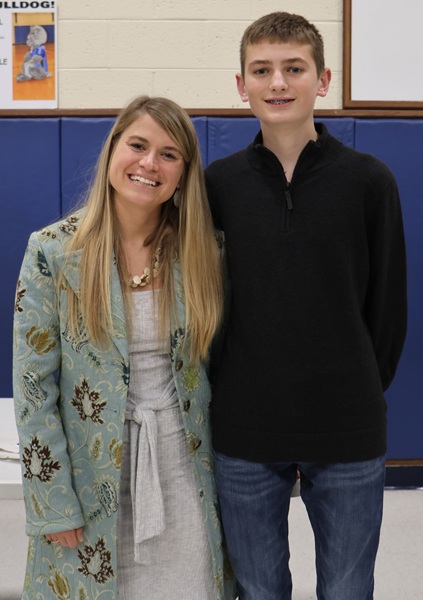
Fifth-year Centreville cross country coach Alicia Schmidtendorff stated that Hulin has some big goals he’s been working to attain since he joined the program back in middle school.
"Will has been running fantastic times this fall. He ran in some different races over the summer and came into this season with the mindset of going after some school records and placing among the top runners in the state. Last year he had to deal with a few injuries, so this is an exciting time for him,' said Schmidtendorff, who ran at Three Rivers High School and Spring Arbor University.
Centreville has more depth, especially on its boys team this season, prompting the Bulldogs to set a team goal of qualifying for the Finals. The Bulldogs' roster numbers 16 runners on the boys side and 13 on the girls.
"Our goal this year is to qualify as a team for state, and we might still accomplish that. It helps to have other guys with the same goals as I have. It pushes me to run faster and do whatever I can to help our team,” Hulin said. “I've been around most of these guys since elementary school. Our coaches have a good workout program for us every week. Everyone makes things fun at practice, and that's always enjoyable."
A quick start during the first mile of every race is a big part of Hulin's strategy.
"I always run my fastest in that first mile and it fades off from there, which I think is typical for most people,” Hulin said. “I like somewhat hilly courses, like the Big Hill Invite at Meyer-Broadway Park in Three Rivers. I really enjoyed that course because this year I was in better shape."
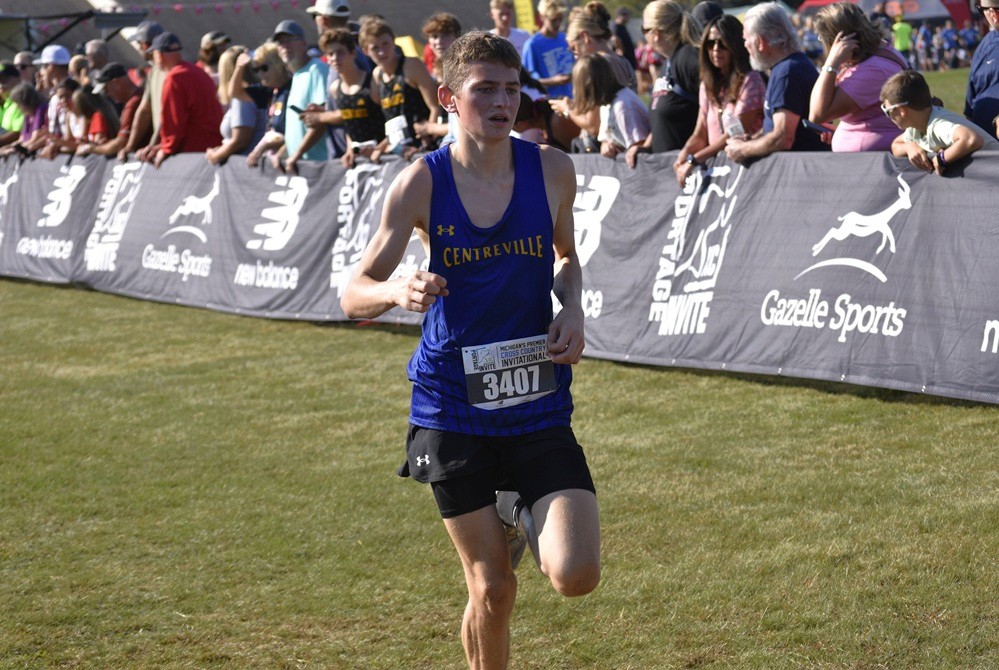
Hulin has turned in consistent times all season as the Bulldogs prepare for their most important meets over the next few weeks. Centreville’s No. 1 runner has finished first in eight of the Bulldogs' 13 races, including winning all three Southwest 10 Conference jamborees. He finished third in the Division 3 boys race at the prestigious Portage Invite on Oct. 4 with at time of 16:12.5. He clocked his all-time personal-best with a fourth-place time of 16:03.8 on Aug. 27 at the Southwest Michigan Rustbuster XC Invite at the Warner Camp in Grand Junction.
 "It's been exciting to see Will's mental and physical growth as a runner this season. He's a very driven person who puts the work in on his own schedule along with what we're doing in practice,” Schmidtendorff said. “Will is very good at communicating how much he's able or not able to handle during workouts. I like knowing as a coach where my athletes are (in terms of) what they are capable of handling each day."
"We have a lot of seniors who are great leaders, but also great racers,” she added. “There are also several young runners who have strong work ethics, and our upperclassmen have been very welcoming to them. This group knows they have to be competitive not only with opposing racers but also with people on their own team. It’s been beneficial to Will to have other guys on his team who can push him in practice. Everyone has their strong suits, and they know what it takes to get the job done. It's a team effort, and we have a coaching staff that has a competitive mindset."
Hulin's goals for the remainder of this season include winning his Regional, qualifying for MIS, earning all-state honors with a top-30 Finals finish, and breaking Logan Weis' 2022 school-record time of 16:01.9 in the 5,000-meter (3.1-mile) race.
"I just try and run as fast as I can every race. I'm chasing Logan's record every meet and getting close to breaking the 16-minute barrier and getting into the high 15s," Hulin said. "It would be really cool to win Regionals as a sophomore. I don't think that many people are aware of me yet."
Hulin feels his biggest strengths as a distance runner are his determination and endurance.
"I always approach every race with some sort of strategy depending on who I'm running against,” he said. “I already know most of the guys I am competing against, so I just try to plan out my strengths to work against their weaknesses.”
 Scott Hassinger is a contributing sportswriter for Leader Publications and previously served as the sports editor for the Three Rivers Commercial-News from 1994-2022. He can be reached at [email protected] with story ideas for Berrien, Cass, St. Joseph and Branch counties.
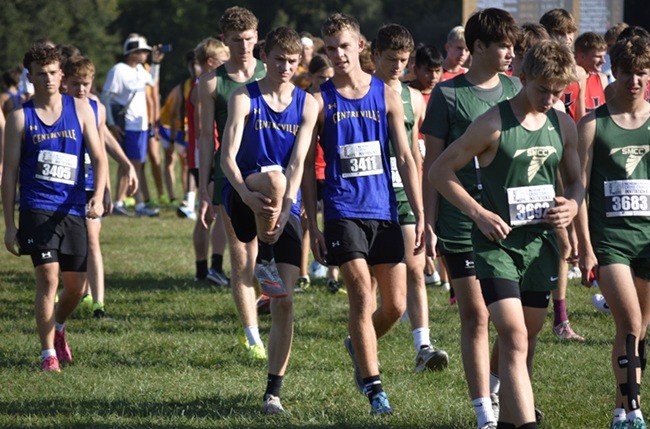
PHOTOS (Top) Centreville’s Will Hulin sprints the closing stretch Oct. 4 at the Portage Invitational. (Middle) Centreville cross country coach Alicia Schmidtendorff, left, is pictured with Hulin at the school's Fall Sports Media Day. (Below) Hulin stretches out prior to the start of the Division 3 boys race at Portage. (Race photos by Scott Hassinger. Media day photo courtesy of the Centreville athletic department.)