


4 Thrusts: In Motion, On Track in 2013-14
December 20, 2013
By Jack Roberts
MHSAA Executive Director
During the fall of 2012 at Update meetings across Michigan, we described “Four Thrusts for Four Years” – four health and safety emphases that would help us keep student-athletes healthier and also get a seat for Michigan’s policies and procedures for school sports on the train of best practices – an express train that is moving faster than we've ever seen it toward more cautious practice and play policies and more educational requirements for coaches.
At this December’s meeting, the MHSAA Representative Council examined a first quarter report card – what’s been accomplished during the first year.
It has been a remarkably strong start, but it’s only a start.
The first thrust, improving management of heat and humidity, received a boost last March when the Representative Council adopted a “Model Policy for Managing Heat and Humidity.” It has been promoted in print, online and at face-to-face meetings; and the response of schools has been nothing short of outstanding.
This rapid acceptance by school administrators and coaches reflects their appreciation for a clear policy that identifies the precise conditions that call for adjustments in activities, and lists specific actions to be taken when temperature and humidity combine to reach un-safe levels. Gut and guesswork are gone.
The second thrust, raising expectations for coaches’ preparedness, is being advanced in three ways.
In May, the Representative Council adopted the requirement that by the 2014-15 school year, schools must attest that, prior to established deadlines, all assistant and subvarsity coaches at the high school level have completed annually the same MHSAA rules meeting required by all varsity head coaches or, in the alternative, one of the free online sports safety courses posted on or linked to MHSAA.com and designated to fulfill this requirement. This popular change is only the first component of this critically important second thrust.
The second component is this. The Representative Council voted in December to require by 2015-16 that MHSAA member high schools certify that all of their varsity head coaches of high school teams have a valid (current) CPR certification, with AED training as a recommended component.
As this requirement was discussed at constituent meetings, the question was frequently raised: “Why just head coaches?”
“Why indeed,” is our response. If a school has the will and resources, it most certainly should make CPR a requirement of all its coaches, as some school districts have required for many years.
CPR training is conveniently available near almost every MHSAA member school in Michigan. Still, the MHSAA will begin offering CPR certification (with AED training) on an optional basis as an extension of Level 1 of the Coaches Advancement Program (CAP) during 2014-15.
The third component of this thrust is scheduled to go before the Representative Council in March. The proposal is that all individuals hired for the first time as a varsity head coach of a high school team, to begin those coaching duties after July 31, 2016, must have completed the Coaches Advancement Program (CAP) Level 1 or 2.
The MHSAA will track compliance and prohibit varsity head coaches from attending their teams’ MHSAA tournament contests if they fail to complete this requirement, beginning in the 2016-17 school year.
In cases of very late hiring, schools may substitute two online courses of the National Federation of State High School Associations – “Fundamentals of Coaching” and “First Aid, Health and Safety.” However, that coach must complete CAP Level 1 or 2 within six months of the hiring date.
These feel like big steps to some people in MHSAA member schools – “too expensive” or “another obstacle to finding qualified coaches,” some say; but these are baby steps.
This barely keeps pace with national trends. Michigan’s tradition of local control and its distaste for unfunded mandates has kept Michigan schools in neutral while schools in most other states have made multiple levels of coaching education, and even licensing or certification, standard operating procedure.
The three initiatives to upgrade coaches education in this critical area of health and safety over the next three years only nudges Michigan to a passing grade for what most parents and the public expect of our programs. We will still trail most other states, which continue to advance the grading curve.
And for a state association that is among the national leaders by almost every other measure, it is unacceptable to be below average in what is arguably the most important of all: promoting athlete health and safety by improving the preparation of coaches.
The third health and safety thrust is a focus on practice policies to improve acclimatization and to reduce head trauma; and the fourth thrust is a focus on game rules to reduce head trauma and to identify each sport’s most injurious situations and reduce their frequency.
Because of the critical attention to football on all levels, peewee to pros, our first focus has been to football with the appointment of a football task force which has effectively combined promotion of the sport’s safety record at the school level and its value to students, schools and communities with probing for ways to make the sport still safer.
The task force proposals for practice policies are receiving most attention and will receive Council action in March (and will be published on Second Half over the next few weeks). But the task force also has assisted MHSAA staff in developing promotional materials that are already in use, and the task force pointed MHSAA staff to playing rules that need emphasis or revision to keep school-based football as safe as possible.
During 2013-14, all MHSAA sport committees will be giving unprecedented time to the topics of the third and fourth thrusts and, when necessary, a task force will be appointed to supplement those sport committee efforts.
Frequently Asked Questions About CPR Certification
Q. Who is authorized to provide CPR certification?
A. The MHSAA does not dictate which organization must provide the CPR education and certification. However, the Michigan Department of Human Services lists the following organizations that are approved to provide CPR training:
- American CPR Training: www.americancpr.com
- American Heart Association: www.americanheart.org
- American Red Cross: www.redcross.org
- American Safety and Health Institute: www.hsi.com/ashi/about
- American Trauma Event Management: www.atem.us
- Cardio Pulmonary Resource Center: 517-543-9180
- Emergency Care and Safety Institute: www.ecsinstitute.org
- EMS Safety Services: www.emssafety.com
- Medic First Aid: www.medicfirstaid.com
- National Safety Council: www.nsc.org
- Pro CPR: www.procpr.org
Q.
A. $0 to $75.
Q. How long does certification take?
A. Two to five hours.
Q. How long does the certification last?
A. Generally, two years.
Q. Does the MHSAA specify the age level for the CPR training?
A. No. Generally, the course for adults alerts candidates of the necessary modifications for children and infants, and vice versa.
Hockey Star-Turned-Champion for School Sports to Receive MHSAA's Forsythe Award
By
Geoff Kimmerly
MHSAA.com senior editor
March 11, 2022
Once or twice a year, Bruce Horsch gets the question – mostly during a Winter Olympics year or after someone has watched “Miracle on Ice” and found out the “Horsch” that is mentioned twice is actually the recently-retired Houghton High School athletic director.
The final goaltender cut from the 1980 U.S. hockey team that went on to stun the world in winning Olympic gold, Horsch went on to coach at multiple college programs before becoming Houghton’s athletic director in 1996 at the age of 40.
These days, many also know him for the commitment, mentorship and leadership shown in that position through his retirement in 2019.
To celebrate his many contributions to interscholastic athletics, Horsch has been named the 2022 honoree for the Michigan High School Athletic Association’s Charles E. Forsythe Award.
 The annual award is in its 45th year and named after former MHSAA Executive Director Charles E. Forsythe, the Association's first full-time and longest-serving chief executive. Forsythe Award recipients are selected each year by the MHSAA Representative Council, based on an individual's outstanding contributions to the interscholastic athletics community.
Horsch was described as a “not in the spotlight guy” by one of those who recommended him for the Forsythe Award, but he certainly spent time there. Horsch was a college hockey star and NHL draft pick, and had begun his minor league hockey career before playing with the U.S. team right up until the final cuts on the way to Lake Placid, N.Y.
After his playing days concluded, he coached collegiately before eventually settling in as Houghton’s athletic director for the 1996-97 school year.
“I was fortunate enough to play at Michigan Tech, and I was on a national championship team (in 1975) and I was on a national runner-up team (in 1976). When you played for (coach) John MacInnes up here, it wasn’t individuals – although we had great individuals – we won because we were a team” Horsch said.
“I’m not out for recognition. I enjoy being part of a team. I enjoy working with other people, and that’s my satisfaction.”
He led many important ones in his roles as a school sports administrator.
Horsch was named his region’s Athletic Director of the Year in both 2003 and 2019 by the Michigan Interscholastic Athletic Administrators Association (MIAAA), and served on the Upper Peninsula Athletic Committee from 2001-05. He has been an active member of the MIAAA, National Interscholastic Athletic Administrators Association (NIAAA) and Upper Peninsula Athletic Directors Association (UPADA), serving as secretary and president of the UPADA.
He also served as president of the Keweenaw Area Athletic Directors Association and secretary and commissioner of the Western Peninsula Athletic Conference.
“For years Bruce was one of the most respected voices not only in the Upper Peninsula but also the entire state,” MHSAA Executive Director Mark Uyl said. “He brought that perspective as a high-end athlete and transitioned extremely well as an educator and athletic director.”
Horsch was a frequent host of MHSAA Tournaments at the District and Regional rounds during his time at Houghton, and also hosted MHSAA Upper Peninsula Finals. He served as a host for sessions of the MHSAA PACE program, the coaching education program predecessor to the current Coaches Advancement Program (CAP).
His dedication to Houghton athletics was further noted when he considered retiring in 2017 but stayed on two more years to assist with a bond that resulted in in the upgrading of the school’s football field and track and building of softball and baseball fields as part of the athletic complex. Previously, he had led a referendum to have a second gymnasium built to provide an additional practice venue with girls basketball moving from the fall to winter season beginning with the 2007-08 school year.
“I’m proud of the fact that in the U.P. there are not many, if any schools that have the facilities that Houghton High School has,” Horsch said.
Horsch is a graduate of Hastings High School in Minnesota and earned a bachelor’s degree in business administration from Michigan Technological University. He led the Huskies hockey team to 58 victories in goal over four seasons and was part of the 1975 NCAA championship team, two of many reasons he was inducted into the Michigan Tech Sports Hall of Fame in 2007. He was drafted by the Montreal Canadiens during the ninth round of the 1976 NHL draft and played minor league hockey for two seasons. He then coached hockey collegiately for most of the 1980s as an assistant at Ferris State and then Michigan Tech.
He has continued to serve his community as a member of the Rotary Club of Houghton.
Past recipients of the Charles E. Forsythe Award
1978 - Brick Fowler, Port Huron; Paul Smarks, Warren
1979 - Earl Messner, Reed City; Howard Beatty, Saginaw
1980 - Max Carey, Freesoil
1981 - Steven Sluka, Grand Haven; Samuel Madden, Detroit
1982 - Ernest Buckholz, Mt. Clemens; T. Arthur Treloar, Petoskey
1983 - Leroy Dues, Detroit; Richard Maher, Sturgis
1984 - William Hart, Marquette; Donald Stamats, Caro
1985 - John Cotton, Farmington; Robert James, Warren
1986 - William Robinson, Detroit; Irving Soderland, Norway
1987 - Jack Streidl, Plainwell; Wayne Hellenga, Decatur
1988 - Jack Johnson, Dearborn; Alan Williams, North Adams
1989 - Walter Bazylewicz, Berkley; Dennis Kiley, Jackson
1990 - Webster Morrison, Pickford; Herbert Quade, Benton Harbor
1991 - Clifford Buckmaster, Petoskey; Donald Domke, Northville
1992 - William Maskill, Kalamazoo; Thomas G. McShannock, Muskegon
1993 - Roy A. Allen Jr., Detroit; John Duncan, Cedarville
1994 - Kermit Ambrose, Royal Oak
1995 - Bob Perry, Lowell
1996 - Charles H. Jones, Royal Oak
1997 - Michael A. Foster, Richland; Robert G. Grimes, Battle Creek
1998 - Lofton C. Greene, River Rouge; Joseph J. Todey, Essexville
1999 - Bernie Larson, Battle Creek
2000 - Blake Hagman, Kalamazoo; Jerry Cvengros, Escanaba
2001 - Norm Johnson, Bangor; George Lovich, Canton
2002 - John Fundukian, Novi
2003 - Ken Semelsberger, Port Huron
2004 - Marco Marcet, Frankenmuth
2005 - Jim Feldkamp, Troy
2006 - Dan McShannock, Midland; Dail Prucka, Monroe
2007 - Keith Eldred, Williamston; Tom Hickman, Spring Lake
2008 - Jamie Gent, Haslett; William Newkirk, Sanford Meridian
2009 - Paul Ellinger, Cheboygan
2010 - Rudy Godefroidt, Hemlock; Mike Boyd, Waterford
2011 - Eric C. Federico, Trenton
2012 - Bill Mick, Midland
2013 - Jim Gilmore, Tecumseh; Dave Hutton, Grandville
2014 - Dan Flynn, Escanaba
2015 - Hugh Matson, Saginaw
2016 - Gary Hice, Petoskey; Gina Mazzolini, Lansing
2017 - Chuck Nurek, Rochester Hills
2018 - Gary Ellis, Allegan
2019 - Jim Derocher, Negaunee; Fredrick J. Smith, Stevensville
2020 - Michael Garvey, Lawton
2021 – Leroy Hackley Jr., Byron Center; Patti Tibaldi, Traverse City
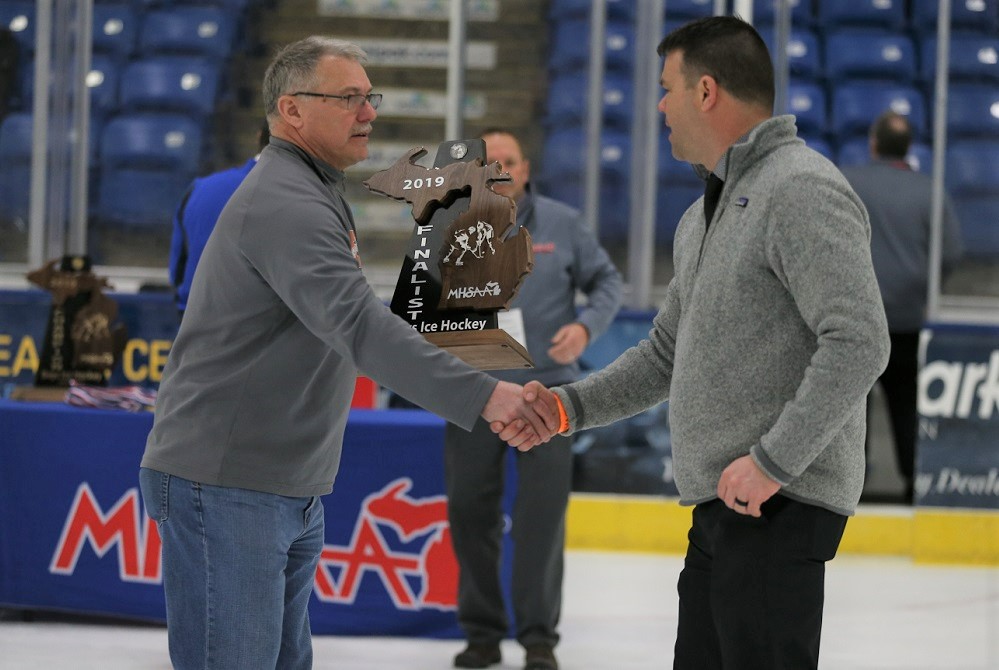
PHOTO: Houghton athletic director Bruce Horsch, left, hands coach Corey Markham the Division 3 finalist trophy after the Gremlins finished Division 3 hockey runners-up in 2019.