

4 Thrusts: In Motion, On Track in 2013-14
December 20, 2013
By Jack Roberts
MHSAA Executive Director
During the fall of 2012 at Update meetings across Michigan, we described “Four Thrusts for Four Years” – four health and safety emphases that would help us keep student-athletes healthier and also get a seat for Michigan’s policies and procedures for school sports on the train of best practices – an express train that is moving faster than we've ever seen it toward more cautious practice and play policies and more educational requirements for coaches.
At this December’s meeting, the MHSAA Representative Council examined a first quarter report card – what’s been accomplished during the first year.
It has been a remarkably strong start, but it’s only a start.
The first thrust, improving management of heat and humidity, received a boost last March when the Representative Council adopted a “Model Policy for Managing Heat and Humidity.” It has been promoted in print, online and at face-to-face meetings; and the response of schools has been nothing short of outstanding.
This rapid acceptance by school administrators and coaches reflects their appreciation for a clear policy that identifies the precise conditions that call for adjustments in activities, and lists specific actions to be taken when temperature and humidity combine to reach un-safe levels. Gut and guesswork are gone.
The second thrust, raising expectations for coaches’ preparedness, is being advanced in three ways.
In May, the Representative Council adopted the requirement that by the 2014-15 school year, schools must attest that, prior to established deadlines, all assistant and subvarsity coaches at the high school level have completed annually the same MHSAA rules meeting required by all varsity head coaches or, in the alternative, one of the free online sports safety courses posted on or linked to MHSAA.com and designated to fulfill this requirement. This popular change is only the first component of this critically important second thrust.
The second component is this. The Representative Council voted in December to require by 2015-16 that MHSAA member high schools certify that all of their varsity head coaches of high school teams have a valid (current) CPR certification, with AED training as a recommended component.
As this requirement was discussed at constituent meetings, the question was frequently raised: “Why just head coaches?”
“Why indeed,” is our response. If a school has the will and resources, it most certainly should make CPR a requirement of all its coaches, as some school districts have required for many years.
CPR training is conveniently available near almost every MHSAA member school in Michigan. Still, the MHSAA will begin offering CPR certification (with AED training) on an optional basis as an extension of Level 1 of the Coaches Advancement Program (CAP) during 2014-15.
The third component of this thrust is scheduled to go before the Representative Council in March. The proposal is that all individuals hired for the first time as a varsity head coach of a high school team, to begin those coaching duties after July 31, 2016, must have completed the Coaches Advancement Program (CAP) Level 1 or 2.
The MHSAA will track compliance and prohibit varsity head coaches from attending their teams’ MHSAA tournament contests if they fail to complete this requirement, beginning in the 2016-17 school year.
In cases of very late hiring, schools may substitute two online courses of the National Federation of State High School Associations – “Fundamentals of Coaching” and “First Aid, Health and Safety.” However, that coach must complete CAP Level 1 or 2 within six months of the hiring date.
These feel like big steps to some people in MHSAA member schools – “too expensive” or “another obstacle to finding qualified coaches,” some say; but these are baby steps.
This barely keeps pace with national trends. Michigan’s tradition of local control and its distaste for unfunded mandates has kept Michigan schools in neutral while schools in most other states have made multiple levels of coaching education, and even licensing or certification, standard operating procedure.
The three initiatives to upgrade coaches education in this critical area of health and safety over the next three years only nudges Michigan to a passing grade for what most parents and the public expect of our programs. We will still trail most other states, which continue to advance the grading curve.
And for a state association that is among the national leaders by almost every other measure, it is unacceptable to be below average in what is arguably the most important of all: promoting athlete health and safety by improving the preparation of coaches.
The third health and safety thrust is a focus on practice policies to improve acclimatization and to reduce head trauma; and the fourth thrust is a focus on game rules to reduce head trauma and to identify each sport’s most injurious situations and reduce their frequency.
Because of the critical attention to football on all levels, peewee to pros, our first focus has been to football with the appointment of a football task force which has effectively combined promotion of the sport’s safety record at the school level and its value to students, schools and communities with probing for ways to make the sport still safer.
The task force proposals for practice policies are receiving most attention and will receive Council action in March (and will be published on Second Half over the next few weeks). But the task force also has assisted MHSAA staff in developing promotional materials that are already in use, and the task force pointed MHSAA staff to playing rules that need emphasis or revision to keep school-based football as safe as possible.
During 2013-14, all MHSAA sport committees will be giving unprecedented time to the topics of the third and fourth thrusts and, when necessary, a task force will be appointed to supplement those sport committee efforts.
Frequently Asked Questions About CPR Certification
Q. Who is authorized to provide CPR certification?
A. The MHSAA does not dictate which organization must provide the CPR education and certification. However, the Michigan Department of Human Services lists the following organizations that are approved to provide CPR training:
- American CPR Training: www.americancpr.com
- American Heart Association: www.americanheart.org
- American Red Cross: www.redcross.org
- American Safety and Health Institute: www.hsi.com/ashi/about
- American Trauma Event Management: www.atem.us
- Cardio Pulmonary Resource Center: 517-543-9180
- Emergency Care and Safety Institute: www.ecsinstitute.org
- EMS Safety Services: www.emssafety.com
- Medic First Aid: www.medicfirstaid.com
- National Safety Council: www.nsc.org
- Pro CPR: www.procpr.org
Q.
A. $0 to $75.
Q. How long does certification take?
A. Two to five hours.
Q. How long does the certification last?
A. Generally, two years.
Q. Does the MHSAA specify the age level for the CPR training?
A. No. Generally, the course for adults alerts candidates of the necessary modifications for children and infants, and vice versa.
Vicksburg AD Roy Honored Nationally for Service to School Sports
By
Pam Shebest
Special for MHSAA.com
February 15, 2022
VICKSBURG — Accepting an award on a national stage is an impressive feat for any athletic director.
 But it was even more special for Vicksburg AD Mike Roy, who shared that stage with his mentor and good buddy.
While Roy was presented a Distinguished Service Award from the National Interscholastic Athletic Administrators Association in December, retired AD Mike Garvey was inducted into its Hall of Fame.
“This award from the NIAAA was exceptionally special to me because Mike got inducted the very same night into the NIAAA Hall of Fame,” Roy said.
“To be able to receive that award with someone who means so much to me and has guided me and been so influential in my career was the icing on the top, the cherry.”
Garvey said to be mentioned as Roy’s mentor “is an amazing compliment. When the Hall of Fame asked me to send some photos, I had to have him in one.”
The two men first connected 23 years ago when Garvey left Lawton High School for the AD’s job in Delton. Roy filled the Lawton position.
“Mike took me under his wing,” Roy said. “He introduced me to another great friend, Fred Smith.
“Just a couple guys who are awesome gentlemen who are recognized throughout the country.”
Garvey reflects that admiration.
“Mike Roy has been recognized in Michigan and it’s time the rest of the country knows how great he is.” Garvey said.
“It was wonderful to share the stage with him. He’s a high-energy person who attacks everything with vigor. He gets things done.”
Two years ago, Roy received the MHSAA’s Allen W. Bush for service, prompting a Roy-like comment.
“With my joking, sarcastic system, I said to myself, ‘I must be getting old because I’m starting to get these awards and being recognized for it,’” he said.
“But, really, upon hearing it, you just sit back and are really taken aback and humbled by it.”
Rooted in Paw Paw
Roy started his athletic career in Paw Paw with football, basketball, baseball and track in high school.
After turning down offers from Division III schools, Roy accepted a football scholarship to University of Nevada, Las Vegas, which was an eye-opener.
“I found out very quickly when I got to UNLV to play football that I was no longer the big fish in the pond,” he said. “I was a very small fish in a very big pond.
“Going to UNLV forced me to grow up. Sometimes when reality smacks you in the face, it kind of wakes you up.”
That experience helps him guide high school athletes today.
 “Looking back now, there are some things I wish I had done on the academic side of it,” he said. “I wasn’t a great student; I wasn’t a terrible student. I wish I had done better.
“My career goal at that time, wishful as it was, was to be an NFL player.”
At UNLV, Roy earned a bachelor’s degree in physical education and health with an endorsement in driver’s education and a master’s in instructional and curricular studies.
Once back in Michigan, Roy coached golf and strength and conditioning at Kalamazoo Valley Community College, taught strength classes at Western Michigan University and was an assistant to Kalamazoo College men’s basketball coach Joe Hacklin.
Roy applied for a job at Vicksburg High School — which he did not get.
Instead, he was hired to replace Garvey at Lawton, also teaching strength and conditioning, and coaching varsity basketball.
Three years later, Roy became AD at Vicksburg, a job he has had for the last 20 years.
Accolades began piling up, including the certified master athletic administrator designation from the NIAAA in 2005, Michigan Interscholastic Athletic Administrator Association (MIAAA) Athletic Director of the Year in 2012, MIAAA president in 2019-20, NIAAA delegate at the National Federation of State High School Associations (NFHS) national conference for 10 years and being named a finalist for National Athletic Director of the Year from the National High School Coaches Association.
At the NHSCA ceremony, Roy said he noticed one of the other finalists.
“One of the guys, when I looked, I said ‘Oh my gosh. He’s been an AD for 45 years.’
“Here I’m sitting with not even half that under my belt, wondering if I’m going to get 45 years in.”
Ever humble, Roy makes a point several times of mentioning that any award he receives is a culmination of efforts from a great support staff.
“I tell people in my joking way, ‘It’s my ugly face that gets the award, but when people come to Vicksburg they meet my ticket-taker or see my game management is on point,” he said.
“I wouldn’t be able to get half this stuff if I didn’t have the athletic secretary (Rhonda VanderKamp) I have. She’s phenomenal.”
VanderKamp, who has worked with Roy all 20 years, said they work well together.
As for sharing in any awards, “I’m honored but truly he deserves those awards,” she said. “We just complement each other.
“I’m so honored when I attend some of the conferences and they go around the room and ask you how many years you’ve been an athletic secretary and how many ADs have you been through. I can say only just one. It’s awesome.”
Showing off a great home
Under Roy, Vicksburg has hosted more than 100 MHSAA postseason events, and he takes pride in the workers and facilities.
“I’ve always been big on the appearance of our facilities,” he said. “Unfortunately, the outside community doesn’t get to see our library. They don’t get to see our science labs and all the other wonderful things we have going on in the building.
“When they come to Vicksburg, they’re drawing their assumptions on how they’re treated when they walk through the gate, how do the facilities look, are the trash cans overflowing, are things broken.”
He said when the MHSAA asks or looks for people to step up and host tournaments, “We have always been willing to do that. I ask our people and they say yes, we want to bring people to Vicksburg and show off our facilities.”
 Roy also implements ideas he hears at various conferences.
“I always try to network and find out who’s doing something better than I’m doing and borrow that,” he said. “The neat thing about athletic directors in our association is we’re willing to share everything.
“We’re different than coaches who have a secret play or a playbook and don’t want anybody to know those plays.”
He noted that not everyone is cut out to be an athletic director.
“Most think all I do is sit around and eat popcorn, a hot dog and watch contests and how cool that is,” he said, laughing.
He said they do not see the contact with officials and support staff, refilling of concession supplies, setting up transportation to away games, notifying parents of any changes or problems and working on game schedules for next year.
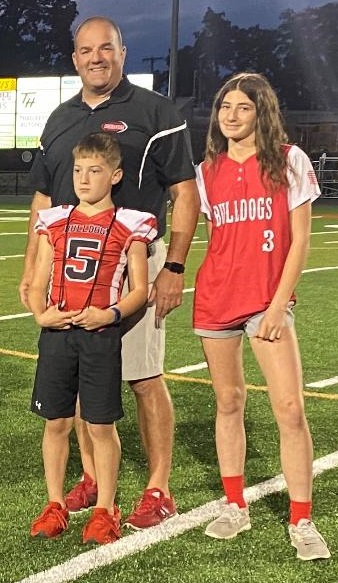
As for non-AD duties, Roy spends time with his two children: Harper, a 5-foot-8 seventh grader whom he coaches on a 12-and-under softball team; and Ryker, a fourth grader involved in football, basketball, wrestling and baseball.
Doing things the right way
Roy said former Gull Lake AD Mike Foster helped craft his philosophy that high school sports are more than just winning.
“To me, in high school educational athletics, we’re here to grow the whole child and just not teach him how to win,” he said.
“I’m hiring my coaches who are going to be the best role models for my kids. We do want to win, because it’s important, but it’s not the ultimate goal for me.”
Speaking of coaches, Roy noted that his mentor is now an employee.
“Funny thing,” he said. “Mike Garvey’s my golf coach here. I always try to surround myself with some talented individuals.”
Garvey said Roy is the only reason he agreed to coach the boys golf team, and he would not consider doing it for anyone else.
“With his coaches, they’re a family and he’s like the patriarch who shows a lot of love and respect,” Garvey said.
***
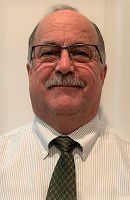 Garvey was one of 10 inductees making up the 13th class of the NIAAA Hall of Fame honored in December. Garvey served as an athletic administrator for 24 years through 2018 with stops at Lawton, Delton Kellogg, Otsego and Kalamazoo Hackett Catholic Prep. He received the MHSAA’s Allen W. Bush Award in 2015 and Charles E. Forsythe Award in 2020. He also was an assistant coach on two MHSAA Finals wrestling championship teams and as head coach led Lawton to the Class D title in 1990.
Garvey has been an active member of both the MIAAA and NIAAA and the Michigan Wrestling Coaches Association, and a member of the faculty for the NIAAA’s Leadership Training Institute while also serving as Michigan’s coordinator for the program. In retirement, he has continued to contribute to school sports in a variety of other ways as well including as a meet manager of the MHSAA’s Team Wrestling Finals at Wings Event Center in Kalamazoo.
Among additional accolades at the state and national levels, Garvey received the NIAAA’s 2016 Distinguished Service Award and the George Lovich State Award of Merit in 2009 from the MIAAA.
 Pam Shebest served as a sportswriter at the Kalamazoo Gazette from 1985-2009 after 11 years part-time with the Gazette while teaching French and English at White Pigeon High School. She can be reached at [email protected] with story ideas for Calhoun, Kalamazoo and Van Buren counties.
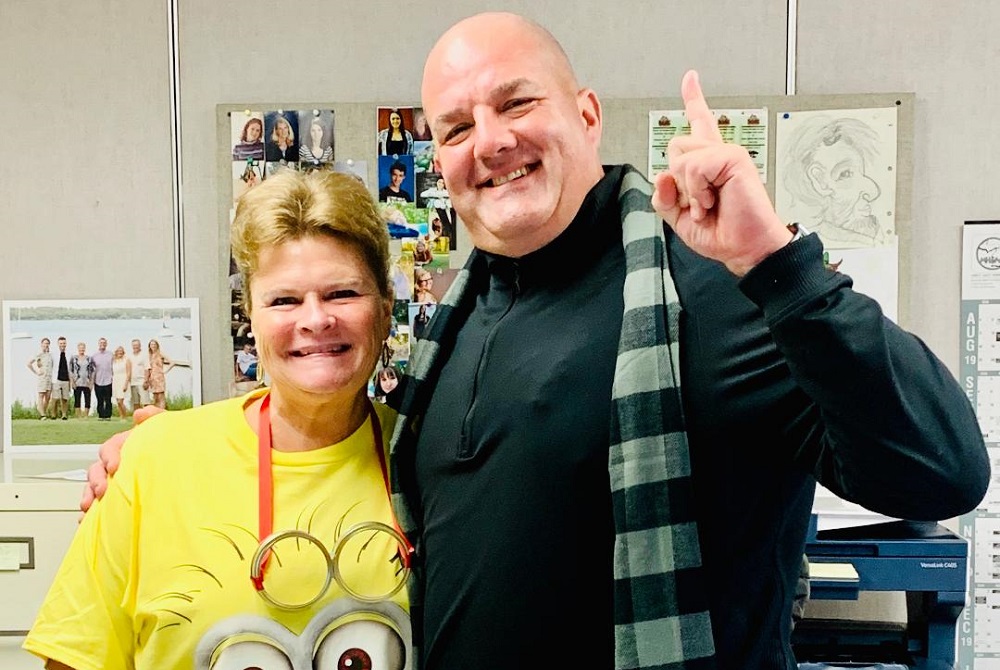
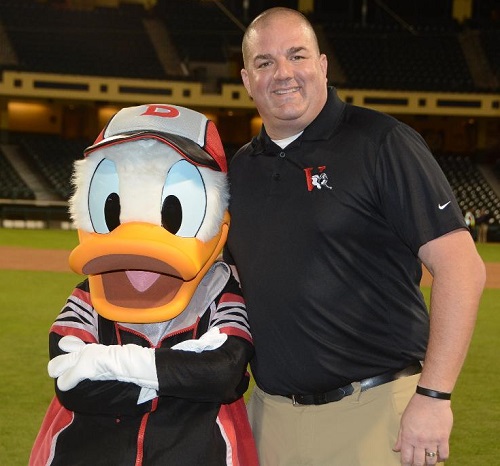
PHOTOS (Top) Vicksburg athletic director Mike Roy gives much credit to his secretary Rhonda VanderKamp, his assistant during the entirety of his two decades at the school. (Middle) Roy takes a minute to take a photo with Donald Duck during a conference in Orlando, Fla. (Below) Roy and his children Harper and Ryker await the presentation of his MHSAA’s Allen W. Bush Award. (Photos courtesy of Mike Roy.)