


4 Thrusts: In Motion, On Track in 2013-14
December 20, 2013
By Jack Roberts
MHSAA Executive Director
During the fall of 2012 at Update meetings across Michigan, we described “Four Thrusts for Four Years” – four health and safety emphases that would help us keep student-athletes healthier and also get a seat for Michigan’s policies and procedures for school sports on the train of best practices – an express train that is moving faster than we've ever seen it toward more cautious practice and play policies and more educational requirements for coaches.
At this December’s meeting, the MHSAA Representative Council examined a first quarter report card – what’s been accomplished during the first year.
It has been a remarkably strong start, but it’s only a start.
The first thrust, improving management of heat and humidity, received a boost last March when the Representative Council adopted a “Model Policy for Managing Heat and Humidity.” It has been promoted in print, online and at face-to-face meetings; and the response of schools has been nothing short of outstanding.
This rapid acceptance by school administrators and coaches reflects their appreciation for a clear policy that identifies the precise conditions that call for adjustments in activities, and lists specific actions to be taken when temperature and humidity combine to reach un-safe levels. Gut and guesswork are gone.
The second thrust, raising expectations for coaches’ preparedness, is being advanced in three ways.
In May, the Representative Council adopted the requirement that by the 2014-15 school year, schools must attest that, prior to established deadlines, all assistant and subvarsity coaches at the high school level have completed annually the same MHSAA rules meeting required by all varsity head coaches or, in the alternative, one of the free online sports safety courses posted on or linked to MHSAA.com and designated to fulfill this requirement. This popular change is only the first component of this critically important second thrust.
The second component is this. The Representative Council voted in December to require by 2015-16 that MHSAA member high schools certify that all of their varsity head coaches of high school teams have a valid (current) CPR certification, with AED training as a recommended component.
As this requirement was discussed at constituent meetings, the question was frequently raised: “Why just head coaches?”
“Why indeed,” is our response. If a school has the will and resources, it most certainly should make CPR a requirement of all its coaches, as some school districts have required for many years.
CPR training is conveniently available near almost every MHSAA member school in Michigan. Still, the MHSAA will begin offering CPR certification (with AED training) on an optional basis as an extension of Level 1 of the Coaches Advancement Program (CAP) during 2014-15.
The third component of this thrust is scheduled to go before the Representative Council in March. The proposal is that all individuals hired for the first time as a varsity head coach of a high school team, to begin those coaching duties after July 31, 2016, must have completed the Coaches Advancement Program (CAP) Level 1 or 2.
The MHSAA will track compliance and prohibit varsity head coaches from attending their teams’ MHSAA tournament contests if they fail to complete this requirement, beginning in the 2016-17 school year.
In cases of very late hiring, schools may substitute two online courses of the National Federation of State High School Associations – “Fundamentals of Coaching” and “First Aid, Health and Safety.” However, that coach must complete CAP Level 1 or 2 within six months of the hiring date.
These feel like big steps to some people in MHSAA member schools – “too expensive” or “another obstacle to finding qualified coaches,” some say; but these are baby steps.
This barely keeps pace with national trends. Michigan’s tradition of local control and its distaste for unfunded mandates has kept Michigan schools in neutral while schools in most other states have made multiple levels of coaching education, and even licensing or certification, standard operating procedure.
The three initiatives to upgrade coaches education in this critical area of health and safety over the next three years only nudges Michigan to a passing grade for what most parents and the public expect of our programs. We will still trail most other states, which continue to advance the grading curve.
And for a state association that is among the national leaders by almost every other measure, it is unacceptable to be below average in what is arguably the most important of all: promoting athlete health and safety by improving the preparation of coaches.
The third health and safety thrust is a focus on practice policies to improve acclimatization and to reduce head trauma; and the fourth thrust is a focus on game rules to reduce head trauma and to identify each sport’s most injurious situations and reduce their frequency.
Because of the critical attention to football on all levels, peewee to pros, our first focus has been to football with the appointment of a football task force which has effectively combined promotion of the sport’s safety record at the school level and its value to students, schools and communities with probing for ways to make the sport still safer.
The task force proposals for practice policies are receiving most attention and will receive Council action in March (and will be published on Second Half over the next few weeks). But the task force also has assisted MHSAA staff in developing promotional materials that are already in use, and the task force pointed MHSAA staff to playing rules that need emphasis or revision to keep school-based football as safe as possible.
During 2013-14, all MHSAA sport committees will be giving unprecedented time to the topics of the third and fourth thrusts and, when necessary, a task force will be appointed to supplement those sport committee efforts.
Frequently Asked Questions About CPR Certification
Q. Who is authorized to provide CPR certification?
A. The MHSAA does not dictate which organization must provide the CPR education and certification. However, the Michigan Department of Human Services lists the following organizations that are approved to provide CPR training:
- American CPR Training: www.americancpr.com
- American Heart Association: www.americanheart.org
- American Red Cross: www.redcross.org
- American Safety and Health Institute: www.hsi.com/ashi/about
- American Trauma Event Management: www.atem.us
- Cardio Pulmonary Resource Center: 517-543-9180
- Emergency Care and Safety Institute: www.ecsinstitute.org
- EMS Safety Services: www.emssafety.com
- Medic First Aid: www.medicfirstaid.com
- National Safety Council: www.nsc.org
- Pro CPR: www.procpr.org
Q.
A. $0 to $75.
Q. How long does certification take?
A. Two to five hours.
Q. How long does the certification last?
A. Generally, two years.
Q. Does the MHSAA specify the age level for the CPR training?
A. No. Generally, the course for adults alerts candidates of the necessary modifications for children and infants, and vice versa.
Accomplished College Coach Giving Back to HS Track at Salem
By
Doug Donnelly
Special for MHSAA.com
April 23, 2021
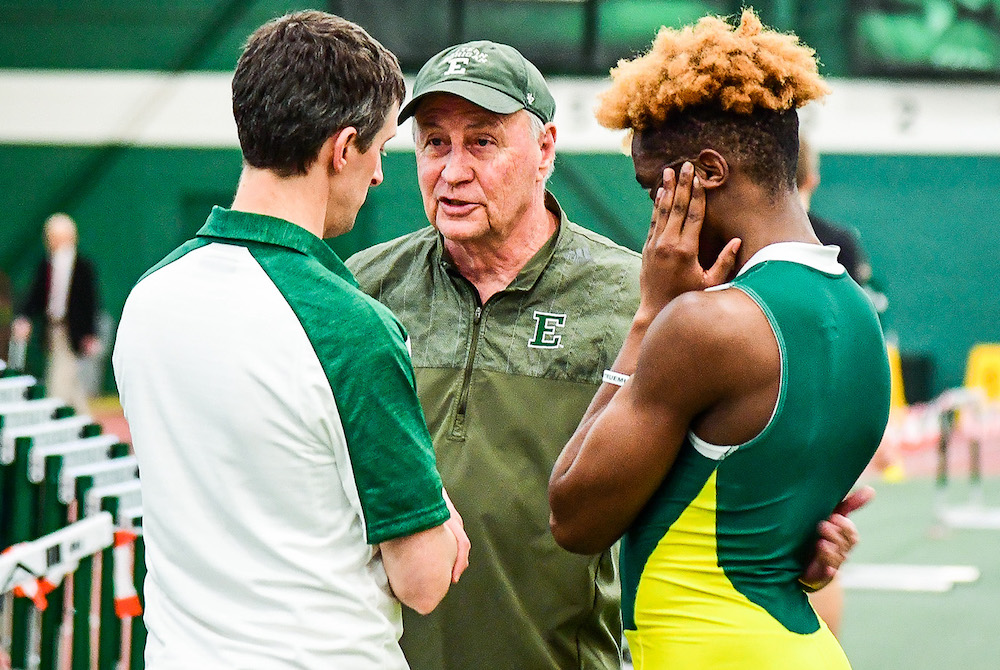
PINCKNEY – John Goodridge has coached athletes of just about every level imaginable.
"My passion for coaching is just as high as ever,” said Goodridge, 72, recently named the head boys track & field coach at Salem High School in Canton. “It’s been fun. You really do come full circle.”
It’s been a tremendous coaching journey over the past 50 years for Goodridge, a New York City native. It was not long after retiring from Eastern Michigan University in the fall that Goodridge got the coaching bug again. It started when he began attending cross country meets in the Ann Arbor area. Soon he realized he wanted to continue coaching and spoke to one of his former EMU athletes who was coaching at Salem and had found out the job as boys track coach was going to be open.
"At some point, late in my career, I had the notion that someday I’d come back and coach high school, where it all started,” Goodridge said. “In the fall, after I retired, an EMU alum who coached at Pinckney High School invited me to his home opening cross country meet.
"It was enough being out there and seeing the young kids that it brought me back to 40-50 years ago. I spent the fall, every week, going to various local cross country meets. Just observing, just to see if I thought it was something I wanted to do.”
Ultimately, Salem athletic director Tim Baechler hired Goodridge, who has an incredible resume as a track & field and cross country coach. From coaching Olympic athletes to the United States team at the World University Cross Country Championships in Austria, Goodridge has coached world class athletes and NCAA championship-level contenders for decades.
High school coaches have always had a special place in Goodridge’s heart. One reason is he interacted with coaches from across the country while recruiting athletes to compete for him at Michigan State University (1979-1982), Wake Forest University (1984-1999) and Eastern Michigan (2001-2020). Another reason is that he started out coaching at that level.
"It’s natural,” he said. “A lot of people think college is a higher level and that kind of stuff, but I’ve always told people that being a high school coach is such an important role and opportunity to work with young people.
"In many cases it’s the most special relationship. A high school coach sets the tone. You are introducing the sport to young kids. That’s quite a responsibility.”
Goodridge graduated from Long Island University in 1972. He and wife Francie (Kraker) met in the northeast while working for a shoe company. They returned to her native Ann Arbor while she was an elite world class athlete. Francie ran on U.S. Olympic teams in 1968 and 1972 and owned a world record in 1967.
While in grad school, Francie was offered the position of track coach at Ann Arbor Huron but couldn’t accept it because she was still an amateur athlete and couldn’t profit from that status and remain eligible for the Olympics.
Instead, she suggested to the Huron athletic director that the school hire her husband. His coaching career was launched.
"We were two young people, trying to get through school on part-time jobs,” Goodridge said. “We didn’t even have a car. (Coaching) was a source of income.”
While coaching high school track, they also coached younger athletes on club squads, before moving to the University of Wisconsin-Milwaukee where they both were hired as coaches – Francie as the women’s track coach and John the men’s. After a short stint there, they returned to Ann Arbor and both took on roles at Ann Arbor Greenhills.
Both coached for years. Goodridge had a long tenure at Wake Forest, coaching both cross country and track & field at a time when the Demon Deacons had unparalleled success in school history with 14 individual Atlantic Coast Conference champions and seven All-Americans. Francie coached at Wake Forest as well.
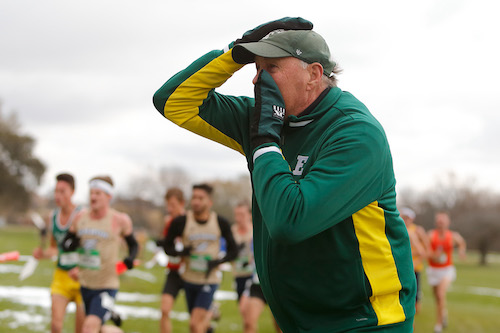
The couple returned to Michigan in the early 2000s, with Goodridge taking over the Eastern Michigan cross country program and serving as an assistant track coach. He later became the head track coach. During his time at Ypsilanti, he directed numerous Eagles squads in both sports to conference titles. During his distinguished career, he coached conference cross country championship teams in the Mid-American, Big Ten and Atlantic Coast Conferences. He was the MAC Coach of the Year 13 times in cross country and coached 22 NCAA track & field All-Americans.
This season he has more than 100 athletes on the Salem boys track & field team. He’s having a blast with it, especially with the freshmen athletes who are just starting out learning about track.
"Some of them may not be the most talented, natural athletes but they want to be part of the team,” he said. “They might not be able to make another team, but they want to be involved in athletics and be on a team. It’s been very intellectually challenging and inspiring to come up with new things for ninth graders, to make it fun and not let them get discouraged.
"They put a smile on my face just about every day. I hope it’s going to be keep me a young 72 and a young 73 and as long as I keep doing this.”
Goodridge also is building relationships with other area coaches. He’s not been afraid to seek out advice.
It’s been a long time since I designed workouts for the young ones,” he said. “It’s fun to sort it out, to my own approach to training, with that age group. All athletes respond differently to training and intensity and what you give them. The age of the athlete is a factor in that. It’s been a long time since I had experience working with freshmen. That’s been fun.”
 Doug Donnelly has served as a sports and news reporter and city editor over 25 years, writing for the Daily Chief-Union in Upper Sandusky, Ohio from 1992-1995, the Monroe Evening News from 1995-2012 and the Adrian Daily Telegram since 2013. He's also written a book on high school basketball in Monroe County and compiles record books for various schools in southeast Michigan. E-mail him at [email protected] with story ideas for Jackson, Washtenaw, Hillsdale, Lenawee and Monroe counties.
PHOTOS: (Top) John Goodridge, center, retired in the fall from coaching the men’s track & field team at Eastern Michigan University. (Middle) Goodridge also served as coach of the men’s cross country team. (Photos courtesy of the EMU athletic department.)