

4 Thrusts: In Motion, On Track in 2013-14
December 20, 2013
By Jack Roberts
MHSAA Executive Director
During the fall of 2012 at Update meetings across Michigan, we described “Four Thrusts for Four Years” – four health and safety emphases that would help us keep student-athletes healthier and also get a seat for Michigan’s policies and procedures for school sports on the train of best practices – an express train that is moving faster than we've ever seen it toward more cautious practice and play policies and more educational requirements for coaches.
At this December’s meeting, the MHSAA Representative Council examined a first quarter report card – what’s been accomplished during the first year.
It has been a remarkably strong start, but it’s only a start.
The first thrust, improving management of heat and humidity, received a boost last March when the Representative Council adopted a “Model Policy for Managing Heat and Humidity.” It has been promoted in print, online and at face-to-face meetings; and the response of schools has been nothing short of outstanding.
This rapid acceptance by school administrators and coaches reflects their appreciation for a clear policy that identifies the precise conditions that call for adjustments in activities, and lists specific actions to be taken when temperature and humidity combine to reach un-safe levels. Gut and guesswork are gone.
The second thrust, raising expectations for coaches’ preparedness, is being advanced in three ways.
In May, the Representative Council adopted the requirement that by the 2014-15 school year, schools must attest that, prior to established deadlines, all assistant and subvarsity coaches at the high school level have completed annually the same MHSAA rules meeting required by all varsity head coaches or, in the alternative, one of the free online sports safety courses posted on or linked to MHSAA.com and designated to fulfill this requirement. This popular change is only the first component of this critically important second thrust.
The second component is this. The Representative Council voted in December to require by 2015-16 that MHSAA member high schools certify that all of their varsity head coaches of high school teams have a valid (current) CPR certification, with AED training as a recommended component.
As this requirement was discussed at constituent meetings, the question was frequently raised: “Why just head coaches?”
“Why indeed,” is our response. If a school has the will and resources, it most certainly should make CPR a requirement of all its coaches, as some school districts have required for many years.
CPR training is conveniently available near almost every MHSAA member school in Michigan. Still, the MHSAA will begin offering CPR certification (with AED training) on an optional basis as an extension of Level 1 of the Coaches Advancement Program (CAP) during 2014-15.
The third component of this thrust is scheduled to go before the Representative Council in March. The proposal is that all individuals hired for the first time as a varsity head coach of a high school team, to begin those coaching duties after July 31, 2016, must have completed the Coaches Advancement Program (CAP) Level 1 or 2.
The MHSAA will track compliance and prohibit varsity head coaches from attending their teams’ MHSAA tournament contests if they fail to complete this requirement, beginning in the 2016-17 school year.
In cases of very late hiring, schools may substitute two online courses of the National Federation of State High School Associations – “Fundamentals of Coaching” and “First Aid, Health and Safety.” However, that coach must complete CAP Level 1 or 2 within six months of the hiring date.
These feel like big steps to some people in MHSAA member schools – “too expensive” or “another obstacle to finding qualified coaches,” some say; but these are baby steps.
This barely keeps pace with national trends. Michigan’s tradition of local control and its distaste for unfunded mandates has kept Michigan schools in neutral while schools in most other states have made multiple levels of coaching education, and even licensing or certification, standard operating procedure.
The three initiatives to upgrade coaches education in this critical area of health and safety over the next three years only nudges Michigan to a passing grade for what most parents and the public expect of our programs. We will still trail most other states, which continue to advance the grading curve.
And for a state association that is among the national leaders by almost every other measure, it is unacceptable to be below average in what is arguably the most important of all: promoting athlete health and safety by improving the preparation of coaches.
The third health and safety thrust is a focus on practice policies to improve acclimatization and to reduce head trauma; and the fourth thrust is a focus on game rules to reduce head trauma and to identify each sport’s most injurious situations and reduce their frequency.
Because of the critical attention to football on all levels, peewee to pros, our first focus has been to football with the appointment of a football task force which has effectively combined promotion of the sport’s safety record at the school level and its value to students, schools and communities with probing for ways to make the sport still safer.
The task force proposals for practice policies are receiving most attention and will receive Council action in March (and will be published on Second Half over the next few weeks). But the task force also has assisted MHSAA staff in developing promotional materials that are already in use, and the task force pointed MHSAA staff to playing rules that need emphasis or revision to keep school-based football as safe as possible.
During 2013-14, all MHSAA sport committees will be giving unprecedented time to the topics of the third and fourth thrusts and, when necessary, a task force will be appointed to supplement those sport committee efforts.
Frequently Asked Questions About CPR Certification
Q. Who is authorized to provide CPR certification?
A. The MHSAA does not dictate which organization must provide the CPR education and certification. However, the Michigan Department of Human Services lists the following organizations that are approved to provide CPR training:
- American CPR Training: www.americancpr.com
- American Heart Association: www.americanheart.org
- American Red Cross: www.redcross.org
- American Safety and Health Institute: www.hsi.com/ashi/about
- American Trauma Event Management: www.atem.us
- Cardio Pulmonary Resource Center: 517-543-9180
- Emergency Care and Safety Institute: www.ecsinstitute.org
- EMS Safety Services: www.emssafety.com
- Medic First Aid: www.medicfirstaid.com
- National Safety Council: www.nsc.org
- Pro CPR: www.procpr.org
Q.
A. $0 to $75.
Q. How long does certification take?
A. Two to five hours.
Q. How long does the certification last?
A. Generally, two years.
Q. Does the MHSAA specify the age level for the CPR training?
A. No. Generally, the course for adults alerts candidates of the necessary modifications for children and infants, and vice versa.
Frankfort Hoops Staff Bolstered by Past Stars Giving Back in Banktson, Kreski
By
Tom Spencer
Special for MHSAA.com
July 18, 2023
Veteran Frankfort girls basketball coach Tim Reznich will have a couple of true superstars on his bench this winter.
 They don’t have MHSAA eligibility remaining, but they should really help the Panthers. They’ve used up their college eligibility as well.
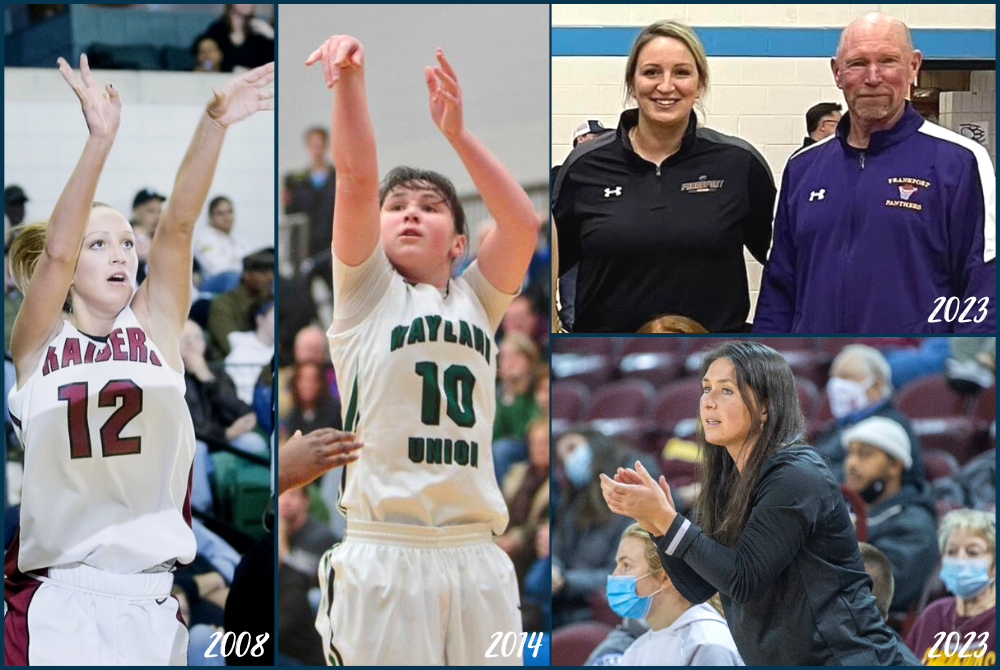
They are Lindsey (Pettit) Banktson, a 2008 graduate of Portland High School and all-state forward, and Presley (Hudson) Kreski, a 2014 product of Wayland High School and all-state guard. And, they are now serving as assistant coaches for Frankfort.
Banktson has been on Reznich’s bench 10 years, and Kreski is headed for her first at Frankfort. Kreski has been on women’s basketball coaching staffs at Western Michigan University and Central Michigan University since her playing days.
“I have always felt very fortunate in my situation at Frankfort,” Reznich said. “I have felt like we have always been able to provide our players with the resources and opportunities to excel at basketball, if that is what they wanted to do.
“When Lindsey came those resources increased, and now adding Presley to the mix just brings everything over the top,” he continued. “Our players are already starting to realize it.”
Kreski, who will be teaching health and physical education at Frankfort, and Banktson, now a physician assistant with Crystal Lake Clinic, are excited to work together and with Reznich this winter as he begins his 22nd season at the helm of the Panthers.
“I’ve loved coaching with Rez the past 10 seasons and am just as excited for season number 11,” said Banktson, who went on to play basketball and softball at Ferris State University. “Every year, the night before our first day of practice, is always like Christmas Eve for me.
“I can’t sleep and I can’t wait for my alarm to go off to head to the gym to start our 2-a-days,” she continued. “I am so grateful to coach with Rez and learn from him.”
Kreske too is eager to work with Rez after getting involved with the Panthers in summer ball.
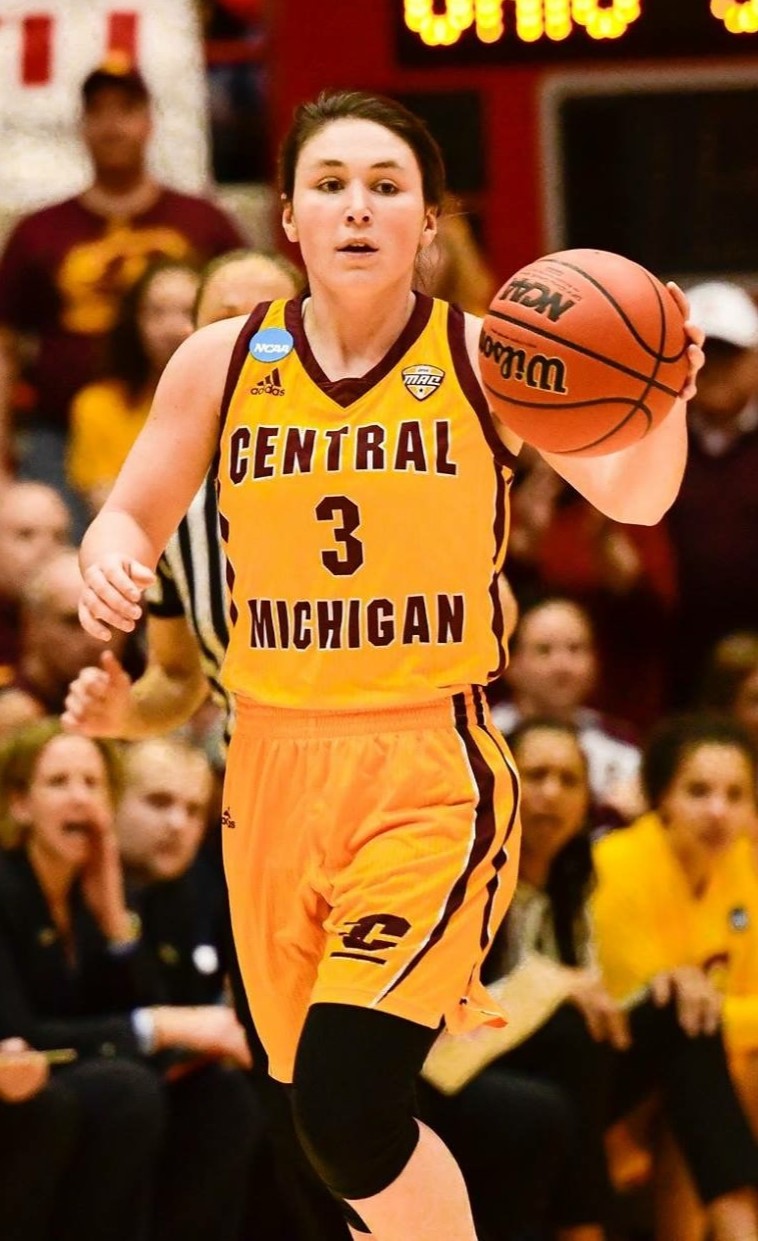
After Wayland, Kreski went on to an illustrious playing career Central Michigan where she won the NCAA 3-point contest in 2019. She also played with the Seattle Storm of the WNBA before playing professionally overseas in Poland.
“I am really excited to be at Frankfort and helping the team out,” Kreski said. “The girls work really hard and want to get better.
“Tim is a great coach, and I am looking forward to working with him and sharing my knowledge of the game as well as learning from him.”
Frankfort is coming off a District championship in 2022 and a District title loss to eventual Division 4 champion Glen Lake in 2023.
Reznich says the Panthers have already noted keys to success just by being around Kreski and Banktson. Reznich, who guided Frankfort to back-to-back Class D championships in 2005 and 2006, admits he may have softened up a bit on his players over the years. Conditioning will be a top priority this year.
“They (Kreski and Banktson) have the first-hand experience of the benefits of pushing yourself hard and not cutting corners,” Reznich said. “Our players will be in the best shape of their lives when those two are finished with them.”
And Banktson is happy to pass on her high school experience to the Panthers. She graduated in 2008 as the Lansing State Journal’s “Female Prep Athlete of the Year” after shining in three sports and leading Portland to the season’s final weekend in two.
“As a player, high school athletics taught me a lot about hard work and dedication,” she said. “High school sports taught me that you have to put in the extra work if you want to be great.
“You have to be in the gym getting extra shots outside of practice, you have to be at the field getting extra reps on the weekends,” she continued. “If you work hard and give everything you’ve got to develop your game, you will be successful.”
Kreski recalls fondly her high school days working hard and having fun with her friends and teammates, along with making deep runs in the tournament.
“High school sports is the truest form of competition,” Kreski said. “It starts with a community who supports everyone from a young age and involves all the friends and family you grew up with.
“High school sports help guide young people into leaders, teaching them how to work hard and be disciplined.”
Kreski led CMU to Sweet 16 her junior year. She is the all-time leading scorer at CMU (2,309) and career assist leader (643). Central won the Mid-American Conference three times during her days with the Chippewas. She married Gage Kreski after that chapter of her career was done.
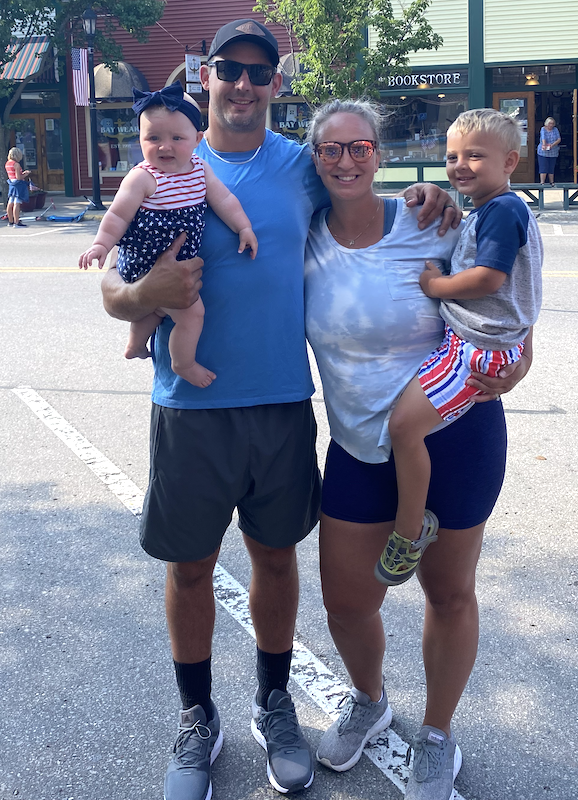
Banktson met her husband Max Banktson at Ferris State, where he played football. They moved to Frankfort, where Max was born and raised. They have a 3-year-old son named Briggs and a 6-month old daughter named Landyn.
Both Reznich and Banktson express respect and appreciation for their coaching together. They’ve been on the same page with game plans and scouting reports, and they expect it will continued with Kreski aboard.
“Rez and I really work well together,” Banktson said. “He has always respected me as a player and coach and has given me so much autonomy with our teams.
“He is always open to my input when it comes to running certain drills in practice, putting in new offenses, or adding defensive schemes,” she continued. “He trusts me to handle our subbing during games.”
Reznich agrees.
“I have always appreciated Lindsey’s perspective on what the girls are doing on the court,” he said. “It is going to be a lot of fun and exciting to add Presley’s ideas.
“We have always treated the regular season as practice for the tournament, making adjustments and tweaking things,” he continued. “I can’t wait to see the end product this year.”
 Banktson was a three-sport, four-year varsity player at Portland earning a combined 12 varsity letters in basketball, softball and volleyball. She helped the Raiders win league, District and Regional titles. Her teams reached MHSAA Semifinals for softball twice and basketball once.
It doesn’t take much to get her back in game mode.
“I can still remember the feeling of adrenaline getting ready in the locker room with my teammates, running out to our warm up music, and battling on the court each game,” she said. “I am thankful for my teammates who, when on the court, were so unselfish. We just wanted to win.”
She hopes to continue to instill greatness in the Panthers.
“I always tell the girls, ‘We were tough’ — not just physically but mentally,” she said. “We had a type of swagger – we played like we knew the bullseyes were on our back, and every game we had to fight to stay at the top.
“We took pride in wearing that Portland Raider jersey,” she continued. “I just want to instill that same mental toughness and swagger into my girls here at Frankfort.”
Having a pair of women who played now coaching and serving as mentors is beneficial on a personal level as well.
“I feel like I can relate to players on a personal level,” Banktson said. “I always try to be a good role model for them and someone they can come to with anything.
“I’m their biggest cheerleader but also not afraid to hold them accountable and help steer them down the right paths of life.”
And Banktson has learned how she might have coached herself.
“I would push myself to continue to work on my right hand, because everyone in the gym knows I’m a lefty,” she said with a smile.
2023 Made In Michigan
July 12: Championship Memories, High School Tennis' Impact Stick with Hackett Pair - Read
July 6: Brother Rice Finals Hero Aiming to Ace Family Life, Financial World - Read
July 5: Lapeer West 4-Time Finals Winner Set to Build Champions at Oklahoma - Read
PHOTOS (Top) Lindsey Banktson plays at Portland in 2008 and stands for a celebratory photo with Frankfort’s District champion last season. Presley Kreski plays for Wayland in 2014 and more recently served on Central Michigan's coaching staff. (Middle) Kreski directs the offense during her time at CMU. (Below) The Banktson family: From left, Landyn, Max, Lindsey and Briggs. (Photos of Banktson courtesy of Lindsey Banktson. CMU photo courtesy of CMU sports information. Wayland photo courtesy of Joel Bissell, MLive.com)