

4 Thrusts: In Motion, On Track in 2013-14
December 20, 2013
By Jack Roberts
MHSAA Executive Director
During the fall of 2012 at Update meetings across Michigan, we described “Four Thrusts for Four Years” – four health and safety emphases that would help us keep student-athletes healthier and also get a seat for Michigan’s policies and procedures for school sports on the train of best practices – an express train that is moving faster than we've ever seen it toward more cautious practice and play policies and more educational requirements for coaches.
At this December’s meeting, the MHSAA Representative Council examined a first quarter report card – what’s been accomplished during the first year.
It has been a remarkably strong start, but it’s only a start.
The first thrust, improving management of heat and humidity, received a boost last March when the Representative Council adopted a “Model Policy for Managing Heat and Humidity.” It has been promoted in print, online and at face-to-face meetings; and the response of schools has been nothing short of outstanding.
This rapid acceptance by school administrators and coaches reflects their appreciation for a clear policy that identifies the precise conditions that call for adjustments in activities, and lists specific actions to be taken when temperature and humidity combine to reach un-safe levels. Gut and guesswork are gone.
The second thrust, raising expectations for coaches’ preparedness, is being advanced in three ways.
In May, the Representative Council adopted the requirement that by the 2014-15 school year, schools must attest that, prior to established deadlines, all assistant and subvarsity coaches at the high school level have completed annually the same MHSAA rules meeting required by all varsity head coaches or, in the alternative, one of the free online sports safety courses posted on or linked to MHSAA.com and designated to fulfill this requirement. This popular change is only the first component of this critically important second thrust.
The second component is this. The Representative Council voted in December to require by 2015-16 that MHSAA member high schools certify that all of their varsity head coaches of high school teams have a valid (current) CPR certification, with AED training as a recommended component.
As this requirement was discussed at constituent meetings, the question was frequently raised: “Why just head coaches?”
“Why indeed,” is our response. If a school has the will and resources, it most certainly should make CPR a requirement of all its coaches, as some school districts have required for many years.
CPR training is conveniently available near almost every MHSAA member school in Michigan. Still, the MHSAA will begin offering CPR certification (with AED training) on an optional basis as an extension of Level 1 of the Coaches Advancement Program (CAP) during 2014-15.
The third component of this thrust is scheduled to go before the Representative Council in March. The proposal is that all individuals hired for the first time as a varsity head coach of a high school team, to begin those coaching duties after July 31, 2016, must have completed the Coaches Advancement Program (CAP) Level 1 or 2.
The MHSAA will track compliance and prohibit varsity head coaches from attending their teams’ MHSAA tournament contests if they fail to complete this requirement, beginning in the 2016-17 school year.
In cases of very late hiring, schools may substitute two online courses of the National Federation of State High School Associations – “Fundamentals of Coaching” and “First Aid, Health and Safety.” However, that coach must complete CAP Level 1 or 2 within six months of the hiring date.
These feel like big steps to some people in MHSAA member schools – “too expensive” or “another obstacle to finding qualified coaches,” some say; but these are baby steps.
This barely keeps pace with national trends. Michigan’s tradition of local control and its distaste for unfunded mandates has kept Michigan schools in neutral while schools in most other states have made multiple levels of coaching education, and even licensing or certification, standard operating procedure.
The three initiatives to upgrade coaches education in this critical area of health and safety over the next three years only nudges Michigan to a passing grade for what most parents and the public expect of our programs. We will still trail most other states, which continue to advance the grading curve.
And for a state association that is among the national leaders by almost every other measure, it is unacceptable to be below average in what is arguably the most important of all: promoting athlete health and safety by improving the preparation of coaches.
The third health and safety thrust is a focus on practice policies to improve acclimatization and to reduce head trauma; and the fourth thrust is a focus on game rules to reduce head trauma and to identify each sport’s most injurious situations and reduce their frequency.
Because of the critical attention to football on all levels, peewee to pros, our first focus has been to football with the appointment of a football task force which has effectively combined promotion of the sport’s safety record at the school level and its value to students, schools and communities with probing for ways to make the sport still safer.
The task force proposals for practice policies are receiving most attention and will receive Council action in March (and will be published on Second Half over the next few weeks). But the task force also has assisted MHSAA staff in developing promotional materials that are already in use, and the task force pointed MHSAA staff to playing rules that need emphasis or revision to keep school-based football as safe as possible.
During 2013-14, all MHSAA sport committees will be giving unprecedented time to the topics of the third and fourth thrusts and, when necessary, a task force will be appointed to supplement those sport committee efforts.
Frequently Asked Questions About CPR Certification
Q. Who is authorized to provide CPR certification?
A. The MHSAA does not dictate which organization must provide the CPR education and certification. However, the Michigan Department of Human Services lists the following organizations that are approved to provide CPR training:
- American CPR Training: www.americancpr.com
- American Heart Association: www.americanheart.org
- American Red Cross: www.redcross.org
- American Safety and Health Institute: www.hsi.com/ashi/about
- American Trauma Event Management: www.atem.us
- Cardio Pulmonary Resource Center: 517-543-9180
- Emergency Care and Safety Institute: www.ecsinstitute.org
- EMS Safety Services: www.emssafety.com
- Medic First Aid: www.medicfirstaid.com
- National Safety Council: www.nsc.org
- Pro CPR: www.procpr.org
Q.
A. $0 to $75.
Q. How long does certification take?
A. Two to five hours.
Q. How long does the certification last?
A. Generally, two years.
Q. Does the MHSAA specify the age level for the CPR training?
A. No. Generally, the course for adults alerts candidates of the necessary modifications for children and infants, and vice versa.
Building Beginning as Okemos Follows 1st-Year Coach Scott-Emuakpor
By
Geoff Kimmerly
MHSAA.com senior editor
August 9, 2022
OKEMOS – The football lay on the turf, landing there before the play had really begun, and the most booming voice from the tallest man on the field yelled a reassuring, “It’s OK. Let’s go,” followed the next play by “Go again,” and then “Figure it out.”
 An hour earlier, first-year Okemos varsity football coach Efe Scott-Emuakpor had been on the phone asking a parent to bring the helmet and practice jersey one of his players had left at home. Nearby, another small group also stood helmetless as they hadn’t yet gotten the pre-participation physical required to join their friends on the field.
Those are typical first-day glitches no matter the school, and fall practices for all sports began Monday at 750 high schools across the state.
But those relatively minor symptoms are what Scott-Emuakpor is focused on treating in the immediate term as he takes on one of the most serious rebuilding efforts in Michigan high school football.
“This is progress,” Scott-Emuakpor said halfway through his team’s first practice, looking out at 39 players on Okemos’ game field – 33 more than showed up for his first offseason workout.
“We’d like to have everything right now. But it’s growing. It’s slowly growing.”
And after Monday, Okemos is one step closer to what would be an incredible turnaround story.
The Wolves have not won since Week 2 of the 2019 season, a stretch of 23 games. After scoring on an 84-yard run during the first quarter of last fall’s opener against Mason, Okemos didn’t score again the rest of the season.
Standing 6-foot-3, and still only a few years from his last college game as a receiver at Ball State University, Scott-Emuakpor looks capable of stepping back into a huddle at a moment’s notice. A little more than a decade ago, in 2011, he was beginning a senior season at East Lansing that would see him cap his varsity career in the MHSAA record book with 134 catches, gaining 1,624 yards, over three seasons. He also was an all-leaguer in basketball and Finals placer in high jump before joining the Cardinals.
 After graduating from Ball State with a computer science bachelor’s degree, and on the way to earning his master’s in business from Saginaw Valley State University, Scott-Emuakpor came home and has worked nearly six years as a business systems analyst with Red Cedar Solutions Group on efforts including the MI School Data website.
But that’s just his fulltime job. Scott-Emuakpor also co-founded a clothing line, Live For Today, and over the last five seasons served as a volunteer assistant coach with his hometown Trojans – who have made the MHSAA Playoffs six seasons running.
He'd never applied for a head coaching job. He’d never really considered coaching at that level. In fact, he was pretty happy with how assisting at East Lansing for longtime coach Bill Feraco fit into his schedule and other pursuits.
But Scott-Emuakpor also is a studier. And as a past rival and co-member of the Capital Area Activities Conference Blue, he and East Lansing saw Okemos plenty.
The Wolves had made the playoffs as recently as 2018, and won their first playoff game that season since 2011. Scott-Emuakpor had played against Okemos’ Taylor Moton, now considered one of the NFL’s top offensive tackles. And the school has had loads of success in other sports, annually ranking among the Lansing area’s best in just about all of them and coming off a statewide Division 1 championship in boys soccer from last fall.
“I paid attention to how things have been around here. And I know what they could be capable of,” Scott-Emuakpor said. “This program was once a good program that was very well-respected; I respected them playing against them in high school. They had great athletes. I think my senior year we beat them by one point (20-19 in 2011). So we had good battles.
“I just saw where they’re at. … We have some good kids around here, and I know there’s more in the school not playing. Maybe when they’re sophomores, juniors, they’ll come out. I think I’m capable of getting that interest up, getting them out on the field and just building something.”
 Raj Singh is a senior this fall, one of only five or so Scott-Emuakpor is expecting to come out this week. He’s also a near all-A student, will play some quarterback and safety along with his receiver spot, and was the guy bringing carloads of classmates to workouts over the summer as he joined his coach in recruiting prospective players.
Singh is following his older brother Joe Singh, an admittedly “smaller than everyone” offensive lineman who earned all-league honors as a senior in 2017. When Joe Singh told his younger brother that playing under the lights on a Friday night is a feeling unlike any other, the idea stuck – which is why it made sense when Raj Singh fractured his wrist in Week 2 last season but was back by Week 7 despite a cast covering one hand.
Watching Singh catch passes one-handed last season during East Lansing’s 49-0 win over Okemos stuck with Scott-Emuakpor. Joe Singh had told his little bother that all that matters is having more heart than his opponent and a fighting spirit – in other words, being the type of player Scott-Emuakpor will rely on to get Okemos up and succeeding again.
“I’ve been playing football since I was 6 years old. It’s just been a dream of mine to be at this moment,” Raj Singh said.
“Coach Efe is bringing in a lot of new aspects, and that’s been very helpful to make it different than last year – make us feel a little more at home this year. Compared to last year, he’s brought a lot of structure. We’ve been really coming together as a family … and it just shows Coach Efe wants to build a community around here.”
The process is about more than building stronger, faster bodies and learning football skills and technique. The Wolves aren’t talking a lot about last year, but there’s something there to overcome – and Scott-Emuakpor started working on that soon after he was hired at the end of March.
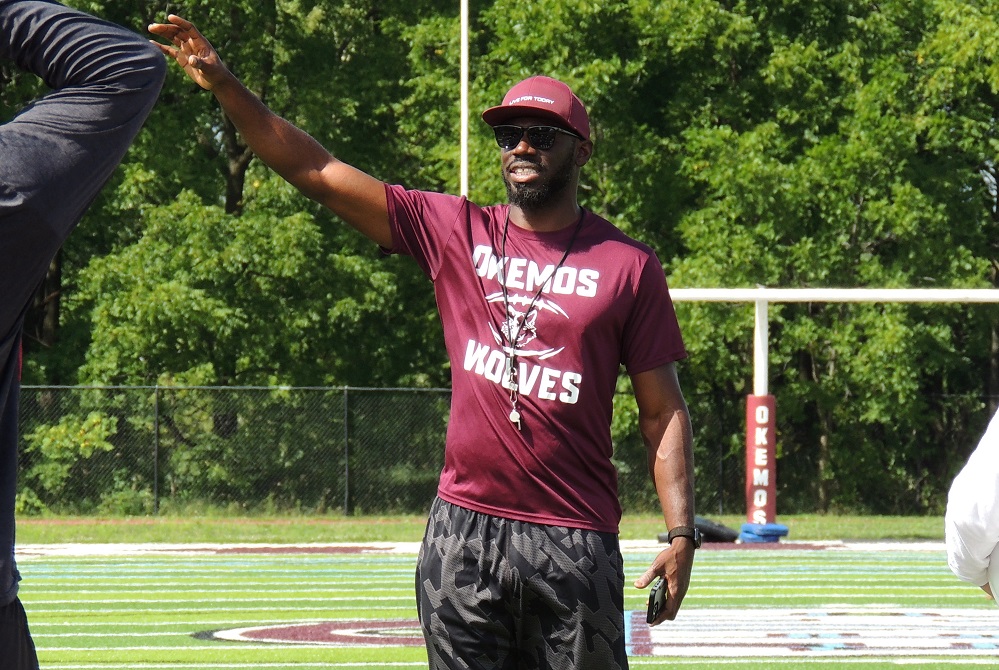 “In the springtime, we were fortunate enough to get in the weight room and I was able to see kids put up good weight and do some things. I’d tell them, ‘You’re actually strong. You’re actually a fast kid,’” Scott-Emuakpor said. “But when you’re not successful for so long, and the way they were losing last year, it was easy for them to not feel confident, not feel they were able to ultimately get the job done. And so I was just there working on minds.”
Last season was going to be uphill for Okemos no matter what. A mid-summer coaching change brought on by a major fulltime job promotion for the former coach led to an interim staff, players leaving the program, and an applaudable effort to just keep teams on the field.
Scott-Emuakpor has surrounded himself with a staff that includes a pair of his past coaches growing up in East Lansing, past players from when he was coaching there and others with winning experience playing at DeWitt and Williamston.
In addition to what he learned playing and coaching under Feraco, Scott-Emuakpor brings a ton of insight from his experiences at Ball State; he had only one catch during his college career while battling injuries, but he spent that time on the sideline observing his coaches and taking mental notes. Just Sunday, he was pulling from the 2012-13 Ball State football handbook a few details to incorporate into his work in progress with the Wolves.
Okemos will have varsity and freshman teams this fall, and the majority of players at Monday’s combined practice were juniors and sophomores – so recruiting remains ongoing. But Singh said the number of classmates who did come out Monday exceeded his expectations – and that just added to the excitement of starting again.
“If you walk through the school, you’ll see some guys, you’ll (say), ‘OK, what does that guy do?’ You find out he plays (only) lacrosse, or only wrestles, where in other areas, other schools, they might do everything because that’s what they do, what they’ve grown up doing” Scott-Emuakpor said. “I’ve been trying to rebuild that connection, that love for football. A lot of them are very intrigued; I feel like some of them are kinda peeking and saying, ‘What’s going on? This new coach seems to be young and interesting.’ And I’ve just been trying to stay focused on the process and not get too far ahead of myself.”
 Geoff Kimmerly joined the MHSAA as its Media & Content Coordinator in Sept. 2011 after 12 years as Prep Sports Editor of the Lansing State Journal. He has served as Editor of Second Half since its creation in January 2012, and MHSAA Communications Director since January 2021. Contact him at [email protected] with story ideas for the Barry, Eaton, Ingham, Livingston, Ionia, Clinton, Shiawassee, Gratiot, Isabella, Clare and Montcalm counties.
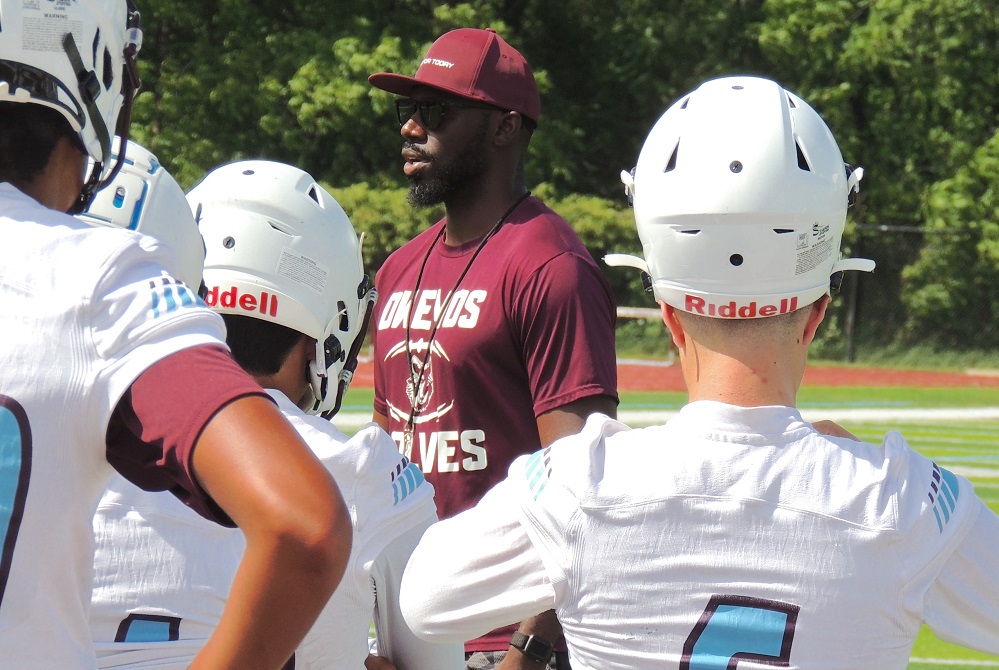
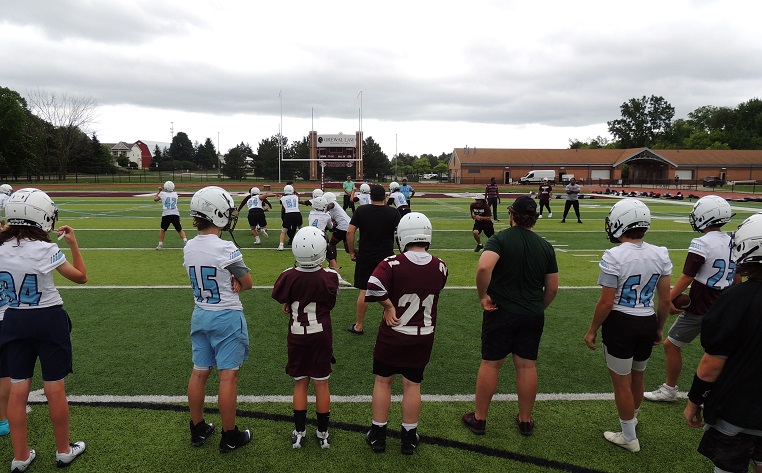
PHOTOS (Top) First-year Okemos varsity football coach Efe Scott-Emuakpor, middle, huddles up his players during Monday's first day of practice. (2) Scott-Emuakpor confers with senior Raj Singh on blocking from his receiver position. (3) The Wolves work on offense during the first part of their Monday session. (4) Scott-Emuakpor speaks with his team at the start of the workout. (Photos by Geoff Kimmerly.)