


'Anyone Can Save a Life' Aims to Prepare
July 28, 2015
By Rob Kaminski
MHSAA benchmarks editor
It was 2008 when Jody Redman and staff at the Minnesota State High School League developed an emergency action plan to provide guidance and procedure in the event of sudden cardiac arrest during scholastic athletic competition.
The desired response from schools upon receipt of the plan was, well, less than enthusiastic.
“Only about 40 percent of our schools used the information and implemented the program,” said Redman, associate director for the MSHSL. “Our focus was completely on sudden cardiac arrest, that being the worst-case scenario regarding athletic-related health issues.”
The MSHSL asked the University of Minnesota to survey its member schools, and results showed that the majority of schools not on board simply felt a sudden cardiac arrest “would never happen at their school.” Naive or not on the schools’ parts, that was the reality – so Redman went back to revise the playbook.
“We expanded the plan to deal with all emergencies, rather than specific incidents,” Redman said. “Now it’s evolved so that we are prepared to deal with a variety of situations which put participants at risk. We shifted gears and got more schools to participate.”
Did they ever. And not just in Minnesota.
This summer, the “Anyone Can Save a Life” program, authored by the MSHSL and the Medtronic Foundation, is being disseminated to high schools nationwide with the financial support of the NFHS Foundation. The program will reach schools in time for the 2015-16 school year.
Once received, schools will find that there are two options for implementation, via in-person training or online.
“The in-person method is facilitated by the athletic administrator with the assistance of a training DVD” Redman said. “The important element is the follow through, ensuring coaches return their completed Emergency Action Plan (EAP). With the e-learning module on anyonecansavealife.org, individuals will complete an e-learning module that will walk them through the details of their specific plan, and as they answer questions, the information will automatically generate a PDF of the Emergency Action Plan (EAP) which they can edit at a later date as information changes.”
Schools will find five major components of the program to be received this summer: the first is an implementation checklist for the AD, explaining their role. Next are sections for in-person training, online training and event staff training. The last item contains a variety of resources that will ensure the successful implementation of a comprehensive emergency response to all emergencies.
Generally speaking, the program prompts schools to assemble preparedness teams, broken into four categories: a 911 team, a CPR team, an AED team and a HEAT STROKE team. The groups are made up of coaches and their students who will be in close proximity to all after-school activities.
“The reality about school sports is, at 3:30 every day the office closes and any type of medical support ceases to exist,” Redman said. “We then send thousands of students out to gyms, courts, fields and rinks to participate without systemic support for emergencies. This program puts into place that systemic support.”
Another stark reality is that the majority of schools in any state do not have full-time athletic trainers. Even for those fortunate enough to employ such personnel, it’s most likely the training “staff” consists of one person. That one body can only be in one place at one time, and on widespread school campuses the time it takes to get from one venue to another could be the difference between life and death.
“Athletic trainers can champion the program, but someone needs to oversee that every coach has a completed EAP in place,” Redman said. “For every minute that goes by when a cardiac arrest occurs, chance for survival decreases by 10 percent.”
Thus, it’s imperative to train and grant responsibility to as many people as possible, including student-athletes. In fact, students are a vital component to having a successful EAP. Students will be put in position to call 911, to meet the ambulance at a pre-determined access point, to locate the nearest AED, to make sure emersion tubs are filled for hot-weather practices, and for those who are trained, to assist with CPR. Coaches will identify students at the beginning of the season and prior to an emergency taking place. They will provide them with the details of the job they are assigned so they will be ready to assist in the event of an emergency.
“We have game plans for every sport, and for every opponent on our schedule,” Redman said. “But we don’t have a plan to save the life of a member of our team or someone attending a game at our school.
“This is about developing a quick and coordinated response to every emergency so we give someone in trouble a chance at survival, and then practicing it once or twice a season. We have ‘drop the dummy’ drills where we drop a dummy and evaluate how it went, and how everyone performed. In one scenario, it’s the coach that goes down, and then you have a group of 15- or 16-year-olds standing there. That’s why students have to take ownership of this, too.”
The key to an effective emergency action plan is to utilize and empower students in every sport and at every level to be a part of the response team. Following are brief descriptions of the teams.
The 911 Team
- Two students will call 911 from a pre-determined phone and provide the dispatcher with the location and details of the emergency.
- Two students will meet the ambulance at a pre-determined access point and take them to the victim.
- Two students will call the athletic trainer, if one is available, and the athletic administrator and alert them to the emergency.
The CPR Team
- The coach is the lead responder on this team and is responsible for attending to the victim and administering CPR, if necessary, until trained medical personnel arrive.
- One person is capable of providing effective CPR for approximately two minutes before the quality begins to diminish. Having several students trained and ready to administer CPR will save lives.
The AED Team
- Two students will retrieve the AED and take it to the victim.
- Two students will physically locate the athletic trainer, if one is available, and take him or her to the victim.
The Heat Stroke Team
- Two students identify locations of emersion tub, water source, ice source and ice towels.
- Two students prepare tub daily for practices and events.
For more information, visit anyonecansavealife.org or contact the MSHSL.
Vander Klay's Dedication to Wyoming Schools Netted 400+ Wins, Trip to Breslin
By
Dean Holzwarth
Special for MHSAA.com
April 6, 2026
WYOMING – Over the past 31 years, it was relatively easy to notice a boys basketball team coached by Thom Vander Klay.
 Athletic and tough-nosed players who competed hard while playing an up-tempo offense and in-your-face defense were trademarks of his teams at Wyoming Park and Wyoming High School.
“In some ways, at Wyoming Park, and then Wyoming, our athletes have been very similar through those 31 years of varsity,” Vander Klay said.
“Some teams were more skilled and more athletic than others, but they were the same. We never had big kids. We’ve always had kind of gritty kids that would compete hard and play fast, and we had quite a few of them on every team. That bled into what we did.”
Vander Klay will retire from teaching after 40 years at the end of May, and his time as the longtime basketball coach will end as well.
“It’s been a struggle, and it’s hard because it’s my home,” Vander Klay said. “I live in Wyoming, my kids went to Wyoming and I went to Wyoming (Park). I’m the youngest of three and my older brother and sister were Vikings and that’s who I was. I was Wyoming, and I still am, so it was really difficult to say I was going to step away from things I really enjoyed doing.”
Vander Klay has been coaching for 41 years. He was the junior varsity coach at Wyoming Park before replacing Kelly McEwen in 1995.
When Wyoming Park and Wyoming Rogers merged in 2012, he became the head coach at the new Wyoming High School.
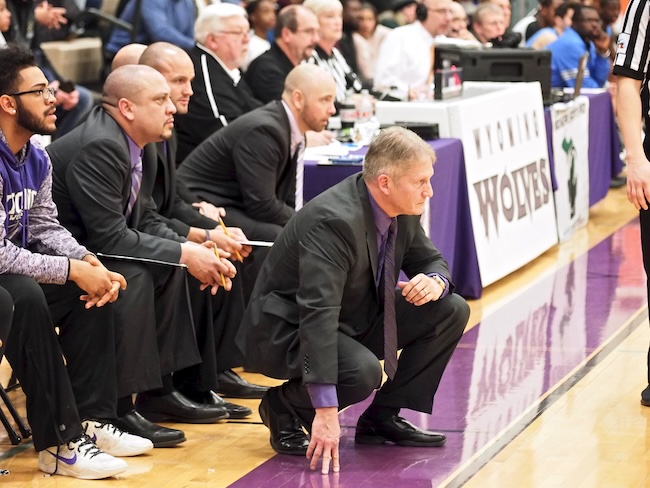
During his tenure, he went 424-274 as a varsity coach and won nine conference championships, six District titles and one Regional title. He also helped coach football and track & field.
“So many memories and so many kids, and you love those kids,” said Vander Klay, who coached his two sons, Brock and Chase. “When I think back to when I started, guys like Jack VerDuin, Ron Engels, Dick Locke, Frank Grimm and Kelly McEwen were great mentors that I had. I go back to those days and blink, and here we are 40 years later and I'm the old guy.”
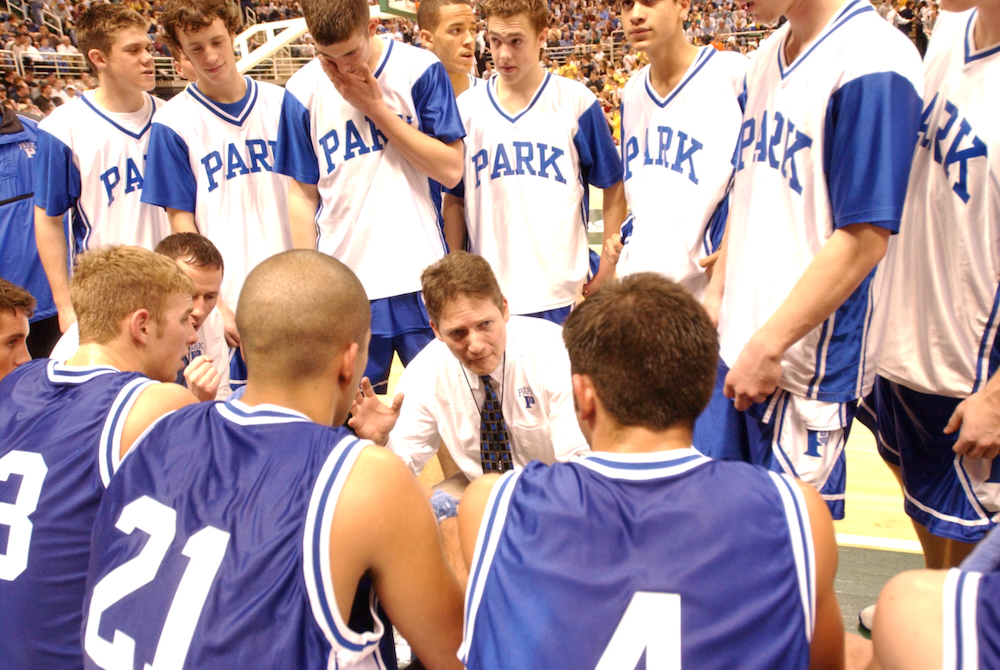
Vander Klay’s best season came in 2004 at Wyoming Park, led by eventual Michigan State standout Drew Neitzel. The Vikings advanced to the Class B Semifinals, losing to Detroit Renaissance.
 Vander Klay was named Class B Coach of the Year and enjoyed his time coaching Neitzel, the Mr. Basketball Award winner who is widely considered one of the best players in program history.
“Drew was so well-rounded,” Vander Klay said. “A great leader, great student, great attitude and just mentally tough and so skilled.
“Coaching him was more about trying to get all five guys on the same page, but those teams that Drew played on, we had good players other than him, too. It wasn't just him because we had other guys who stepped up – but he was the best player in the state.”
Jacob Underhill, Vander Klay’s longtime assistant and junior varsity coach, said Vander Klay has been more than just a mentor.
“He has been the blueprint for the teacher and coach I strive to be,” Underhill said. “He has always been incredibly gracious in sharing his knowledge of the game and his wisdom on how to lead young men. Every decision he makes is filtered through a single focus: doing what is best for the students and athletes of Wyoming.
“While his retirement marks the end of an era, his legacy is undeniable. Since the merger of Wyoming Park and Wyoming Rogers, he has been the heartbeat of the basketball program. He has had a profound impact on my professional career, and I cherish the time we’ve spent serving the community together.”
Underhill has witnessed firsthand the influence Vander Klay has had on former players with whom he has reconnected.
“It’s a true testament to his character,” Underhill said. “He is an exceptional human being who makes everyone around him better and ensures they recognize their own value.”
The 62-year-old Vander Klay is keeping his options open in terms of a return to coaching elsewhere.
“I’ll take some time off and maybe there is something else out there,” he said. “I'm wide open to anything, and maybe I’ll coach again and maybe not. We will see what the future holds.”
Two other longtime Grand Rapids-area coaches also stepped down after longstanding careers on the hardwood.
Unity Christian coach Scott Soodsma retired after 43 years on the sidelines. He won more than 800 games and three MHSAA Finals championships as a boys and girls coach. Soodsma coached his last game in the Division 2 Boys Basketball Final at Breslin Center. The Crusaders lost to Freeland, 42-32.
Sparta boys basketball coach Scott Berry also retired after 34 seasons. He won 245 games at Comstock Park and Sparta.
 Dean Holzwarth has covered primarily high school sports for Grand Rapids-based WOOD-TV for five years after serving at the Grand Rapids Press and MLive for 16 years along with shorter stints at the Ionia Sentinel and WZZM. Contact him at [email protected] with story ideas for Allegan, Kent and Ottawa counties.
PHOTOS (Top) Coach Thom Vander Klay (kneeling) talks to his Wyoming Park team during a break in its 2004 Class B Semifinal at Breslin Center. (Middle) Vander Klay (kneeling) coaches his Wyoming High team. (Top photo from MHSAA archives; middle photo submitted by Thom Vander Klay.)