


'Anyone Can Save a Life' Aims to Prepare
July 28, 2015
By Rob Kaminski
MHSAA benchmarks editor
It was 2008 when Jody Redman and staff at the Minnesota State High School League developed an emergency action plan to provide guidance and procedure in the event of sudden cardiac arrest during scholastic athletic competition.
The desired response from schools upon receipt of the plan was, well, less than enthusiastic.
“Only about 40 percent of our schools used the information and implemented the program,” said Redman, associate director for the MSHSL. “Our focus was completely on sudden cardiac arrest, that being the worst-case scenario regarding athletic-related health issues.”
The MSHSL asked the University of Minnesota to survey its member schools, and results showed that the majority of schools not on board simply felt a sudden cardiac arrest “would never happen at their school.” Naive or not on the schools’ parts, that was the reality – so Redman went back to revise the playbook.
“We expanded the plan to deal with all emergencies, rather than specific incidents,” Redman said. “Now it’s evolved so that we are prepared to deal with a variety of situations which put participants at risk. We shifted gears and got more schools to participate.”
Did they ever. And not just in Minnesota.
This summer, the “Anyone Can Save a Life” program, authored by the MSHSL and the Medtronic Foundation, is being disseminated to high schools nationwide with the financial support of the NFHS Foundation. The program will reach schools in time for the 2015-16 school year.
Once received, schools will find that there are two options for implementation, via in-person training or online.
“The in-person method is facilitated by the athletic administrator with the assistance of a training DVD” Redman said. “The important element is the follow through, ensuring coaches return their completed Emergency Action Plan (EAP). With the e-learning module on anyonecansavealife.org, individuals will complete an e-learning module that will walk them through the details of their specific plan, and as they answer questions, the information will automatically generate a PDF of the Emergency Action Plan (EAP) which they can edit at a later date as information changes.”
Schools will find five major components of the program to be received this summer: the first is an implementation checklist for the AD, explaining their role. Next are sections for in-person training, online training and event staff training. The last item contains a variety of resources that will ensure the successful implementation of a comprehensive emergency response to all emergencies.
Generally speaking, the program prompts schools to assemble preparedness teams, broken into four categories: a 911 team, a CPR team, an AED team and a HEAT STROKE team. The groups are made up of coaches and their students who will be in close proximity to all after-school activities.
“The reality about school sports is, at 3:30 every day the office closes and any type of medical support ceases to exist,” Redman said. “We then send thousands of students out to gyms, courts, fields and rinks to participate without systemic support for emergencies. This program puts into place that systemic support.”
Another stark reality is that the majority of schools in any state do not have full-time athletic trainers. Even for those fortunate enough to employ such personnel, it’s most likely the training “staff” consists of one person. That one body can only be in one place at one time, and on widespread school campuses the time it takes to get from one venue to another could be the difference between life and death.
“Athletic trainers can champion the program, but someone needs to oversee that every coach has a completed EAP in place,” Redman said. “For every minute that goes by when a cardiac arrest occurs, chance for survival decreases by 10 percent.”
Thus, it’s imperative to train and grant responsibility to as many people as possible, including student-athletes. In fact, students are a vital component to having a successful EAP. Students will be put in position to call 911, to meet the ambulance at a pre-determined access point, to locate the nearest AED, to make sure emersion tubs are filled for hot-weather practices, and for those who are trained, to assist with CPR. Coaches will identify students at the beginning of the season and prior to an emergency taking place. They will provide them with the details of the job they are assigned so they will be ready to assist in the event of an emergency.
“We have game plans for every sport, and for every opponent on our schedule,” Redman said. “But we don’t have a plan to save the life of a member of our team or someone attending a game at our school.
“This is about developing a quick and coordinated response to every emergency so we give someone in trouble a chance at survival, and then practicing it once or twice a season. We have ‘drop the dummy’ drills where we drop a dummy and evaluate how it went, and how everyone performed. In one scenario, it’s the coach that goes down, and then you have a group of 15- or 16-year-olds standing there. That’s why students have to take ownership of this, too.”
The key to an effective emergency action plan is to utilize and empower students in every sport and at every level to be a part of the response team. Following are brief descriptions of the teams.
The 911 Team
- Two students will call 911 from a pre-determined phone and provide the dispatcher with the location and details of the emergency.
- Two students will meet the ambulance at a pre-determined access point and take them to the victim.
- Two students will call the athletic trainer, if one is available, and the athletic administrator and alert them to the emergency.
The CPR Team
- The coach is the lead responder on this team and is responsible for attending to the victim and administering CPR, if necessary, until trained medical personnel arrive.
- One person is capable of providing effective CPR for approximately two minutes before the quality begins to diminish. Having several students trained and ready to administer CPR will save lives.
The AED Team
- Two students will retrieve the AED and take it to the victim.
- Two students will physically locate the athletic trainer, if one is available, and take him or her to the victim.
The Heat Stroke Team
- Two students identify locations of emersion tub, water source, ice source and ice towels.
- Two students prepare tub daily for practices and events.
For more information, visit anyonecansavealife.org or contact the MSHSL.
MHSAA Vault: Shooks a Legend as Freshman Coach
By
Geoff Kimmerly
MHSAA.com senior editor
September 4, 2026
The following originally appeared in the Lansing State Journal on Oct. 28, 2004, and was reprinted by the MHSAA that winter.
Wayne Shooks retired from coaching entirely in 2008 and died Tuesday at the age of 84.
Wayne Shooks tried the varsity football thing once. Some time during the late 1980s, longtime DeWitt coach Gail Thornton asked Shooks to be his offensive coordinator.
“I didn't sleep a night. My wife, after three weeks, said, ‘You're going back to freshmen,’” Shooks remembered.
And those three weeks were in the month of June.
But Shooks' wife must have been on to something. Because few, if any, freshman football coaches have accomplished what Shooks finished with one last win last fall.
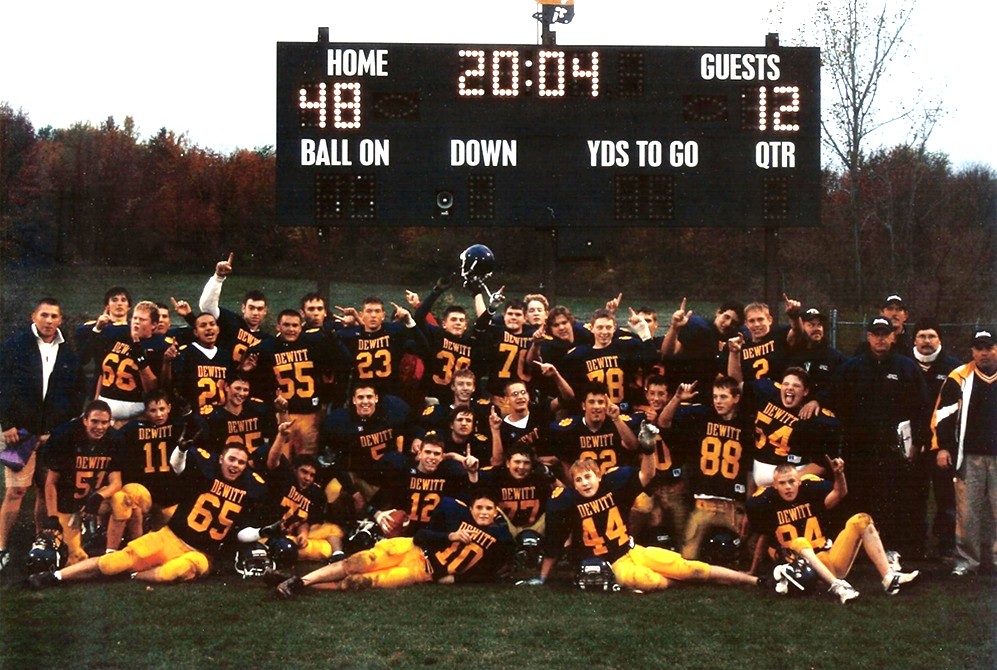
He ended his 16th and final season as freshman coach with a 135-2-1 record.
Amazing.
“You can't lose a game for him, or you'll feel bad,” DeWitt senior Mat Brynick recalled from his days as a freshman. “Coach never says it, but it's what everyone expects.
“He taught us how to win.”
 Guys like Shooks, 62, usually go unappreciated.
They get the kids fresh to high school, fresh to high school sports, and still learning things like not spiking the ball after a touchdown.
But few freshman football coaches are as legendary as Shooks is in DeWitt. They are so unappreciated that it's impossible to find out if anyone has accomplished what he's done.
Shook is not big on numbers. Never has been during his 41 years teaching in the district, or more than 20 coaching everything from football to basketball to wrestling to tennis. Oh, and track since 1980.
He also coached 8th-grade football for a few years, junior varsity for one season and was a varsity assistant. But he'll be remembered for what he did with the freshmen.
The losses came in 1993 to Mason during a terrible wind storm, and in 2002 to Greenville. That same year, the Panthers tied Haslett, meaning it was the only year during his tenure that DeWitt wasn't sure if it finished first in its league, since league titles aren't handed out at the freshmen level.
“The kids felt bad. They did their best,” Shooks remembered.
But the losses, however few, were more of a relief for Shooks than a letdown.
Don't take that to mean Shooks doesn't like to win.
Sure, he embraced the role of teacher as much as any freshman coach. But as DeWitt varsity coach Rob Zimmerman said, “If he was a 5th-grade coach, he'd be the most competitive 5th-grade coach you've ever seen.”
“I never pointed (our record) out, it was not our goal,” Shooks said. “Our goal was to win the next week. Although the kids knew it. They just assumed we were going to go 9-0, I guess.”
Guess so.
Shooks had more easily-attainable goals:
- Have fun
- Learn fundamentals
- Emphasize the logical stuff, like the importance of bringing equipment to school every day
“He does a really good job teaching expectations about being young men and being great students,” Zimmerman said. “It's gigantic.”
And it kept kids coming back to junior varsity and varsity. You could hear the fun coming out in Brynick's voice.
He was remembering his freshman football experience, remembering his time with perhaps Michigan's most successful coach at that level.
“I remember a few games, we'd find one play that works, and we ran it to death, pounding it and pounding it,” Brynick recalled. “He loves running the same play over and over. If you can do that, march 80 yards down the field, you're doing something right. No one could stop us.”
That was not all Brynick remembered, or didn't.
Shooks almost never yelled. If he did, it meant a kid messed something up over and over and over again.
He has a doctorate in zoology. Education is obviously a big deal. He loves to win, but he loves to teach. And he's hesitant to go looking for any attention for what he's done.
All made him a perfect freshmen football coach.
“Sometimes I don't think people understand about coaches. You think college level, they are coaches first, that's their job, but not at the high school level,” Shooks said.
“It's not what I've done, it's what they've done. I've always believed the focus should be on the kids. My job is a teacher. I coach because I love to coach.”
PHOTO DeWitt freshman coach Wayne Shooks, fourth from right, stands for a photo with this final football team in 2004. (Photos courtesy of the DeWitt football program.)