


Fenton Principal Bakker Selected as MHSAA's Charles E. Forsythe Award Honoree
By
Geoff Kimmerly
MHSAA.com senior editor
March 11, 2026
An educator who has served in several roles – as a teacher, coach, athletic director, assistant principal and for the last four years principal at Fenton High School – Mike Bakker is able to draw from a wealth of experiences as he serves students not only in his school district but as a statewide decision-maker and leader.
In recognition of his several contributions over the last two decades, especially to educational athletics, Bakker has been selected to receive this year’s MHSAA Charles E. Forsythe Lifetime Achievement Award.
The annual award is in its 49th year and named after past MHSAA Executive Director Charles E. Forsythe, the Association's first full-time and longest-serving chief executive. Forsythe Award recipients are selected each year by the MHSAA Representative Council, based on an individual's outstanding contributions to the interscholastic athletics community at the local, regional and statewide levels. Bakker will be honored this weekend during the Michigan Interscholastic Athletic Administrators Association (MIAAA) annual conference in Traverse City.
Bakker began his professional career at Mason High School. He was hired initially as the boys tennis coach while still a junior in college, and then served twice as a long-term substitute teacher before being hired full time and teaching mathematics and statistics, serving as a club advisor and coaching girls and boys swimming & diving in addition to tennis. He moved to Fenton Area Public Schools as the middle and high school athletic director and assistant principal in 2004. Bakker became interim principal midway through the 2021-22 school year, with that promotion made permanent that March.
“I do think that because I’ve held all of those different roles, I still have all of those connections, and there are other athletic directors who have gone on to become principals and those are the people I reach out to – I know they have a passion for making sure everybody, because of the positions they’ve held, has success in different areas,” Bakker said. “Working in athletics so long, and helping those students find success and helping coaches find success, helped me help students who are not in athletics have success. It’s provided a pretty awesome opportunity and perspective to see how the system works and how to help students be successful and help teachers and coaches be successful.”
Bakker’s contributions have long stretched beyond his classroom and office duties as well. Locally, he’s served on the Fenton Education Foundation board of directors for two decades. As athletic director, he hosted more than 125 MHSAA Tournaments over 17 years and served on a dozen MHSAA committees.
Bakker also has been a member of both the MIAAA – the state’s professional organization for athletic administrators – and National Interscholastic Athletic Administrators Association (NIAAA) for 22 years and has served in several leadership roles with the MIAAA including as president during the 2015-16 school year and as assistant executive director since 2018.
Bakker also is serving his second school year as a member of the MHSAA Representative Council.
 “As someone who has dedicated himself to education and served in various roles over the last 25 years, Mike Bakker has gained a broad perspective that has helped shape his leadership – and he continues to give more of himself with his contributions at the MHSAA and MIAAA leadership levels,” MHSAA Executive Director Mark Uyl said. “As a member of the Representative Council, he provides input on how decisions could affect all groups involved, and our schools are fortunate to have his valuable voice and viewpoint.”
Bakker also has been a member of both the Michigan Association of Secondary School Principals (MASSP) and National Association of Secondary School Principals (NASSP) for 15 years. As a coach he was a member of the Michigan Interscholastic Swim Coaches Association (MISCA) and served as a Zone representative from 2001-04.
Bakker was selected as the MIAAA’s Region 9 Athletic Director of the Year in 2010, and as its statewide Tom Rashid Athletic Director of the Year for 2020-21. He also was named Athletic Director of the Year in 2021 by the Michigan High School Coaches Association.
“For me, being an educator, and part of why I went into education and administration, was to help in the education process of the whole student. That doesn’t include just the classroom walls from the first bell to the last bell,” Bakker said. “To really impact kids, you have to build relationships, meet them where they’re at, and you have to help them find success not just in the classroom but out(side it), to help them become better than they thought they could be. … Even when I was athletic director, I still going and seeing kids perform in other things, and I was in charge of clubs as the athletic director, and all of those things allowed me to help meet students where they are and where their needs are as they are figuring out who they want to be when they leave.”
A 1994 graduate of Rochester High School – where he swam and played soccer, tennis and basketball – Bakker earned a bachelor’s degree in mathematics from Michigan State University in 1998 and his secondary teaching certificate from MSU in 2000. He earned a master’s degree in educational leadership from MSU in 2004 and a master’s in sports administration from Eastern Michigan University in 2011. He also received his certified master athletic administrator designation from the NIAAA in 2011.
Bakker and his wife Denise have been married for 23 years and have three children – sons Jasper and Tristan and daughter Paige.
Past recipients of the Charles E. Forsythe Award
1978 - Brick Fowler, Port Huron; Paul Smarks, Warren
1979 - Earl Messner, Reed City; Howard Beatty, Saginaw
1980 - Max Carey, Freesoil
1981 - Steven Sluka, Grand Haven; Samuel Madden, Detroit
1982 - Ernest Buckholz, Mt. Clemens; T. Arthur Treloar, Petoskey
1983 - Leroy Dues, Detroit; Richard Maher, Sturgis
1984 - William Hart, Marquette; Donald Stamats, Caro
1985 - John Cotton, Farmington; Robert James, Warren
1986 - William Robinson, Detroit; Irving Soderland, Norway
1987 - Jack Streidl, Plainwell; Wayne Hellenga, Decatur
1988 - Jack Johnson, Dearborn; Alan Williams, North Adams
1989 - Walter Bazylewicz, Berkley; Dennis Kiley, Jackson
1990 - Webster Morrison, Pickford; Herbert Quade, Benton Harbor
1991 - Clifford Buckmaster, Petoskey; Donald Domke, Northville
1992 - William Maskill, Kalamazoo; Thomas G. McShannock, Muskegon
1993 - Roy A. Allen Jr., Detroit; John Duncan, Cedarville
1994 - Kermit Ambrose, Royal Oak
1995 - Bob Perry, Lowell
1996 - Charles H. Jones, Royal Oak
1997 - Michael A. Foster, Richland; Robert G. Grimes, Battle Creek
1998 - Lofton C. Greene, River Rouge; Joseph J. Todey, Essexville
1999 - Bernie Larson, Battle Creek
2000 - Blake Hagman, Kalamazoo; Jerry Cvengros, Escanaba
2001 - Norm Johnson, Bangor; George Lovich, Canton
2002 - John Fundukian, Novi
2003 - Ken Semelsberger, Port Huron
2004 - Marco Marcet, Frankenmuth
2005 - Jim Feldkamp, Troy
2006 - Dan McShannock, Midland; Dail Prucka, Monroe
2007 - Keith Eldred, Williamston; Tom Hickman, Spring Lake
2008 - Jamie Gent, Haslett; William Newkirk, Sanford Meridian
2009 - Paul Ellinger, Cheboygan
2010 - Rudy Godefroidt, Hemlock; Mike Boyd, Waterford
2011 - Eric C. Federico, Trenton
2012 - Bill Mick, Midland
2013 - Jim Gilmore, Tecumseh; Dave Hutton, Grandville
2014 - Dan Flynn, Escanaba
2015 - Hugh Matson, Saginaw
2016 - Gary Hice, Petoskey; Gina Mazzolini, Lansing
2017 - Chuck Nurek, Rochester Hills
2018 - Gary Ellis, Allegan
2019 - Jim Derocher, Negaunee; Fredrick J. Smith, Stevensville
2020 - Michael Garvey, Lawton
2021 – Leroy Hackley Jr., Byron Center; Patti Tibaldi, Traverse City
2022 – Bruce Horsch, Houghton
2023 – Karen Leinaar, Frankfort
2024 – Sean Jacques, Calumet
2025 – Kris Isom, Adrian
PHOTOS (Top) Fenton's Mike Bakker monitors activities from the field during a Tigers football game. (Middle) Bakker, left, takes a photo with daughter Paige and wife Denise as Paige holds the Flint Metro League volleyball championship trophy. (Photos provided by Mike Bakker.)
Indispensable Only Begins to Describe Vicksburg Athletics 'MVP' VanderKamp
By
Pam Shebest
Special for MHSAA.com
September 20, 2022
VICKSBURG — Reading, traveling, enjoying time with family and sitting by the pool are all on Rhonda VanderKamp’s retirement list.
 But before she embarks on that journey in June, she is finishing her 21st year as Vicksburg High School athletic secretary.
One person not looking forward to that June day is Vicksburg athletic director Mike Roy.
“I keep waking up every day coming to work, and maybe she’ll tell me I’m going to do one more (year),” Roy said.
“Like the Tampa Bay Buccaneers when Tom Brady retires, they’re going to dearly miss him. That’s the best analogy I can give; that’s how important she is to the team we have here.”
Roy should know.
The two have worked together all 21 years, forming a work family that’s become an anomaly in the world of high school athletics.
Her own family is the reason VanderKamp landed at Vicksburg.
She left her job at Heco, formerly Hatfield Electric, in Kalamazoo, after 17 years because “I wanted to be on the same schedule as what my kids were,” she said. “This allowed me to have my summers off with them and Christmas and spring breaks. It’s been just fantastic.
 “Both of them were athletes in school. My daughter was in middle school when I started. I think it was good for them to have me here when they were in high school.”
VanderKamp and Roy were hired into the athletic department within a month of each other.
She realizes how unusual their tenure is when she attends conferences.
“They’ll ask you to stand up, introduce yourself and say what school you’re from, how many years you’ve been an athletic secretary and how many athletic directors you’ve been through,” she said.
“It’s always such pride for me to say I’ve been an athletic secretary ‘X’ amount of years and I’ve only had one athletic director. That’s just not heard of these days.”
Roy, always quick with a quip, looked back at their first year working together.
“I told her from Day One: I’m like a new husband. You train me the way you need me to be,” he laughed.
He then got serious: “She’s the MVP. There’s so much stuff that gets done in this office behind the scenes, and it’s all because of Rhonda VanderKamp.”
Roy is not the only one calling VanderKamp “MVP.”
Seven-year wrestling coach Jeff Mohney echoes that sentiment, noting that his wrestlers call her Mrs. Rhonda or Mrs. V.
“She has never told me ‘no, I don’t have time for that,’” he said. “She handles everything from contracts, referee fees, cancelations, and student-athlete eligibility. She knows every student at Vicksburg and most of their parents.
“What separates her from others is her commitment to the coaching staff and the student-athlete. She is family-driven and lets us be a part of that. She shares stories of her family and asks about ours as well.”
Mohney said one portion of their tenures together stands out in his mind.
“Her commitment to us was not more evident than when masks were required at school,” he said. “We didn’t see her face for over a year. She was trying to keep her families safe to the best of her ability.
 “Now the highlight of my day is seeing Mrs. Rhonda’s smile. Vicksburg wrestling would not be relevant without Mrs. Rhonda’s commitment to us.”
One of VanderKamp’s proudest achievements during her 21 years was the addition of 10 varsity sports: hockey, equestrian plus boys and girls clay target, bowling, lacrosse and skiing.
In addition to her athletic secretary duties, she is also in charge of coordinating attendance and discipline.
“All the sick kids, the late kids, the kids who need to leave early all come through my office,” she said.
“Discipline also comes through my office, although I have help with that now.”
Her typical day begins about 7 a.m., and she is usually greeted by the ringing of phones.
“The kids are coming in with notes they have to get out early, parents are calling for sick children, I’m listening to (phone) messages,” she said.
“Once school starts, it’s constant activity. I always make sure I confirm my refs scheduled for that day, make sure my rosters are ready to go.
“Mike always double checks transportation. It’s a cycle. You just know what needs to be done, and you go with it.”
She said the job has also become a lot busier with the additional sports including “entering every athlete into the athletic software, making sure they’re all getting their awards, keeping on top of coaches when they add athletes, submitting pictures once I receive them onto our website and to boosters so we can print a booklet for each season.”
Time to travel abroad
The travel part of her retirement will include a trip to the Netherlands to visit Suzan Hauwert, who lived with the VanderKamps during the 2001 school year, and to Germany to visit Annika Busch, who lived with the family in 2003. Both were exchange students.
In addition, “My husband spoke Dutch before he spoke English, so his parents came right over on the boat,” the soft-spoken VanderKamp said.
Her husband, Gerrit, was in the U.S. Army and stationed in Germany, so they also plan to visit some of his old bases.
While VanderKamp has never visited Europe, both exchange “daughters” have been back to Vicksburg several times to visit.
 “Both were in my daughter’s wedding five years ago,” she said. “They’ll join us on vacations or come to visit. It’s such an intense bond we share with them.”
She also is looking forward to spending more time with 2-year-old granddaughter Presley, who lives in Portage with parents Andrea (VanderKamp) and Michael Prior.
Son Robert, and his wife, Shelby, live in Kalamazoo.
While she expects to leave her job in June, she said she does not need a lot of praise or attention – but deservingly is receiving it.
One of those praising her is Vicksburg’s 16-year volleyball coach Katrina Miller.
“Rhonda is a miracle worker” Miller said. “I swear she can do it all!
“As far as impacting my sport, it’s always nice for me to know that things are in order with my team and their paperwork and information.
“I have emailed her at odd hours looking for copies of physical forms or eligibility for tryouts and she is always right on it. She is going to be very missed, but we are happy that she will be able to have some time with herself and with her family.”
While her daily job may be over in June, VanderKamp and the Bulldogs will see each other again.
“I love the kids, I love my co-workers,” VanderKamp said. “I plan to sub if they need me in the office, so it’s not really goodbye. It’s ‘See you around.’”
 Pam Shebest served as a sportswriter at the Kalamazoo Gazette from 1985-2009 after 11 years part-time with the Gazette while teaching French and English at White Pigeon High School. She can be reached at [email protected] with story ideas for Calhoun, Kalamazoo and Van Buren counties.
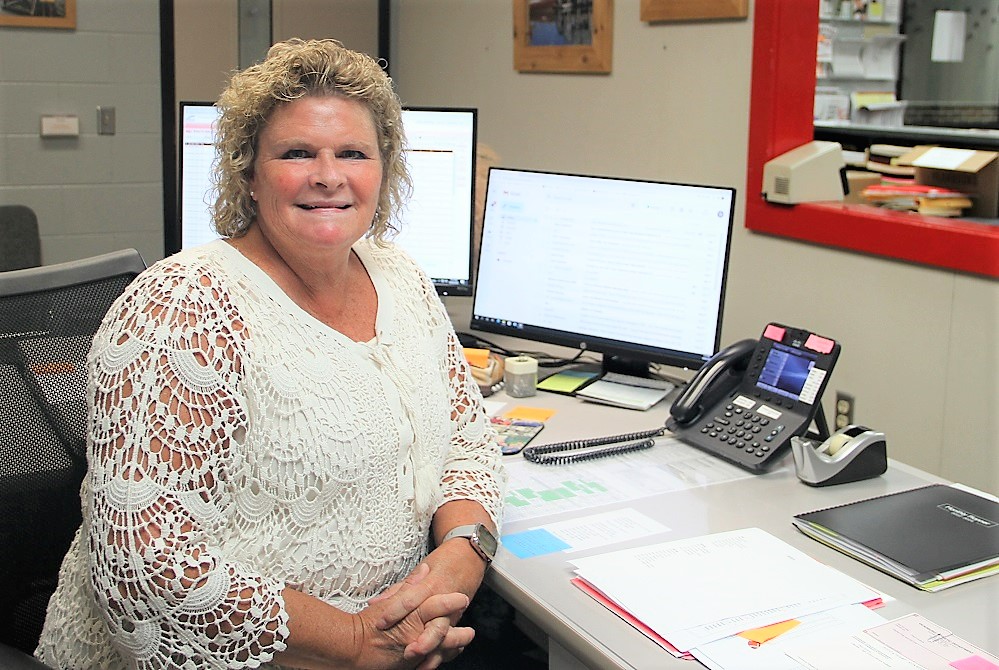
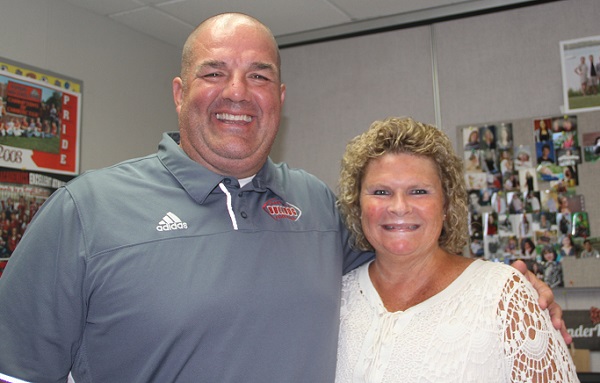
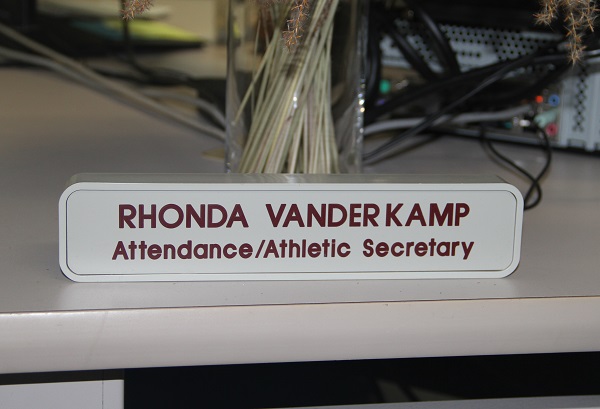
PHOTOS (Top) Rhonda VanderKamp sits at her desk as she begins her 21st year in the Vicksburg athletic department. (2) VanderKamp has worked all 21 years alongside athletic director Michael Roy. (3) The VanderKamp family, from left: son Robert VanderKamp, daughter-in-law Shelby VanderKamp, son-in-law Michael Prior, granddaughter Presley Prior, daughter Andrea Prior, Rhonda VanderKamp, husband Gerrit VanderKamp and father Bob Rainwater. (4) Rhonda VanderKamp has welcomed thousands of students during her time as athletic and attendance secretary. (Top two and bottom photos by Pam Shebest; family photo courtesy of Rhonda VanderKamp.)