


Fenton Principal Bakker Selected as MHSAA's Charles E. Forsythe Award Honoree
By
Geoff Kimmerly
MHSAA.com senior editor
March 11, 2026
An educator who has served in several roles – as a teacher, coach, athletic director, assistant principal and for the last four years principal at Fenton High School – Mike Bakker is able to draw from a wealth of experiences as he serves students not only in his school district but as a statewide decision-maker and leader.
In recognition of his several contributions over the last two decades, especially to educational athletics, Bakker has been selected to receive this year’s MHSAA Charles E. Forsythe Lifetime Achievement Award.
The annual award is in its 49th year and named after past MHSAA Executive Director Charles E. Forsythe, the Association's first full-time and longest-serving chief executive. Forsythe Award recipients are selected each year by the MHSAA Representative Council, based on an individual's outstanding contributions to the interscholastic athletics community at the local, regional and statewide levels. Bakker will be honored this weekend during the Michigan Interscholastic Athletic Administrators Association (MIAAA) annual conference in Traverse City.
Bakker began his professional career at Mason High School. He was hired initially as the boys tennis coach while still a junior in college, and then served twice as a long-term substitute teacher before being hired full time and teaching mathematics and statistics, serving as a club advisor and coaching girls and boys swimming & diving in addition to tennis. He moved to Fenton Area Public Schools as the middle and high school athletic director and assistant principal in 2004. Bakker became interim principal midway through the 2021-22 school year, with that promotion made permanent that March.
“I do think that because I’ve held all of those different roles, I still have all of those connections, and there are other athletic directors who have gone on to become principals and those are the people I reach out to – I know they have a passion for making sure everybody, because of the positions they’ve held, has success in different areas,” Bakker said. “Working in athletics so long, and helping those students find success and helping coaches find success, helped me help students who are not in athletics have success. It’s provided a pretty awesome opportunity and perspective to see how the system works and how to help students be successful and help teachers and coaches be successful.”
Bakker’s contributions have long stretched beyond his classroom and office duties as well. Locally, he’s served on the Fenton Education Foundation board of directors for two decades. As athletic director, he hosted more than 125 MHSAA Tournaments over 17 years and served on a dozen MHSAA committees.
Bakker also has been a member of both the MIAAA – the state’s professional organization for athletic administrators – and National Interscholastic Athletic Administrators Association (NIAAA) for 22 years and has served in several leadership roles with the MIAAA including as president during the 2015-16 school year and as assistant executive director since 2018.
Bakker also is serving his second school year as a member of the MHSAA Representative Council.
 “As someone who has dedicated himself to education and served in various roles over the last 25 years, Mike Bakker has gained a broad perspective that has helped shape his leadership – and he continues to give more of himself with his contributions at the MHSAA and MIAAA leadership levels,” MHSAA Executive Director Mark Uyl said. “As a member of the Representative Council, he provides input on how decisions could affect all groups involved, and our schools are fortunate to have his valuable voice and viewpoint.”
Bakker also has been a member of both the Michigan Association of Secondary School Principals (MASSP) and National Association of Secondary School Principals (NASSP) for 15 years. As a coach he was a member of the Michigan Interscholastic Swim Coaches Association (MISCA) and served as a Zone representative from 2001-04.
Bakker was selected as the MIAAA’s Region 9 Athletic Director of the Year in 2010, and as its statewide Tom Rashid Athletic Director of the Year for 2020-21. He also was named Athletic Director of the Year in 2021 by the Michigan High School Coaches Association.
“For me, being an educator, and part of why I went into education and administration, was to help in the education process of the whole student. That doesn’t include just the classroom walls from the first bell to the last bell,” Bakker said. “To really impact kids, you have to build relationships, meet them where they’re at, and you have to help them find success not just in the classroom but out(side it), to help them become better than they thought they could be. … Even when I was athletic director, I still going and seeing kids perform in other things, and I was in charge of clubs as the athletic director, and all of those things allowed me to help meet students where they are and where their needs are as they are figuring out who they want to be when they leave.”
A 1994 graduate of Rochester High School – where he swam and played soccer, tennis and basketball – Bakker earned a bachelor’s degree in mathematics from Michigan State University in 1998 and his secondary teaching certificate from MSU in 2000. He earned a master’s degree in educational leadership from MSU in 2004 and a master’s in sports administration from Eastern Michigan University in 2011. He also received his certified master athletic administrator designation from the NIAAA in 2011.
Bakker and his wife Denise have been married for 23 years and have three children – sons Jasper and Tristan and daughter Paige.
Past recipients of the Charles E. Forsythe Award
1978 - Brick Fowler, Port Huron; Paul Smarks, Warren
1979 - Earl Messner, Reed City; Howard Beatty, Saginaw
1980 - Max Carey, Freesoil
1981 - Steven Sluka, Grand Haven; Samuel Madden, Detroit
1982 - Ernest Buckholz, Mt. Clemens; T. Arthur Treloar, Petoskey
1983 - Leroy Dues, Detroit; Richard Maher, Sturgis
1984 - William Hart, Marquette; Donald Stamats, Caro
1985 - John Cotton, Farmington; Robert James, Warren
1986 - William Robinson, Detroit; Irving Soderland, Norway
1987 - Jack Streidl, Plainwell; Wayne Hellenga, Decatur
1988 - Jack Johnson, Dearborn; Alan Williams, North Adams
1989 - Walter Bazylewicz, Berkley; Dennis Kiley, Jackson
1990 - Webster Morrison, Pickford; Herbert Quade, Benton Harbor
1991 - Clifford Buckmaster, Petoskey; Donald Domke, Northville
1992 - William Maskill, Kalamazoo; Thomas G. McShannock, Muskegon
1993 - Roy A. Allen Jr., Detroit; John Duncan, Cedarville
1994 - Kermit Ambrose, Royal Oak
1995 - Bob Perry, Lowell
1996 - Charles H. Jones, Royal Oak
1997 - Michael A. Foster, Richland; Robert G. Grimes, Battle Creek
1998 - Lofton C. Greene, River Rouge; Joseph J. Todey, Essexville
1999 - Bernie Larson, Battle Creek
2000 - Blake Hagman, Kalamazoo; Jerry Cvengros, Escanaba
2001 - Norm Johnson, Bangor; George Lovich, Canton
2002 - John Fundukian, Novi
2003 - Ken Semelsberger, Port Huron
2004 - Marco Marcet, Frankenmuth
2005 - Jim Feldkamp, Troy
2006 - Dan McShannock, Midland; Dail Prucka, Monroe
2007 - Keith Eldred, Williamston; Tom Hickman, Spring Lake
2008 - Jamie Gent, Haslett; William Newkirk, Sanford Meridian
2009 - Paul Ellinger, Cheboygan
2010 - Rudy Godefroidt, Hemlock; Mike Boyd, Waterford
2011 - Eric C. Federico, Trenton
2012 - Bill Mick, Midland
2013 - Jim Gilmore, Tecumseh; Dave Hutton, Grandville
2014 - Dan Flynn, Escanaba
2015 - Hugh Matson, Saginaw
2016 - Gary Hice, Petoskey; Gina Mazzolini, Lansing
2017 - Chuck Nurek, Rochester Hills
2018 - Gary Ellis, Allegan
2019 - Jim Derocher, Negaunee; Fredrick J. Smith, Stevensville
2020 - Michael Garvey, Lawton
2021 – Leroy Hackley Jr., Byron Center; Patti Tibaldi, Traverse City
2022 – Bruce Horsch, Houghton
2023 – Karen Leinaar, Frankfort
2024 – Sean Jacques, Calumet
2025 – Kris Isom, Adrian
PHOTOS (Top) Fenton's Mike Bakker monitors activities from the field during a Tigers football game. (Middle) Bakker, left, takes a photo with daughter Paige and wife Denise as Paige holds the Flint Metro League volleyball championship trophy. (Photos provided by Mike Bakker.)
Sailor Nation Works Together to Save Life
December 12, 2019
By Tom Kendra
Special for Second Half
Bob Mirkle calls it a miracle that he’s still alive.
 The 74-year-old Norton Shores resident had a brush with death Oct. 18 in front of 7,000 fans packed into Sailor Stadium for the blockbuster Muskegon at Mona Shores football game.
Just as the huge crowd stood for the national anthem, Mirkle was slumping back onto the bleachers from cardiac arrest, later identified as the failure of a heart stent which had been implanted 18 years ago.
“Something’s wrong with grandpa!” screamed his grandson, causing a ruckus in the Mona Shores reserved section, about 10 rows below the press box.
What transpired over the next 30 minutes was an incredible performance by the Mona Shores fans, coaches, media and entire community to save Mirkle’s life. It was a textbook reaction which was lauded by Norton Shores public safety officials – and the Mirkle family.
“We live in a great community,” said Cheryl Mirkle, Bob’s wife, who stayed home that night to babysit two of her grandchildren. “In a lot of other places, he wouldn’t have made it. We were told that 1 out of 9 people who have that situation happen don’t make it. So we believe it was nothing short of a miracle.”
The immediate family surrounding Mirkle – many of whom were at the game to support Shores starting junior linebacker Karsen Marihugh, Bob’s great-nephew, and two other family members who are cheerleaders – helped clear a small area in the packed stands and get Mirkle down flat on his back.
A woman sitting four rows back, who was well trained in cardio-pulmonary resuscitation, was able to clear Mirkle’s airway and immediately start chest compressions.
Mark Konecny, a Mona Shores assistant coach and part-time Norton Shores fireman, recognized what was going on and grabbed the automated external defibrillator (AED) on the sidelines and headed up into the stands. Konecny, who was an all-state quarterback for Shores in 1980 and went on to play two years in the NFL with Miami and Philadelphia, was able to connect the defibrillator and shock Mirkle’s heart back into action.
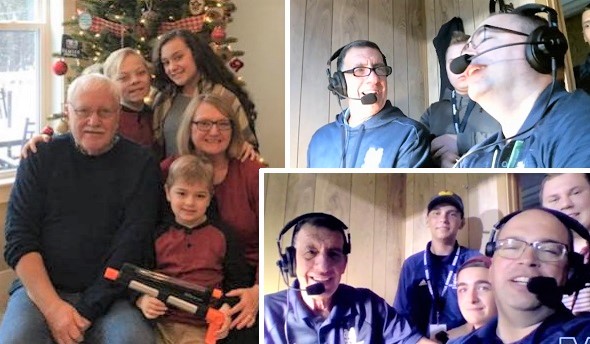
 Joe Kinnucan, who was in the press box about to go on the air with a Sailor Nation Sports Network broadcast of the game, threw down his headset and made a beeline for Mirkle, leaving his son Noah to make his unplanned broadcasting debut.
“There was no second thought,” explained Kinnucan, whose full-time job is Deputy Fire Chief for the Norton Shores Fire Department. “You ask any first responder who is truly vested in their work, and they will tell you that they are always on call. I was just happy to be able to help out.”
The huge crowd and both teams, who were wired for one of the state’s biggest regular-season prep football games of the year, briefly put aside the intense rivalry and went dead quiet out of respect. Shores public address announcer Dan Vandermyde even asked those in attendance to say a prayer as Mirkle was carried underneath the bleachers, where Konecny and Kinnucan and others continued working on him as the game began.
Cheryl Mirkle, meanwhile, who was at home and receiving cryptic, panicked phone calls and texts from friends and family, believed that her husband had died. That is until she got a call from her niece, screaming: “He’s breathing! He’s alive!”
Cheryl first saw her husband at Mercy Hospital in Muskegon where, like a true fan, the first words out of his mouth were: “What’s the score?”
The score of that night’s game was surprisingly one-sided: Muskegon 53, Mona Shores 0. Since that shocking night, both Mirkle and the Sailors have been on the recovery trail.
Mirkle underwent heart bypass surgery Oct. 23, five days after the game, and ended up spending 11 days in the hospital. He is back home and even mowed the lawn one day, and will start his therapy sessions this week.
“I’m doing great,” said Mirkle, a retired truck driver and devout fisherman. “I’m getting better and getting ready to start going to therapy. My story has a happy ending.”
As Mirkle was recovering, the Sailors and Big Reds were putting together long playoff runs, with both culminating Thanksgiving weekend in MHSAA Finals appearances at Ford Field in Detroit.
Muskegon’s run came to a disappointing end in a 30-7 loss to River Rouge in the Division 3 championship game.
Mona Shores, meanwhile, continued its magic run under diminutive junior quarterback Brady Rose, upsetting Detroit Martin Luther King, 35-26, in the Division 2 title game.
It capped an amazing rags-to-riches story for Mona Shores, which until recently had become synonymous with losing on the football field. Shores had only one winning season during a 14-year stretch from 1998 to 2012, but ended its playoff drought in 2013 and then made it all the way to the Division 2 championship game in both 2014 and 2018, before taking it all this time.
“We have waited all of these years for Shores to win some football games, and now it’s happening,” said Cheryl, who has been going to games with her husband since the late 1980s when their nephew, Sam Wakefield, was playing for the Sailors. “It really has been an amazing season in so many ways.”
At the community celebration at the school’s gym on Dec. 1, Mona Shores athletic director Todd Conrad praised the community for its support of the team and for rising up and raising funds to help defray the cost of travel en route to the championship.
It was actually the second time this season that the Mona Shores community responded quickly in a time of need.
“The saving of that man’s life was a textbook example of an entire community responding in the right way,” said Kinnucan. “People responded in a split-second with training which they had acquired somewhere along the line.
“Sure, we went on to win a state championship, which is incredible, but it still doesn’t top that moment and how everyone worked together to save his life.”
 Tom Kendra worked 23 years at The Muskegon Chronicle, including five as assistant sports editor and the final six as sports editor through 2011. E-mail him at [email protected] with story ideas for Muskegon, Oceana, Mason, Lake, Oceola, Mecosta and Newaygo counties.
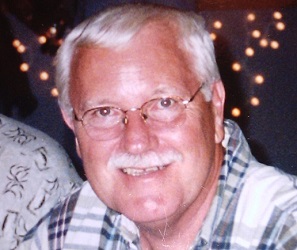
PHOTOS: (Top left) Bob and Cheryl Mirkle sit for a photo with their three grandchildren during Christmas 2017. (Top right) Joe Kinnucan, far right, returns to the press box Oct. 18 to share with play-by-play partner Nick Davros and their viewers that a man in the stands who was experiencing a cardiac event was “breathing and had a pulse.” (Top below) The Sailor Nation Sports Network crew, from left: Nick Davros, Noah Kinnucan, Connor Fritz, Joe Kinnucan and John Hall (with videographer Kimon Kotos on the roof). (Middle) Bob Mirkle. (Photos courtesy of Joe Kinnucan and Bob Mirkle, respectively.)