

Health & Safety: A Look Back, Gallop Ahead
By
John E. (Jack) Roberts
MHSAA Executive Director, 1986-2018
August 7, 2015
We are just completing year six of eight during which we have been addressing the four important health and safety issues that, for ease of conversation, we call the “Four Hs.”
During the 2009-10 and 2010-11 school years, our focus was on Health Histories. We made enhancements in the pre-participation physical examination form, stressing the student’s health history, which we believe was and is the essential first step to participant health and safety.
During the 2011-12 and 2012-13 school years, our focus was on Heads. We were an early adopter of removal-from-play and return-to-play protocols, and our preseason rules/risk management meetings for coaches included information on concussion prevention, recognition and aftercare.
Without leaving that behind, during the 2013-14 and 2014-15 school years, our focus was on Heat – acclimatization. We adopted a policy to manage heat and humidity – it is recommended for regular season and it’s a requirement for MHSAA tournaments. The rules/risk management meetings for coaches during these years focused on heat and humidity management.
At the mid-point of this two-year period, the MHSAA adopted policies to enhance acclimatization at early season practices and to reduce head contact at football practices all season long.
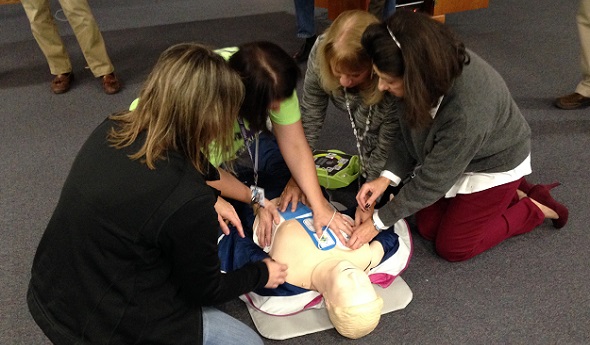
Without leaving any of the three previous health and safety “H’s” behind, during the 2015-16 and 2016-17 school years, our focus will be on Hearts – sudden cardiac arrest and sudden cardiac death.
Coinciding with this emphasis is the requirement that all high school level, varsity level head coaches be CPR certified starting this fall. Our emphasis will be on AEDs and emergency action plans – having them and rehearsing them.
On Feb. 10, bills were introduced into both the U.S. Senate and House of Representatives, together called the “Safe Play Act (see below),” which addressed three of the four health and safety “H’s” just described: Heat, Hearts and Heads.
For each of these topics, the federal legislation would mandate that the director of the Centers for Disease Control develop educational material and that each state disseminate that material.
For the heat and humidity management topic, the legislation states that schools will be required to adopt policies very much like the “MHSAA Model Policy to Manage Heat and Humidity” which the MHSAA adopted in March of 2013.
For both the heart and heat topics, schools will be required to have and to practice emergency action plans like we have been promoting in the past and distributed to schools this summer.
For the head section, the legislation would amend Title IX of the 1972 Education Amendments and eliminate federal funding to states and schools which fail to educate their constituents or fail to support students who are recovering from concussions. This support would require multi-disciplinary concussion management teams that would include medical personnel, parents and others to provide academic accommodations for students recovering from concussions that are similar to the accommodations that are already required of schools for students with disabilities or handicaps.
This legislation would require return-to-play protocols similar to what we have in Michigan, and the legislation would also require reporting and recordkeeping that is beyond what occurs in most places.
This proposed federal legislation demonstrates two things. First, that we have been on target in Michigan with our four Hs – it’s like they read our playbook of priorities before drafting this federal legislation.
This proposed federal legislation also demonstrates that we still have some work to do.
And what will the following two years – 2017-18 and 2018-19 – bring? Here are some aspirations – some predictions, but not quite promises – of where we will be.
First, we will have circled back to the first “H” – Health Histories – and be well on our way to universal use of paperless pre-participation physical examination forms and records.
Second, we will have made the immediate reporting and permanent recordkeeping of all head injury events routine business in Michigan school sports, for both practices and contests, in all sports and at all levels.
Third, we will have added objectivity and backbone to removal from play decisions for suspected concussions at both practices and events where medical personnel are not present; and we could be a part of pioneering “telemedicine” technology to make trained medical personnel available at every venue for every sport where it is missing today.
Fourth, we will have provided a safety net for families who are unable to afford no-deductible, no exclusion concussion care insurance that insists upon and pays for complete recovery from head injury symptoms before return to activity is permitted.
We should be able to do this, and more, without judicial threat or legislative mandate. We won’t wait for others to set the standards or appropriate the funds, but be there to welcome the requirements and resources when they finally arrive.
Safe Play Act — H.R.829
114th Congress (2015-2016) Introduced in House (02/10/2015)
Supporting Athletes, Families and Educators to Protect the Lives of Athletic Youth Act or the SAFE PLAY Act
Amends the Public Health Service Act to require the Centers for Disease Control and Prevention (CDC) to develop public education and awareness materials and resources concerning cardiac health, including:
- information to increase education and awareness of high risk cardiac conditions and genetic heart rhythm abnormalities that may cause sudden cardiac arrest in children, adolescents, and young adults;
- sudden cardiac arrest and cardiomyopathy risk assessment worksheets to increase awareness of warning signs of, and increase the likelihood of early detection and treatment of, life-threatening cardiac conditions;
- training materials for emergency interventions and use of life-saving emergency equipment; and
- recommendations for how schools, childcare centers, and local youth athletic organizations can develop and implement cardiac emergency response plans.
Requires the CDC to: (1) provide for dissemination of such information to school personnel, coaches, and families; and (2) develop data collection methods to determine the degree to which such persons have an understanding of cardiac issues.
Directs the Department of Health and Human Services to award grants to enable eligible local educational agencies (LEAs) and schools served by such LEAs to purchase AEDs and implement nationally recognized CPR and AED training courses.
Amends the Elementary and Secondary Education Act of 1965 to require a state, as a condition of receiving funds under such Act, to certify that it requires: (1) LEAs to implement a standard plan for concussion safety and management for public schools; (2) public schools to post information on the symptoms of, the risks posed by, and the actions a student should take in response to, a concussion; (3) public school personnel who suspect a student has sustained a concussion in a school-sponsored activity to notify the parents and prohibit the student from participating in such activity until they receive a written release from a health care professional; and (4) a public school's concussion management team to ensure that a student who has sustained a concussion is receiving appropriate academic supports.
Directs the National Oceanic and Atmospheric Administration to develop public education and awareness materials and resources to be disseminated to schools regarding risks from exposure to excessive heat and humidity and recommendations for how to avoid heat-related illness. Requires public schools to develop excessive heat action plans for school-sponsored athletic activities.
Requires the CDC to develop guidelines for the development of emergency action plans for youth athletics.
Authorizes the Food and Drug Administration to develop information about the ingredients used in energy drinks and their potential side effects, and recommend guidelines for the safe use of such drinks by youth, for dissemination to public schools.
Requires the CDC to: (1) expand, intensify, and coordinate its activities regarding cardiac conditions, concussions, and heat-related illnesses among youth athletes; and (2) report on fatalities and catastrophic injuries among youths participating in athletic activities.
Martin Brings LA Marathon Championship Experience Home as Jackson High Coach
By
Doug Donnelly
Special for MHSAA.com
April 23, 2026
Nathan Martin has the best possible example a coach can give when it comes to the old phrase, “It’s never over, until it’s over.”
 Last month, the Jackson cross country head coach and track assistant captured national attention when he miraculously came from behind to win the Los Angeles Marathon.
The winning margin was one hundredth (0.01) of a second.
“I didn’t really know if I won,” said Martin. “I tried not to get too emotional or celebrate too much. Then people around me started confirming it.”
Martin, 36, was running his race when, with about five miles to go, he had a surge and passed the pack he was with to get comfortably into second place.
“There was only one guy to catch at that point; he was so far ahead,” Martin said. “I couldn’t even see him. At that point, it was like, ‘Okay, let’s push, let’s finish, be strong, and all that kind of stuff.”
Slowly, the leader came into focus.
“Within the last mile, I’d say, he came into view,” Martin said. “By 800 meters to go I thought I had a serious shot to try and win.
“I made one final surge. That last 800 was super painful. I was thinking to myself maybe I’ll catch him, maybe I won’t, but I definitely wanted to make sure I crossed that finish line with no regrets, knowing I left everything out there.”
As he and the leader, Michael Kimani Kamau of Kenya, approached the finish, the crowed braced for the finish.
“It was the last 50 to 80 meters where the true opportunity to win presented itself and I took full advantage of it,” Martin said. “When I crossed the line, it was so close. I was trying to hold back the excitement and emotions and all of that kind of stuff. People started confirming it, and it was surreal. I just started absorbing the moment and everything going on.”
He credits his own coach, James McCurdy, with preparing him with everything from the right nutrition to handling the Los Angeles heat to the running strategy.”
“It was painful, but I still had something left in the tank,” he said. “If the race would have been a couple miles longer, I would have been okay (to finish).”
Martin finished with a personal best time of 2 hours, 11 minutes, 16.5 seconds. It was the closest finish in LA Marathon history.
 “It was pretty special,” Martin said.
Martin was born in Chicago Heights, Ill., and moved with his family to Three Rivers before he started school. He began running in middle school and competed throughout high school. He ran the mile in high school and the 5K in college.
“I had a lot of success in my running journey,” he said. “Eventually, my coach thought I had what it takes to run a marathon.”
It wanted until late in his college career at Spring Arbor University that Martin ran his first marathon. He was 23.
“I won the 10K, then 36 hours later I won the marathon,” he said. “My coach was like, ‘Okay, you need to do this.’”
Martin is now a professional runner and has sponsors. He was at the Boston Marathon on Monday making appearances and connecting with people in the running community.
After college he began substitute teaching while trying to advance his running career. That’s when he launched his coaching career.
“There was a year where I was substitute teaching and going to races to try and place well,” he said. “By year two or three, I was coaching and I’ve continued that on.”
Martin said coaching is rewarding, “Especially seeing a kid overcome some kind of challenge.
“It’s being able to use my experiences to give back,” he added. “I want to help kids along their running journey. Even if they don’t become a big-time runner, I hope the types of lessons they learn, they can apply in life.
“Just see them be able to fight through something makes me feel like I am making a positive impact in the world.”
Martin has run fewer than 20 marathons in his life. “If you are training at an insanely high level, you usually look at doing one, maybe two or three a year,” he said.
He has taken some time away from marathon training recently as he’s made several national appearances.
And an assistant at Jackson this year, he said he’s noticed a buzz around the distance runners.
“There’s way more interest in distance running,” he said. “Normally they give me my two minutes of fame, then they are back to being high school students. This has been different. They’ve made me feel like definitely I’ve done something.”
He will begin ramping up his training and plans on competing in a half marathon soon, then has set his sights on either the New York or Chicago Marathon.
“It’s been pretty cool,” he said of the running community in Jackson. “They’ve been showing me a lot of love, and they are super proud. If I did Chicago, I imagine I would get a chunk of people down to watch. I’ve had so many people supporting me. It’s a really good feeling.”
 Doug Donnelly has served as a news and sports reporter at the Adrian Daily Telegram and the Monroe News for 30 years, including 10 years as city editor in Monroe. He's written a book on high school basketball in Monroe County and compiles record books for various schools in southeast Michigan. He is now publisher and editor of The Blissfield Advance, a weekly newspaper. E-mail him at [email protected] with story ideas for Jackson, Washtenaw, Hillsdale, Lenawee and Monroe counties.
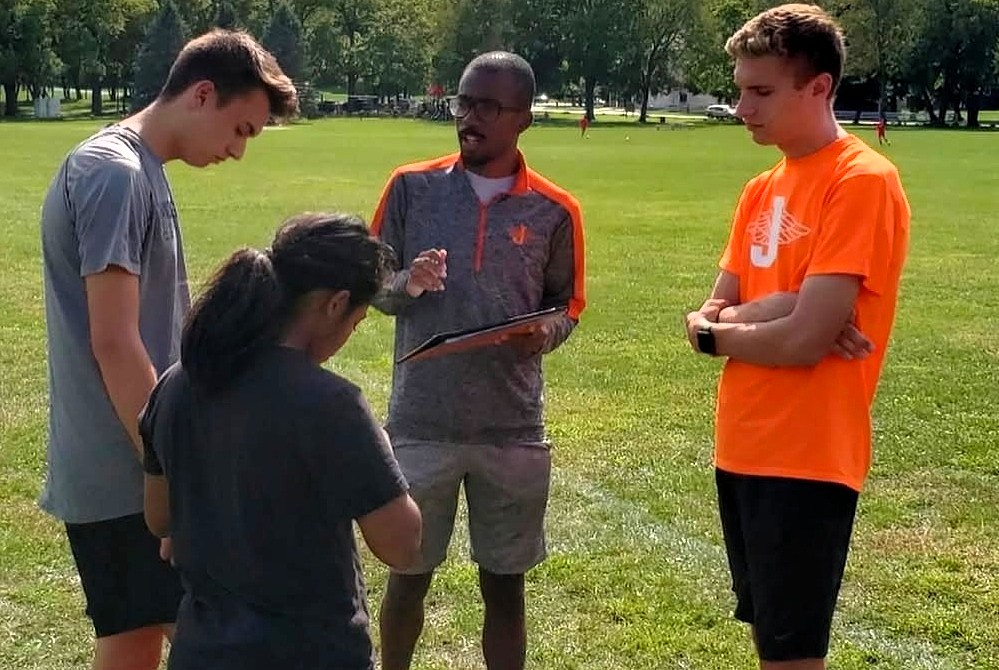
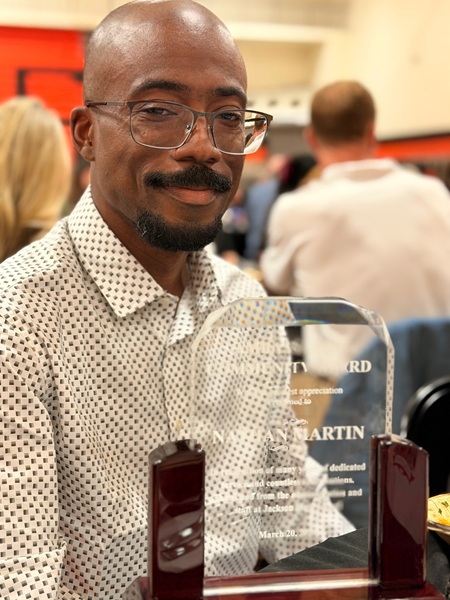
PHOTOS (Top) Nathan Martin, middle with clipboard, coaches his Jackson distance runners. (Middle) Martin poses for a photo with a community award he received from the school. (Photos courtesy of Nathan Martin.)