

Health & Safety: A Look Back, Gallop Ahead
By
John E. (Jack) Roberts
MHSAA Executive Director, 1986-2018
August 7, 2015
We are just completing year six of eight during which we have been addressing the four important health and safety issues that, for ease of conversation, we call the “Four Hs.”
During the 2009-10 and 2010-11 school years, our focus was on Health Histories. We made enhancements in the pre-participation physical examination form, stressing the student’s health history, which we believe was and is the essential first step to participant health and safety.
During the 2011-12 and 2012-13 school years, our focus was on Heads. We were an early adopter of removal-from-play and return-to-play protocols, and our preseason rules/risk management meetings for coaches included information on concussion prevention, recognition and aftercare.
Without leaving that behind, during the 2013-14 and 2014-15 school years, our focus was on Heat – acclimatization. We adopted a policy to manage heat and humidity – it is recommended for regular season and it’s a requirement for MHSAA tournaments. The rules/risk management meetings for coaches during these years focused on heat and humidity management.
At the mid-point of this two-year period, the MHSAA adopted policies to enhance acclimatization at early season practices and to reduce head contact at football practices all season long.
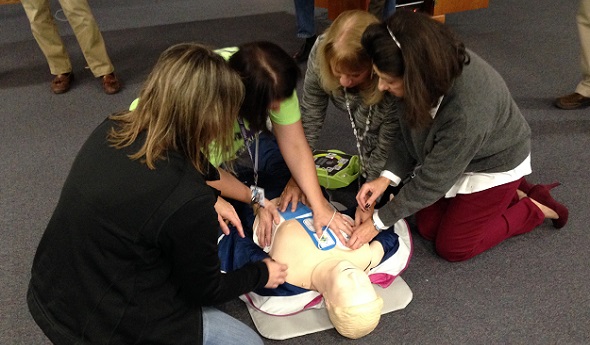
Without leaving any of the three previous health and safety “H’s” behind, during the 2015-16 and 2016-17 school years, our focus will be on Hearts – sudden cardiac arrest and sudden cardiac death.
Coinciding with this emphasis is the requirement that all high school level, varsity level head coaches be CPR certified starting this fall. Our emphasis will be on AEDs and emergency action plans – having them and rehearsing them.
On Feb. 10, bills were introduced into both the U.S. Senate and House of Representatives, together called the “Safe Play Act (see below),” which addressed three of the four health and safety “H’s” just described: Heat, Hearts and Heads.
For each of these topics, the federal legislation would mandate that the director of the Centers for Disease Control develop educational material and that each state disseminate that material.
For the heat and humidity management topic, the legislation states that schools will be required to adopt policies very much like the “MHSAA Model Policy to Manage Heat and Humidity” which the MHSAA adopted in March of 2013.
For both the heart and heat topics, schools will be required to have and to practice emergency action plans like we have been promoting in the past and distributed to schools this summer.
For the head section, the legislation would amend Title IX of the 1972 Education Amendments and eliminate federal funding to states and schools which fail to educate their constituents or fail to support students who are recovering from concussions. This support would require multi-disciplinary concussion management teams that would include medical personnel, parents and others to provide academic accommodations for students recovering from concussions that are similar to the accommodations that are already required of schools for students with disabilities or handicaps.
This legislation would require return-to-play protocols similar to what we have in Michigan, and the legislation would also require reporting and recordkeeping that is beyond what occurs in most places.
This proposed federal legislation demonstrates two things. First, that we have been on target in Michigan with our four Hs – it’s like they read our playbook of priorities before drafting this federal legislation.
This proposed federal legislation also demonstrates that we still have some work to do.
And what will the following two years – 2017-18 and 2018-19 – bring? Here are some aspirations – some predictions, but not quite promises – of where we will be.
First, we will have circled back to the first “H” – Health Histories – and be well on our way to universal use of paperless pre-participation physical examination forms and records.
Second, we will have made the immediate reporting and permanent recordkeeping of all head injury events routine business in Michigan school sports, for both practices and contests, in all sports and at all levels.
Third, we will have added objectivity and backbone to removal from play decisions for suspected concussions at both practices and events where medical personnel are not present; and we could be a part of pioneering “telemedicine” technology to make trained medical personnel available at every venue for every sport where it is missing today.
Fourth, we will have provided a safety net for families who are unable to afford no-deductible, no exclusion concussion care insurance that insists upon and pays for complete recovery from head injury symptoms before return to activity is permitted.
We should be able to do this, and more, without judicial threat or legislative mandate. We won’t wait for others to set the standards or appropriate the funds, but be there to welcome the requirements and resources when they finally arrive.
Safe Play Act — H.R.829
114th Congress (2015-2016) Introduced in House (02/10/2015)
Supporting Athletes, Families and Educators to Protect the Lives of Athletic Youth Act or the SAFE PLAY Act
Amends the Public Health Service Act to require the Centers for Disease Control and Prevention (CDC) to develop public education and awareness materials and resources concerning cardiac health, including:
- information to increase education and awareness of high risk cardiac conditions and genetic heart rhythm abnormalities that may cause sudden cardiac arrest in children, adolescents, and young adults;
- sudden cardiac arrest and cardiomyopathy risk assessment worksheets to increase awareness of warning signs of, and increase the likelihood of early detection and treatment of, life-threatening cardiac conditions;
- training materials for emergency interventions and use of life-saving emergency equipment; and
- recommendations for how schools, childcare centers, and local youth athletic organizations can develop and implement cardiac emergency response plans.
Requires the CDC to: (1) provide for dissemination of such information to school personnel, coaches, and families; and (2) develop data collection methods to determine the degree to which such persons have an understanding of cardiac issues.
Directs the Department of Health and Human Services to award grants to enable eligible local educational agencies (LEAs) and schools served by such LEAs to purchase AEDs and implement nationally recognized CPR and AED training courses.
Amends the Elementary and Secondary Education Act of 1965 to require a state, as a condition of receiving funds under such Act, to certify that it requires: (1) LEAs to implement a standard plan for concussion safety and management for public schools; (2) public schools to post information on the symptoms of, the risks posed by, and the actions a student should take in response to, a concussion; (3) public school personnel who suspect a student has sustained a concussion in a school-sponsored activity to notify the parents and prohibit the student from participating in such activity until they receive a written release from a health care professional; and (4) a public school's concussion management team to ensure that a student who has sustained a concussion is receiving appropriate academic supports.
Directs the National Oceanic and Atmospheric Administration to develop public education and awareness materials and resources to be disseminated to schools regarding risks from exposure to excessive heat and humidity and recommendations for how to avoid heat-related illness. Requires public schools to develop excessive heat action plans for school-sponsored athletic activities.
Requires the CDC to develop guidelines for the development of emergency action plans for youth athletics.
Authorizes the Food and Drug Administration to develop information about the ingredients used in energy drinks and their potential side effects, and recommend guidelines for the safe use of such drinks by youth, for dissemination to public schools.
Requires the CDC to: (1) expand, intensify, and coordinate its activities regarding cardiac conditions, concussions, and heat-related illnesses among youth athletes; and (2) report on fatalities and catastrophic injuries among youths participating in athletic activities.
WISL Honoree Leads by Making Connections
By
Geoff Kimmerly
MHSAA.com senior editor
January 29, 2020
Nikki Norris received her life’s education from professional educators. Her father Howes Smith served as an assistant principal and then principal at Ithaca High School, and her mother Maple was a teacher. Howes’ mom also taught.
Their influence and example certainly rubbed off on Nikki and her siblings. Norris has worked in education for more than 30 years, while her sister is a school guidance counselor and their brother a college professor.
In fact, Norris has impacted educational athletics in nearly every role possible as a teacher and athletic director at multiple schools, coach at various levels and game official. She is in her second year as athletic director at East Lansing High School after eight in that position for Corunna Public Schools. She previously taught for six years at Carson City-Crystal and then 11 at Corunna before taking over the Cavaliers’ athletic department during the summer of 2010.
She also coached volleyball at multiple levels over more than 15 years including Corunna’s varsity from 1999-2002 and 2006-09, and coached high school basketball for a combined eight years during her time at the two schools where she taught. Before and between her volleyball coaching stints, Norris also has served as an MHSAA registered volleyball official for a total of 12 years.
Norris’ many and continuing contributions will be celebrated Sunday, Feb. 2, when she receives the Michigan High School Athletic Association’s 33rd Women In Sports Leadership Award during the WISL Banquet at the Crowne Plaza Lansing West.
“I try to connect with all students, athletes or not, because there are so many kids who just need a connection," Norris said. "And if we can find it through sports, or through clubs, or teaching – I do look at them all as my own children, to a certain extent. We used to say in Corunna, 'They're all our kids.' And I want them to be successful in whatever it is they want. And if I can help them, that's what I'm there for.
“So many people did it for me. Coming from a family of educators, and my dad an administrator, I knew what that entailed as far as how they get into your heart. I want to do that for kids.”
Each year, the MHSAA Representative Council considers the achievements of women coaches, officials and athletic administrators affiliated with the MHSAA who show exemplary leadership capabilities and positive contributions to athletics.
Those who wrote letters recommending Norris for this year’s WISL Award especially noted that personal impact she has on students, staff and colleagues.
Fowlerville athletic director Brian Osborn – one of her former coaches – wrote of how Norris goes above and beyond to care for and connect with her student-athletes. Owosso athletic director Dallas Lintner wrote of Norris’ dedication to children’s safety and educational values. Fenton athletic director Mike Bakker noted how fortunate her students are that Norris made the decision to leave coaching for administration, where she can have an even larger impact.
“Someone asked me once, why do you want to be an athletic director? Well, I can go from impacting 100 kids a day, at that time (as a coach and teacher), to maybe 600 kids a day, to now 1,200 kids a day (at East Lansing),” Norris said, then quipping, “Well, maybe (not all) 1,200 every day.”
But she does continue to lead on wide-ranging levels, both at her much larger school and beyond.
 While at Corunna, Norris served as master scheduler and part of the constitution committee for the Genesee Area Conference. Her schools have hosted various MHSAA Tournament events in multiple sports, in addition to local invitationals and conference meets. She’s served on every type of MHSAA Committee, providing input on a variety of sports, site selection, officials selection and the Scholar-Athlete Award. She also annually volunteers as a tournament administrator at the MHSAA’s Volleyball Finals in November and Baseball/Softball/Girls Soccer Finals in June.
A certified Red Cross instructor, Norris has provided CPR/AED training to coaches, bus drivers and staff members. Corunna in multiple years received the state’s HEARTSafe School designation recognizing preparedness to respond to cardiac emergencies.
As a member of the Michigan Interscholastic Athletic Administrators Association (MIAAA), she has facilitated sessions and presented at its conferences and served on the newsletter committee.
She was named the MIAAA’s Region 7 “Athletic Director of the Year” in 2016. She also has received “Certified Athletic Administrator” designation from the National Interscholastic Athletic Administrators Association (NIAAA).
“Nikki is one of the most genuine, caring and hard-working people I’ve ever met in athletics,” MHSAA Executive Director Mark Uyl said. “She has worked extremely hard in both Corunna and East Lansing to develop a first-class program that produced high-character people. Nikki is truly a role model to everyone in the world of athletic administration.”
A 1987 graduate of Ithaca High School, Norris received her bachelor’s degree in biology with a minor in exercise health science from Alma College – where she also competed as a runner and thrower in track & field – and then earned master’s degrees in biological sciences from Michigan State University and educational leadership from American College of Education.
Norris lives in Bancroft and is the mother to two daughters, Meredith and Elizabeth Norris. Neither is planning to go into education – but sports is a big part of both their current lives and likely futures, and no doubt the impact of growing up in a sports family has played a significant part. (Their dad, Dr. Robert Norris, played basketball at Alma College and serves as physician for the MSU hockey, volleyball and baseball programs and Lansing Lugnuts.)
Meredith was named the state’s Miss Volleyball Award winner in 2017 as a senior at Corunna and plays currently at Michigan State. Elizabeth is a senior at Corunna and was a finalist for the same award this past fall, and will continue her academic and volleyball careers at University of North Dakota. Meredith is majoring in kinesiology, and Elizabeth is planning on orthopedic surgery.
“I look at the names that are on the (WISL Award) list, and there are so many deserving women who over my career I've looked up to and aspired to be like when I 'grow up,'" Norris said. "So to even be considered in that group is amazing, humbling. It's an honor."
Past recipients of the Women In Sports Leadership Award
1990 – Carol Seavoy, L’Anse
1991 – Diane Laffey, Harper Woods
1992 – Patricia Ashby, Scotts
1993 – Jo Lake, Grosse Pointe
1994 – Brenda Gatlin, Detroit
1995 – Jane Bennett, Ann Arbor
1996 – Cheryl Amos-Helmicki, Huntington Woods
1997 – Delores L. Elswick, Detroit
1998 – Karen S. Leinaar, Delton
1999 – Kathy McGee, Flint
2000 – Pat Richardson, Grass Lake
2001 – Suzanne Martin, East Lansing
2002 – Susan Barthold, Kentwood
2003 – Nancy Clark, Flint
2004 – Kathy Vruggink Westdorp, Grand Rapids
2005 – Barbara Redding, Capac
2006 – Melanie Miller, Lansing
2007 – Jan Sander, Warren Woods
2008 – Jane Bos, Grand Rapids
2009 – Gail Ganakas, Flint; Deb VanKuiken, Holly
2010 – Gina Mazzolini, Lansing
2011 – Ellen Pugh, West Branch; Patti Tibaldi, Traverse City
2012 – Janet Gillette, Comstock Park
2013 – Barbara Beckett, Traverse City
2014 – Teri Reyburn, DeWitt
2015 – Jean LaClair, Bronson
2016 – Betty Wroubel, Pontiac
2017 – Dottie Davis, Ann Arbor
2018 – Meg Seng, Ann Arbor
2019 – Kris Isom, Adrian
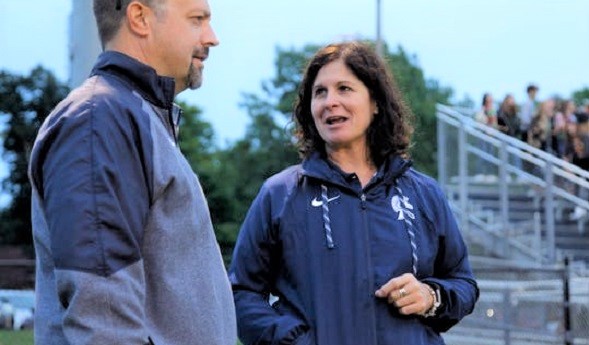
PHOTOS: (Top) East Lansing athletic director Nikki Norris confers with Grand Ledge athletic director Steve Baker during a 2018 football game. (Middle) Norris with daughters Elizabeth, left, and Meredith, after Nikki presented the Cavaliers with a District championship trophy won in 2016. (Top photo courtesy of the Lansing State Journal; middle photo courtesy of Nikki Norris.)