

Health & Safety: A Look Back, Gallop Ahead
By
John E. (Jack) Roberts
MHSAA Executive Director, 1986-2018
August 7, 2015
We are just completing year six of eight during which we have been addressing the four important health and safety issues that, for ease of conversation, we call the “Four Hs.”
During the 2009-10 and 2010-11 school years, our focus was on Health Histories. We made enhancements in the pre-participation physical examination form, stressing the student’s health history, which we believe was and is the essential first step to participant health and safety.
During the 2011-12 and 2012-13 school years, our focus was on Heads. We were an early adopter of removal-from-play and return-to-play protocols, and our preseason rules/risk management meetings for coaches included information on concussion prevention, recognition and aftercare.
Without leaving that behind, during the 2013-14 and 2014-15 school years, our focus was on Heat – acclimatization. We adopted a policy to manage heat and humidity – it is recommended for regular season and it’s a requirement for MHSAA tournaments. The rules/risk management meetings for coaches during these years focused on heat and humidity management.
At the mid-point of this two-year period, the MHSAA adopted policies to enhance acclimatization at early season practices and to reduce head contact at football practices all season long.
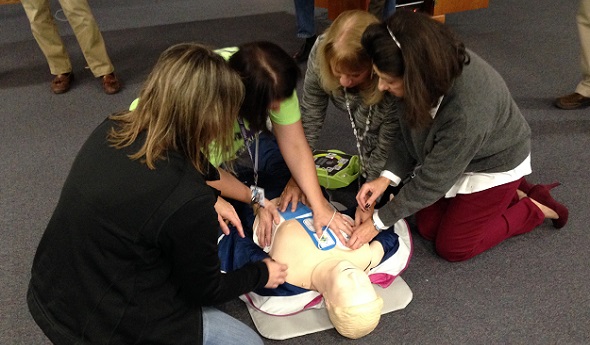
Without leaving any of the three previous health and safety “H’s” behind, during the 2015-16 and 2016-17 school years, our focus will be on Hearts – sudden cardiac arrest and sudden cardiac death.
Coinciding with this emphasis is the requirement that all high school level, varsity level head coaches be CPR certified starting this fall. Our emphasis will be on AEDs and emergency action plans – having them and rehearsing them.
On Feb. 10, bills were introduced into both the U.S. Senate and House of Representatives, together called the “Safe Play Act (see below),” which addressed three of the four health and safety “H’s” just described: Heat, Hearts and Heads.
For each of these topics, the federal legislation would mandate that the director of the Centers for Disease Control develop educational material and that each state disseminate that material.
For the heat and humidity management topic, the legislation states that schools will be required to adopt policies very much like the “MHSAA Model Policy to Manage Heat and Humidity” which the MHSAA adopted in March of 2013.
For both the heart and heat topics, schools will be required to have and to practice emergency action plans like we have been promoting in the past and distributed to schools this summer.
For the head section, the legislation would amend Title IX of the 1972 Education Amendments and eliminate federal funding to states and schools which fail to educate their constituents or fail to support students who are recovering from concussions. This support would require multi-disciplinary concussion management teams that would include medical personnel, parents and others to provide academic accommodations for students recovering from concussions that are similar to the accommodations that are already required of schools for students with disabilities or handicaps.
This legislation would require return-to-play protocols similar to what we have in Michigan, and the legislation would also require reporting and recordkeeping that is beyond what occurs in most places.
This proposed federal legislation demonstrates two things. First, that we have been on target in Michigan with our four Hs – it’s like they read our playbook of priorities before drafting this federal legislation.
This proposed federal legislation also demonstrates that we still have some work to do.
And what will the following two years – 2017-18 and 2018-19 – bring? Here are some aspirations – some predictions, but not quite promises – of where we will be.
First, we will have circled back to the first “H” – Health Histories – and be well on our way to universal use of paperless pre-participation physical examination forms and records.
Second, we will have made the immediate reporting and permanent recordkeeping of all head injury events routine business in Michigan school sports, for both practices and contests, in all sports and at all levels.
Third, we will have added objectivity and backbone to removal from play decisions for suspected concussions at both practices and events where medical personnel are not present; and we could be a part of pioneering “telemedicine” technology to make trained medical personnel available at every venue for every sport where it is missing today.
Fourth, we will have provided a safety net for families who are unable to afford no-deductible, no exclusion concussion care insurance that insists upon and pays for complete recovery from head injury symptoms before return to activity is permitted.
We should be able to do this, and more, without judicial threat or legislative mandate. We won’t wait for others to set the standards or appropriate the funds, but be there to welcome the requirements and resources when they finally arrive.
Safe Play Act — H.R.829
114th Congress (2015-2016) Introduced in House (02/10/2015)
Supporting Athletes, Families and Educators to Protect the Lives of Athletic Youth Act or the SAFE PLAY Act
Amends the Public Health Service Act to require the Centers for Disease Control and Prevention (CDC) to develop public education and awareness materials and resources concerning cardiac health, including:
- information to increase education and awareness of high risk cardiac conditions and genetic heart rhythm abnormalities that may cause sudden cardiac arrest in children, adolescents, and young adults;
- sudden cardiac arrest and cardiomyopathy risk assessment worksheets to increase awareness of warning signs of, and increase the likelihood of early detection and treatment of, life-threatening cardiac conditions;
- training materials for emergency interventions and use of life-saving emergency equipment; and
- recommendations for how schools, childcare centers, and local youth athletic organizations can develop and implement cardiac emergency response plans.
Requires the CDC to: (1) provide for dissemination of such information to school personnel, coaches, and families; and (2) develop data collection methods to determine the degree to which such persons have an understanding of cardiac issues.
Directs the Department of Health and Human Services to award grants to enable eligible local educational agencies (LEAs) and schools served by such LEAs to purchase AEDs and implement nationally recognized CPR and AED training courses.
Amends the Elementary and Secondary Education Act of 1965 to require a state, as a condition of receiving funds under such Act, to certify that it requires: (1) LEAs to implement a standard plan for concussion safety and management for public schools; (2) public schools to post information on the symptoms of, the risks posed by, and the actions a student should take in response to, a concussion; (3) public school personnel who suspect a student has sustained a concussion in a school-sponsored activity to notify the parents and prohibit the student from participating in such activity until they receive a written release from a health care professional; and (4) a public school's concussion management team to ensure that a student who has sustained a concussion is receiving appropriate academic supports.
Directs the National Oceanic and Atmospheric Administration to develop public education and awareness materials and resources to be disseminated to schools regarding risks from exposure to excessive heat and humidity and recommendations for how to avoid heat-related illness. Requires public schools to develop excessive heat action plans for school-sponsored athletic activities.
Requires the CDC to develop guidelines for the development of emergency action plans for youth athletics.
Authorizes the Food and Drug Administration to develop information about the ingredients used in energy drinks and their potential side effects, and recommend guidelines for the safe use of such drinks by youth, for dissemination to public schools.
Requires the CDC to: (1) expand, intensify, and coordinate its activities regarding cardiac conditions, concussions, and heat-related illnesses among youth athletes; and (2) report on fatalities and catastrophic injuries among youths participating in athletic activities.
2026 MHSAA Bush Awards Honorees Exemplify Dedicated Service in Several Roles
By
Geoff Kimmerly
MHSAA.com senior editor
June 30, 2026
Athletic administrators must balance multiple roles no matter the size of their school districts or numbers of sports they direct, and St. Ignace’s Don Gustafson, Brethren’s Jason Kemler, Grand Rapids’ Jolinda Lucas and Greenville’s Brian Zdanowski have thrived while shouldering wide-ranging responsibilities to provide first-rate athletic experiences for their students.
Their dedication to school sports and those athletes – both locally and statewide – made them clearly deserving recipients of 2026 Allen W. Bush Meritorious Service Awards as selected by the Michigan High School Athletic Association’s Representative Council.
Al Bush served as executive director of the MHSAA for 10 years. The award honors individuals for past and continuing service to school athletics as a coach, administrator, official, trainer, doctor or member of the media. The award was developed to bring recognition to people who are giving and serving locally, regionally or statewide without a lot of attention. This is the 35th year of the award.
 Gustafson has taught at his alma mater St. Ignace since 1982 and continued even after retiring from administration in 2021. In addition to his classroom work, he served as assistant athletic director his first three years, then athletic director for four, as junior high principal from 1994-2005, high school principal from 2005-11 and superintendent for the next decade.
He’s also been an MHSAA-registered game official since 1978, working six Finals in football, one in basketball and numerous in cross country, in addition to several more postseason events during his time officiating seven sports. He was named to the Basketball Coaches Association of Michigan (BCAM) Hall of Honor in 2021 as an official and “Friend of Basketball.”
Gustafson served on the MHSAA Representative Council from 2015-21. The Michigan State University grad also has served on St. Ignace’s city council, taking time away only during his tenure as superintendent.
“Don Gustafson’s contributions to school sports span nearly half a century and have included everything from behind-the-scenes support to being considered one of the state’s top game officials and a valued voice on our Representative Council,” MHSAA Executive Director Mark Uyl said. “He has long been a knowledgeable and positive voice impacting not only the Upper Peninsula but our community statewide.”
 Brethren High School athletic director Jason Kemler recently completed his 20th year with the Kaleva Norman Dickson school district, where he has hosted several MHSAA Tournament events in a variety of sports including Regionals in track & field both at the high school and middle school/junior high levels. He’s also served on multiple MHSAA committees including the Junior High/Middle School Committee.
Kemler has done extensive work as well as part of the Michigan Interscholastic Athletic Administrators Association (MIAAA), serving as a regional representative, historical records chairperson and co-chair of the middle school/junior high committee, and also co-chair for the MIAAA’s 60th and 65th anniversary celebrations. He was named the MIAAA’s Region 3 Athletic Director of the Year in 2023.
Kemler is a graduate of Dansville High School and Albion College and received his teaching certificate from Michigan State University and master’s from Central Michigan University. He also serves as a captain for his local fire department.
“Jason Kemler’s stamp is all over the Brethren athletic department and community as a whole, as he’s embraced all of the roles that go with serving at a small school – teaching physical education and history and coaching as well as serving as athletic director and representing his school in significant ways among his colleagues statewide,” Uyl said. “His commitment and dedication are fine examples of what the Bush Award seeks to recognize.”
 Lucas also has made an outsized impact at the middle school level during her 14 years serving in multiple roles for Grand Rapids Public Schools, including as middle school athletic director, director of all GRPS elementary sports and as athletic director for Grand Rapids University Prep Academy, whose students compete for either Ottawa Hills or Union High School. She has served on the MHSAA Junior High/Middle School Committee, contributing to an increasing emphasis at that level, and was selected as a meet manager for inaugural MHSAA Cross Country and Track & Field Regionals for junior high/middle school athletes.
Also a teacher at University Prep and an MHSAA-registered official the last six years for track & field and cross country – and the last two for volleyball – Lucas has served as sportsmanship chair for the MIAAA and as part of the MHSAA/Farm Bureau Insurance Scholar-Athlete Award Committee, and on the board for the Michigan-based Academy of Sports Leadership. She was named the MIAAA’s Region 14 Athletic Director of the Year in 2022.
Lucas graduated from Hobart (Ind.) High School and has a bachelor’s degree in physical education and health from Indiana State University, a master’s in educational leadership from Indiana University, and earned her certified athletic administrator designation from the National Interscholastic Athletic Administrators Association (NIAAA). She is a Red Cross instructor and has served on the GRPS health and physical education leadership team. Prior to coming to Grand Rapids, Lucas served in multiple athletic administration roles in Indiana, where she also taught for 24 years and earned a 30-year coaching and multiple 20-year service awards.
“Jolinda Lucas has brought a special dedication to our junior high and middle school sports and their important roles in educational athletics,” Uyl said. “She has provided valuable input on a variety of historic decisions, including the addition of sixth graders to MHSAA competition and creation of Regional competitions in cross country and track & field. Her foresight is impacting Michigan’s school-sports athletes at the youngest levels and making a difference that will continue to benefit them as they advance to high school programs.”
 Zdanowski recently completed his 28th school year as athletic director at Greenville after previously serving as a teacher, coach and athletic director over a decade at Onaway and Midland Bullock Creek. As an athletic director, he has hosted more than 100 MHSAA Tournament events, including five 8-Player Football Finals and 13 11-Player Semifinals. He also has been an MHSAA-registered game official for 44 years, working five sports including Finals in baseball in 1995 and football in 2001.
The longtime administrator also has served on multiple MHSAA committees, including more than a decade on the MHSAA/Farm Bureau Insurance Scholar-Athlete Award Committee, and served as Ottawa-Kent Conference president for two years. He’s been a member of the MIAAA for 34 years, Michigan Association of Secondary School Principals (MASSP) for 28 years and National Association of Sports Officials (NASO) for 25. He was named the MIAAA’s Region 4 Athletic Director of the Year in 2008.
Zdanowski, a graduate of Standish-Sterling, has a bachelor’s degree in teacher education from Saginaw Valley State University and a master’s in athletic administration from Central Michigan University. He’s also completed 24 courses from the NIAAA Leadership Training Institute.
“Brian Zdanowski has created a program at Greenville that is the model of quality, and that was proven deservedly when his athletic department was named an Exemplary Athletic Program by the MIAAA in 2000, the first year of that prestigious recognition program,” Uyl said. “He has consistently shared what he’s built at home with the rest of the state for now several decades, and we continue to be thankful for Brian’s desire to serve and contribute to school sports in a variety of leadership roles.”
The MHSAA is a private, not-for-profit corporation of voluntary membership by more than 1,500 public and private senior high schools and junior high/middle schools which exists to develop common rules for athletic eligibility and competition. No government funds or tax dollars support the MHSAA, which was the first such association nationally to not accept membership dues or tournament entry fees from schools. Member schools which enforce these rules are permitted to participate in MHSAA tournaments, which attract more than 1.4 million spectators each year.