


'Hearts' Focus Includes Action Planning
November 12, 2015
By Geoff Kimmerly
Second Half editor
As most of Michigan’s high school athletes move inside this month for the start of winter sports, many will take part in a program introduced to Michigan High School Athletic Association member schools this fall that assists coaches and students in preparing for the possibility of a health emergency during their after-school practices and events.
Prior to the start of this 2015-16 school year, the MHSAA sent every member school the “Anyone Can Save a Life” emergency action plan authored by the Minnesota State High School League and the Medtronic Foundation. The program instructs schools to assemble teams made up of coaches and their students that will act in the event someone suffers sudden cardiac arrest or another emergency medical situation.
“Anyone Can Save a Life” suggests a game plan that establishes four teams on every level of every sport in a school – a 911 Team, CPR (cardiopulmonary resuscitation) Team, AED (automated external defibrillator) Team and Heat Stroke Team. The groups are made up of coaches and their students who will be in close proximity to all after-school activities.
It’s another valuable tool as the MHSAA begins work on the fourth piece of its eight-year “4 H’s” health and safety emphasis. The next two school years focus on Hearts to go with efforts over the last six years centered on Health Histories, Heads and Heat issues faced by MHSAA athletes. This fall, for the first time, all varsity head coaches at MHSAA member schools were required to have CPR certification – another means by which athletic personnel can work to counter the random, unpredictable nature of sudden cardiac arrest.
“There is something we can do. We can be prepared. We can develop emergency plans, display AEDs and deliver CPR. And, like any good sports teams, we need to practice our preparations,” MHSAA Executive Director John E. “Jack” Roberts said. “’Anyone Can Save a Life’ can help schools revise or revitalize their existing emergency plans in ways that engage team members in planning, practice and execution. This could help save lives now and also convey important lifelong life-saving lessons to students involved on these teams.”
Students are a vital component to having a successful emergency action plan. They will be put in position to call 911, meet the ambulance at a pre-determined access point, locate the nearest AED, make sure immersion tubs are filled for hot-weather practices, and for those who are trained, to assist with CPR. Coaches identify students at the beginning of the season and prior to an emergency taking place, and provide them with the details of the job they are assigned so they will be ready to assist in the event of an emergency.
The “Anyone Can Save a Life” plan was sent to schools nationwide with assistance from the National Federation of State High School Associations and the NFHS Foundation. Click for information on "Anyone Can Save a Life."
“The ‘Anyone Can Save a Life’ initiative promotes the need to have and to practice planning for different kinds of emergencies,” Roberts said. “The result can be a fresh, comprehensive emphasis on preparing for emergencies well before they occur and then responding with more confidence when those emergencies inevitably happen. It is the perfect link between the last two years when we focused on heat illness and the next two years when we focus on sudden cardiac arrest.”
This fall’s focus on “Hearts” began in the wake of 122 Michigan schools receiving recognition this spring as HEARTSafe by the Michigan Department of Health and Human Services, Michigan Department of Education, American Heart Association, Michigan Alliance for Prevention of Sudden Cardiac Death of the Young and the MHSAA.
Public Act 12 of 2014 requires all schools (grades kindergarten to 12) to have a cardiac emergency response plan in place. This MI HEARTSafe School designation recognizes 122 schools that have taken steps above and beyond to prepare to respond in the event of a cardiac emergency, and is awarded for a period of three years.
In order for a school to receive MI HEARTSafe designation, it must perform at least one cardiac emergency response drill per year, have a written medical emergency response plan and team, have current CPR/AED certification of at least 10 percent of staff, have accessible, properly maintained and inspected AEDs with signs identifying their location, and ensure pre-participation sports screening of all student-athletes using the current physical and history form endorsed by the MHSAA.
Schools that meet all requirements are able to apply for the MI HEARTSafe School designation each year. Click for information and for a list of designated schools.
Peck Bands Together to Honor Welch's Memory as Pirates Return to Diamond
By
Paul Costanzo
Special for MHSAA.com
April 15, 2026
Bill Kerr didn’t need to spend much time back at the Little League fields in Peck before his childhood friend James Welch caught his ear.
 Not in conversation, but from the dugout, doing one of the things he loved most – coaching kids.
“When I got back to Peck 10 years ago, he was coaching Little League. We started talking about how we could get him in front of more kids and doing more,” said Kerr, the Peck superintendent. “I always joked that I was recruiting him. I’ve been around coaches forever, evaluated coaches forever, and you could just hear it, even at the Little League fields. You could hear his message and how strong it was.”
Kerr brought Welch on board at Peck, first as the baseball coach and eventually as athletic director, and over a few short years he made an out-sized impact on the kids he worked with and the community at large.
Welch died unexpectedly on Nov. 6, 2025, but that impact is still being felt today on the baseball diamond and beyond.
“He was always so authentic and positive with (students),” Kerr said. “In this day and age, a lot of adults are kind of hesitant to kind of address some of the things that don’t apply on the field. He and I talked a lot about making them good people and leaders rather than worry about what type of athlete they were. That was the most important thing to him, with his baseball players, he wanted to make sure they were good people.”
The Peck gymnasium was required to host all the people who showed up for Welch’s memorial service, and school was canceled the day after his passing.
His players were there, however.
“The next day we had school off, but the school was open because staff had to report,” said Jen Kluger, Welch’s friend and assistant coach. “All the boys came in. We all sat in James’ office and talked and cried. We were just together.”
Kluger, who began working in Peck in 2023, was surprised at how much the community came together in the days after Welch’s passing.
“It happened on a Thursday, and that Sunday we had a booster meeting because the funeral was going to be at the school and the boosters were going to handle everything,” Kluger said. “Normally, we have five or six people show up, and on that day, I don’t even know how many people were there. I was blown away. Jessica Royle is the booster president and we were texting a couple days later, I was like, ‘I am blown away by all these people that just showed up.’ She was like, ‘That’s Peck. That’s what they do.’”
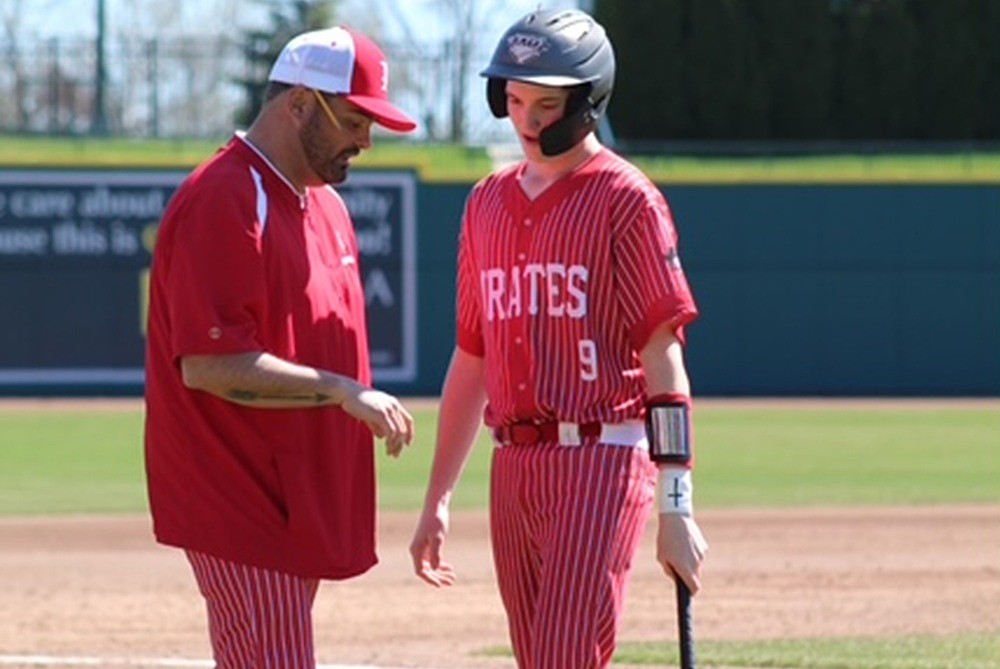
While the entire community was mourning Welch, it was also there to support his family – his wife Shane and son Grady, who is a junior at Peck.
 “I would say it definitely helped,” Grady said. “I felt like I wasn’t alone in grieving. Everyone in the whole community knew him, knew everything about him and what he stood for.”
The Welch family was part of the Peck community long before James began working at the school. He was a star athlete for the Pirates during the 1990s, playing football, basketball and baseball. He was part of the 1995 Peck football team that advanced to the Semifinals, and the 1994 baseball team that advanced to the Quarterfinals.
That 1994 team was inducted into the Peck High School Hall of Fame – something Welch worked with Kerr to establish – shortly after his passing.
“He was like one of those five-tool guys,” said Kerr, who graduated from Peck a year before Welch. “His best sport was football, but he was a very good baseball player.”
Now, while weather has not allowed them to get onto the field much for practice let alone play a game, Welch’s players are together again for the start of baseball season. Kluger has taken over the program as coach, which was announced in December.
“The day before we went on Christmas break, I called them all down to the gym, and I couldn’t say anything until the board approved it, so I had to sit on it for three weeks,” Kluger said. “I sat them all down, and I didn’t know how they were going to react. They didn’t seem upset about it. I got some hugs, got some claps, got some high fives.”
Not only were the players not upset, it’s the move they wanted as they had to move into a world without their coach.
“It definitely helped a lot,” Grady Welch said. “She knew how my dad ran practices, everyone knows her and she’s a nice person. It definitely helps to transition into baseball season knowing that things aren’t going to change.”
Of course, for Grady, it’s much more than simply not having a coach. He admits that the beginning of the season has been difficult – as does Kluger – but his teammates have been there to lift him up when he needs it. Many of them have been his teammates, and played for his father, since T-ball.
“I always have my space if I do need to take space,” Grady said. “But we’ve always been a group that’s been together all the time. We have a very good friendship between all of us.”
To honor James Welch, Kerr said supporters are working to create a scholarship in his name, and that his former high school number will be hung on the outfield fence at Peck.
Welch wore No. 9, as his father’s favorite player was Roger Maris. That number has been worn the past two years by Grady, who switched to it in middle school because of his dad.
Stepping onto the field in a game for the first time – which would be Thursday if weather permits – is certain to be an emotional moment for Kluger, Grady, his teammates and everyone in attendance. But it will also be the next step in honoring Welch by being together and playing the sport he loved.
“There’s a few that are going to struggle (emotionally),” Kluger said. “But I think at this point, they all want to be on the field and want to play.”
 Paul Costanzo served as a sportswriter at The Port Huron Times Herald from 2006-15, including three years as lead sportswriter, and prior to that as sports editor at the Hillsdale Daily News from 2005-06. He can be reached at [email protected] with story ideas for Genesee, Lapeer, St. Clair, Sanilac, Huron, Tuscola, Saginaw, Bay, Arenac, Midland and Gladwin counties.
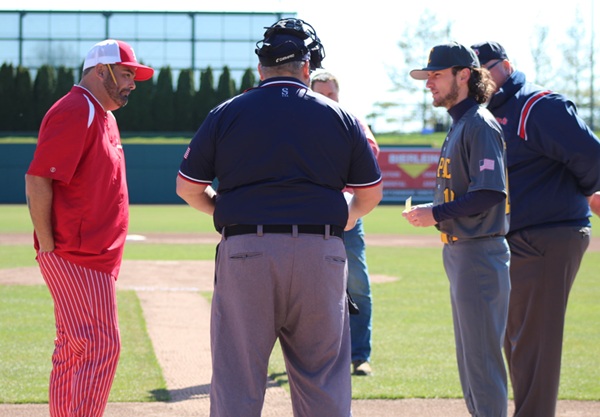
PHOTOS (Top) Peck baseball coach James Welch, left, talks with son Grady during a game from a recent season. (Middle) Welch, far left, stands at the plate for a pregame conference before taking on Capac. (Photos provided by Jen Kluger.)