


'Hearts' Focus Includes Action Planning
November 12, 2015
By Geoff Kimmerly
Second Half editor
As most of Michigan’s high school athletes move inside this month for the start of winter sports, many will take part in a program introduced to Michigan High School Athletic Association member schools this fall that assists coaches and students in preparing for the possibility of a health emergency during their after-school practices and events.
Prior to the start of this 2015-16 school year, the MHSAA sent every member school the “Anyone Can Save a Life” emergency action plan authored by the Minnesota State High School League and the Medtronic Foundation. The program instructs schools to assemble teams made up of coaches and their students that will act in the event someone suffers sudden cardiac arrest or another emergency medical situation.
“Anyone Can Save a Life” suggests a game plan that establishes four teams on every level of every sport in a school – a 911 Team, CPR (cardiopulmonary resuscitation) Team, AED (automated external defibrillator) Team and Heat Stroke Team. The groups are made up of coaches and their students who will be in close proximity to all after-school activities.
It’s another valuable tool as the MHSAA begins work on the fourth piece of its eight-year “4 H’s” health and safety emphasis. The next two school years focus on Hearts to go with efforts over the last six years centered on Health Histories, Heads and Heat issues faced by MHSAA athletes. This fall, for the first time, all varsity head coaches at MHSAA member schools were required to have CPR certification – another means by which athletic personnel can work to counter the random, unpredictable nature of sudden cardiac arrest.
“There is something we can do. We can be prepared. We can develop emergency plans, display AEDs and deliver CPR. And, like any good sports teams, we need to practice our preparations,” MHSAA Executive Director John E. “Jack” Roberts said. “’Anyone Can Save a Life’ can help schools revise or revitalize their existing emergency plans in ways that engage team members in planning, practice and execution. This could help save lives now and also convey important lifelong life-saving lessons to students involved on these teams.”
Students are a vital component to having a successful emergency action plan. They will be put in position to call 911, meet the ambulance at a pre-determined access point, locate the nearest AED, make sure immersion tubs are filled for hot-weather practices, and for those who are trained, to assist with CPR. Coaches identify students at the beginning of the season and prior to an emergency taking place, and provide them with the details of the job they are assigned so they will be ready to assist in the event of an emergency.
The “Anyone Can Save a Life” plan was sent to schools nationwide with assistance from the National Federation of State High School Associations and the NFHS Foundation. Click for information on "Anyone Can Save a Life."
“The ‘Anyone Can Save a Life’ initiative promotes the need to have and to practice planning for different kinds of emergencies,” Roberts said. “The result can be a fresh, comprehensive emphasis on preparing for emergencies well before they occur and then responding with more confidence when those emergencies inevitably happen. It is the perfect link between the last two years when we focused on heat illness and the next two years when we focus on sudden cardiac arrest.”
This fall’s focus on “Hearts” began in the wake of 122 Michigan schools receiving recognition this spring as HEARTSafe by the Michigan Department of Health and Human Services, Michigan Department of Education, American Heart Association, Michigan Alliance for Prevention of Sudden Cardiac Death of the Young and the MHSAA.
Public Act 12 of 2014 requires all schools (grades kindergarten to 12) to have a cardiac emergency response plan in place. This MI HEARTSafe School designation recognizes 122 schools that have taken steps above and beyond to prepare to respond in the event of a cardiac emergency, and is awarded for a period of three years.
In order for a school to receive MI HEARTSafe designation, it must perform at least one cardiac emergency response drill per year, have a written medical emergency response plan and team, have current CPR/AED certification of at least 10 percent of staff, have accessible, properly maintained and inspected AEDs with signs identifying their location, and ensure pre-participation sports screening of all student-athletes using the current physical and history form endorsed by the MHSAA.
Schools that meet all requirements are able to apply for the MI HEARTSafe School designation each year. Click for information and for a list of designated schools.
Chase Remains On Pace as Wroubel Ranks 2nd Among Nation's Winningest Active Coaches
By
Keith Dunlap
Special for MHSAA.com
September 18, 2026
PONTIAC — While the Pontiac Notre Dame Prep girls volleyball team pursues wins in Michigan this fall, parents, supporters and others around the program are also paying attention to what a program in Alabama is doing.
 Why? It has everything to do with a prominent coaching record on the national level.
At the moment, it’s a nice neck-and-neck race to see who will finish this season as the active coach with the most wins nationally, Betty Wroubel of Notre Dame Prep or Ann Schilling of Bayside Academy in Daphne, Ala.
Going into the season, Schilling had 1,796 career wins, three more than Wroubel. As of Wednesday, Schilling had added 16 wins to her total to make it 1,812, while Wroubel added 14 for a grand total of 1,807.
The two are also third and fourth, respectively, on the overall all-time wins list nationally. Two coaches who are retired, Jodi Manore of Temperance Bedford (2,231) and Jack Magelssen of Portage Northern (1,832), top the list.
Schilling and Wroubel are fast approaching Magelssen, but if there is one person who isn’t too occupied with it all, it’s Wroubel.
Sure, she has a good laugh or smile when parents or other school officials have casually come up to her over the past few weeks to mention the situation. But as has been the case throughout her legendary career, there is a greater purpose for her.
“It’s the kids’ winning,” Wroubel said. “I get to facilitate a little bit. But it’s really about the kids, and I’ve been blessed with some really good kids here over the years and some coaches who have coached with me.”
Notre Dame Prep senior Nicole McDowell said trying to win so Wroubel can keep up with Schilling hasn’t really been talked about much among players this season. But that doesn’t mean the chase can’t provide a little more incentive the rest of the fall.
“That will help motivate us more,” McDowell said.
The head coach of Notre Dame Prep since 1994, Wroubel remains an institution for not only her school, but the volleyball coaching community statewide.
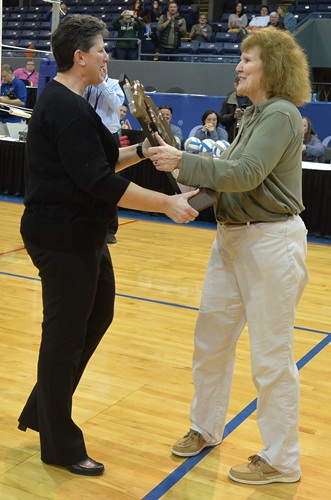
Wroubel has guided Notre Dame Prep to four Finals titles in Class B/Division 2, with the latest in 2021. When Notre Dame Prep won the Class B championship in 2007 (fall season), the Fighting Irish not only captured the school’s first volleyball title but became the first program in Oakland County history to win at the Finals.
“I just love being around the kids, and they provide the energy and keep you going,” said Wroubel, who is also the athletic director and varsity softball coach at Notre Dame Prep.
Even as eras and the sport have changed drastically, players have enjoyed playing for Wroubel as much as she’s enjoyed coaching them.
“She really is competitive and she’s hard on us, but she wants to win and all of her intentions are good,” said McDowell, who has committed to play collegiately for Rider University (N.J.) and is a returning all-state player. “Outside of volleyball, she is the most generous person I know.”
Time will tell if Notre Dame Prep (14-12-2) can continue to pile up wins this season for itself and Wroubel.
While the coaching wins angle could be a fun storyline for the program and its supporters to follow, it certainly won’t sway Wroubel from her ultimate objective to make her players better volleyball players and women.
“I just love my job,” she said. “I think this is where God has placed me. There’s a place where we’re all supposed to be, and this is part of my mission. This is where I’m supposed to be. God has blessed me with great support and great athletes, and I just love it here.”
 Keith Dunlap has served in Detroit-area sports media for more than two decades, including as a sportswriter at the Oakland Press from 2001-16 primarily covering high school sports but also college and professional teams. His bylines also have appeared in USA Today, the Washington Post, the Detroit Free Press, the Houston Chronicle and the Boston Globe. He served as the administrator for the Oakland Activities Association’s website from 2017-2020. Contact him at [email protected] with story ideas for Oakland, Macomb and Wayne counties.
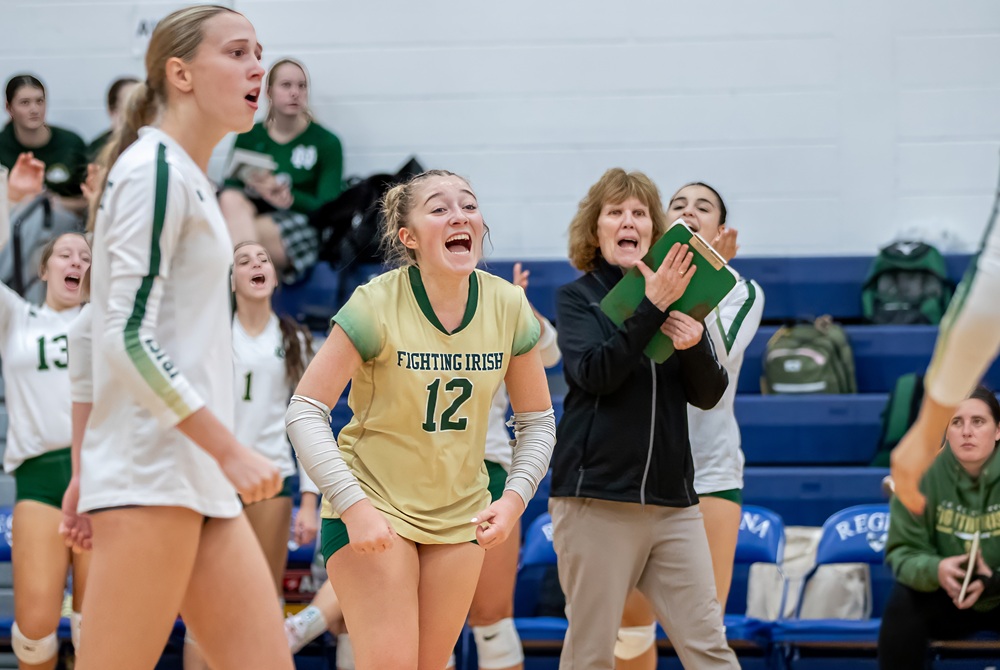
PHOTOS (Top) Pontiac Notre Dame Prep girls volleyball coach Betty Wroubel encourages her team during a match last season against Warren Regina. (Middle) Wroubel, right, accepts the 2021 Division 2 championship trophy from Vicky Groat. (Top photo by KMS Photography.)