


'Hearts' Focus Includes Action Planning
November 12, 2015
By Geoff Kimmerly
Second Half editor
As most of Michigan’s high school athletes move inside this month for the start of winter sports, many will take part in a program introduced to Michigan High School Athletic Association member schools this fall that assists coaches and students in preparing for the possibility of a health emergency during their after-school practices and events.
Prior to the start of this 2015-16 school year, the MHSAA sent every member school the “Anyone Can Save a Life” emergency action plan authored by the Minnesota State High School League and the Medtronic Foundation. The program instructs schools to assemble teams made up of coaches and their students that will act in the event someone suffers sudden cardiac arrest or another emergency medical situation.
“Anyone Can Save a Life” suggests a game plan that establishes four teams on every level of every sport in a school – a 911 Team, CPR (cardiopulmonary resuscitation) Team, AED (automated external defibrillator) Team and Heat Stroke Team. The groups are made up of coaches and their students who will be in close proximity to all after-school activities.
It’s another valuable tool as the MHSAA begins work on the fourth piece of its eight-year “4 H’s” health and safety emphasis. The next two school years focus on Hearts to go with efforts over the last six years centered on Health Histories, Heads and Heat issues faced by MHSAA athletes. This fall, for the first time, all varsity head coaches at MHSAA member schools were required to have CPR certification – another means by which athletic personnel can work to counter the random, unpredictable nature of sudden cardiac arrest.
“There is something we can do. We can be prepared. We can develop emergency plans, display AEDs and deliver CPR. And, like any good sports teams, we need to practice our preparations,” MHSAA Executive Director John E. “Jack” Roberts said. “’Anyone Can Save a Life’ can help schools revise or revitalize their existing emergency plans in ways that engage team members in planning, practice and execution. This could help save lives now and also convey important lifelong life-saving lessons to students involved on these teams.”
Students are a vital component to having a successful emergency action plan. They will be put in position to call 911, meet the ambulance at a pre-determined access point, locate the nearest AED, make sure immersion tubs are filled for hot-weather practices, and for those who are trained, to assist with CPR. Coaches identify students at the beginning of the season and prior to an emergency taking place, and provide them with the details of the job they are assigned so they will be ready to assist in the event of an emergency.
The “Anyone Can Save a Life” plan was sent to schools nationwide with assistance from the National Federation of State High School Associations and the NFHS Foundation. Click for information on "Anyone Can Save a Life."
“The ‘Anyone Can Save a Life’ initiative promotes the need to have and to practice planning for different kinds of emergencies,” Roberts said. “The result can be a fresh, comprehensive emphasis on preparing for emergencies well before they occur and then responding with more confidence when those emergencies inevitably happen. It is the perfect link between the last two years when we focused on heat illness and the next two years when we focus on sudden cardiac arrest.”
This fall’s focus on “Hearts” began in the wake of 122 Michigan schools receiving recognition this spring as HEARTSafe by the Michigan Department of Health and Human Services, Michigan Department of Education, American Heart Association, Michigan Alliance for Prevention of Sudden Cardiac Death of the Young and the MHSAA.
Public Act 12 of 2014 requires all schools (grades kindergarten to 12) to have a cardiac emergency response plan in place. This MI HEARTSafe School designation recognizes 122 schools that have taken steps above and beyond to prepare to respond in the event of a cardiac emergency, and is awarded for a period of three years.
In order for a school to receive MI HEARTSafe designation, it must perform at least one cardiac emergency response drill per year, have a written medical emergency response plan and team, have current CPR/AED certification of at least 10 percent of staff, have accessible, properly maintained and inspected AEDs with signs identifying their location, and ensure pre-participation sports screening of all student-athletes using the current physical and history form endorsed by the MHSAA.
Schools that meet all requirements are able to apply for the MI HEARTSafe School designation each year. Click for information and for a list of designated schools.
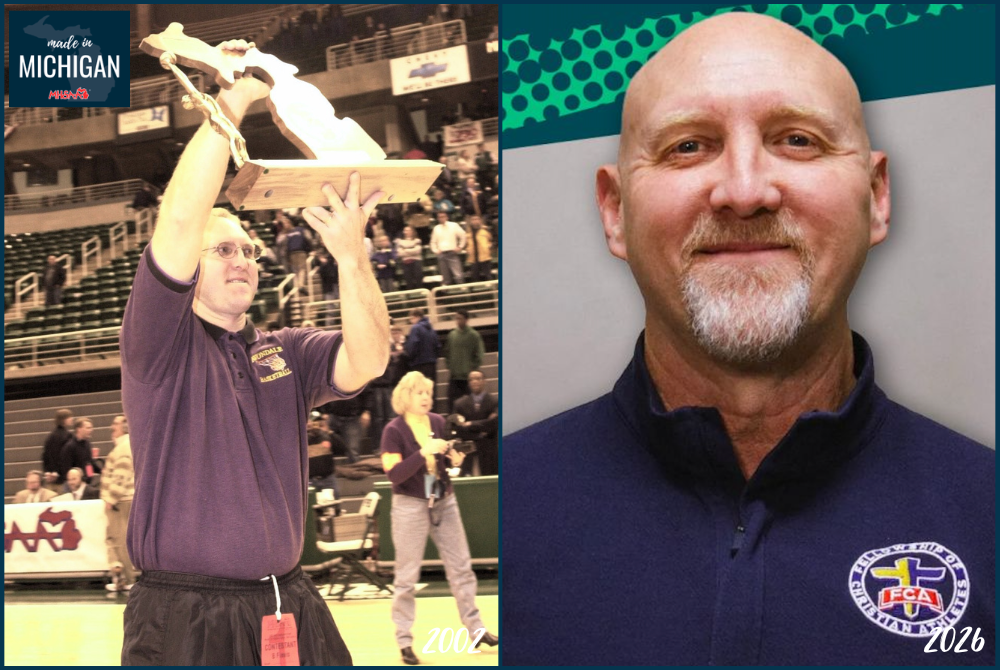
Nearly 25 Years After Leading Unexpected Run, Morton Directing Life-Changing Mission
By
Keith Dunlap
Special for MHSAA.com
August 11, 2026
Nearly a quarter century after presiding over arguably one of the most improbable boys basketball state championships in Michigan history, the same fight and underdog mentality still exists for Tim Morton.
 Back in 2002, Morton was the head boys basketball head coach at Auburn Hills Avondale, which produced a Hollywood-type run during that season’s Class B tournament.
Unranked and without a future Division I college player in the lineup, a Yellow Jackets team headlined by seven seniors went on a quest that stunned many statewide observers.
Avondale avenged the disappointment of not getting out of the District round the previous year and then recorded a stunning upset of a highly-ranked Flint Southwestern team in their Regional Final, winning in double overtime. But after squeaking out a six-point win over a solid Williamston team in a Quarterfinal and earning an 11-point win over Comstock Park in the Semifinals, surely midnight was going to strike for Cinderella in the championship game. After all, Avondale was up against a powerful Grand Rapids South Christian team which had multiple future Division I college players on its roster.
It didn’t matter as Avondale, led by tough-as-nails captains Mike Lewis and Wes Whiteside, senior Dionte Miller and sophomore Dave Holston, completed its stunning run with a 70-65 win to capture what still stands as the program’s only Finals basketball championship.
Morton said he thought his team the previous year that couldn’t make it out of Districts was more talented, but there were intangibles the 2001-02 team possessed that couldn’t be matched.
“I think that nobody really thought that they’d have a shot,” Morton said of his team. “I think that is why we were unranked, because of what had left. But you’ve got to have something to fight for, and I think the reason was the year before. We were motivated. I think playing that underdog role, we just loved it. We won games in so many different ways and got on that roll.”
This past March, Morton and other alumni of the Avondale team certainly were thrilled to see this year’s squad advance to the Semifinals for the first time since their 2001-02 team did so. This time, the Yellow Jackets suffered a three-point Semifinal loss to eventual Class A champion Rockford.
Today, Morton is also heading another team that has an underdog mentality but is motivated to fight for each other and surrounding communities.
Morton is the multi-area director for the Southeast Michigan chapter of the Fellowship of Christian Athletes, which aims to serve kids, coaches and communities by promoting through activities faith, self-esteem, serving others and being the best version of yourself.
The organization has roughly 50 student-led “huddles” that meet at high schools or middle schools, where students can have a safe haven to talk about problems, promote successes, go over scripture and bond during a challenging time of life.
Through volunteers and other staff members, the organization also conducts camps throughout the state for coaches, athletes and others to learn from each other and grow as leaders.
The chapter will have its annual golf outing Sept. 28 at Oakland University’s Sharf Golf Course.
“We just want to be really good at cultivating those relationships, making sure that we’re following up with people, and sharing what the Lord is doing so people feel like they can be connected to something bigger than themselves.”
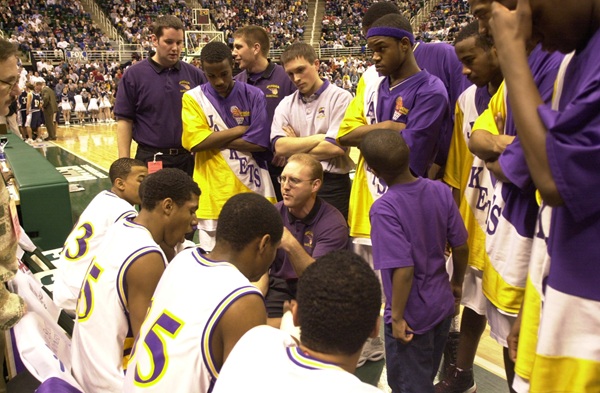 Playing for something bigger than themselves certainly worked for the 2002 team, and Morton said there is a 25th anniversary reunion in the works for next spring.
But while he nor anyone else in the Avondale community will forget that run in 2002, these days Morton is spearheading a team he said is playing for an even greater purpose, one he tried to describe to a group of youth football coaches in Flint during a recent gathering.
“I had only about 15 to 20 minutes to share with these guys,” Morton said. “I shared that we won a state title in 2002 and I was driven to be the best coach I could possibly be. A lot of great things happened, and the state championship happened. I’m on my way home from the state championship and we’re watching the video, and it’s crazy because this fear came over me. How are we going to do this again?
“Every coach that puts his or her full identity in the performance of the team, that’s scary and that’s not good. I got out six years later because of that fear. The most important relationships of my life were not good because I had to be validated by the performance of my team. That conversation kind of led into, “Why are you coaching? Why are you doing what you are doing? I wanted them to be motivated to be the best versions of themselves, for those kids, their wives and children. That’s why I’m in FCA. That’s my cause to fight for.”
2026 Made In Michigan
Aug. 7: Significance of Historic Run, Relationships Formed Live On for 1973 Unity Champs - Report
Aug. 4: Work Ethic Continues to Drive Van Dyk's Endeavors as Co-Owner of Family Farm - Report
July 24: Hackett Mentor's Care Sparked Lifetime in Hoops for BCAM President White - Report
July 24: Mackey Leaving Court with 500+ College Hoops Wins, Many More Lessons Shared - Report
July 16: Country Day Two-Time Champ Moore Building Perennial Winner at Harvard - Report
July 9: Multi-Sport Career at TC West Helps Gillis Thrive as Pro in Game She Once Left Behind - Report
July 2: Inspired by Home, Eager to Give Back, Spencer Hosts Hoop City Alumni Games - Report
PHOTOS At left, Tim Morton raises the Class B championship trophy in 2002. At right, Morton now a director for Fellowship of Christian Athletes. (Middle) Morton, kneeling, speaks to his team during the championship win at Breslin Center. (MHSAA archives)