

Hockey Star-Turned-Champion for School Sports to Receive MHSAA's Forsythe Award
By
Geoff Kimmerly
MHSAA.com senior editor
March 11, 2022
Once or twice a year, Bruce Horsch gets the question – mostly during a Winter Olympics year or after someone has watched “Miracle on Ice” and found out the “Horsch” that is mentioned twice is actually the recently-retired Houghton High School athletic director.
The final goaltender cut from the 1980 U.S. hockey team that went on to stun the world in winning Olympic gold, Horsch went on to coach at multiple college programs before becoming Houghton’s athletic director in 1996 at the age of 40.
These days, many also know him for the commitment, mentorship and leadership shown in that position through his retirement in 2019.
To celebrate his many contributions to interscholastic athletics, Horsch has been named the 2022 honoree for the Michigan High School Athletic Association’s Charles E. Forsythe Award.
 The annual award is in its 45th year and named after former MHSAA Executive Director Charles E. Forsythe, the Association's first full-time and longest-serving chief executive. Forsythe Award recipients are selected each year by the MHSAA Representative Council, based on an individual's outstanding contributions to the interscholastic athletics community.
Horsch was described as a “not in the spotlight guy” by one of those who recommended him for the Forsythe Award, but he certainly spent time there. Horsch was a college hockey star and NHL draft pick, and had begun his minor league hockey career before playing with the U.S. team right up until the final cuts on the way to Lake Placid, N.Y.
After his playing days concluded, he coached collegiately before eventually settling in as Houghton’s athletic director for the 1996-97 school year.
“I was fortunate enough to play at Michigan Tech, and I was on a national championship team (in 1975) and I was on a national runner-up team (in 1976). When you played for (coach) John MacInnes up here, it wasn’t individuals – although we had great individuals – we won because we were a team” Horsch said.
“I’m not out for recognition. I enjoy being part of a team. I enjoy working with other people, and that’s my satisfaction.”
He led many important ones in his roles as a school sports administrator.
Horsch was named his region’s Athletic Director of the Year in both 2003 and 2019 by the Michigan Interscholastic Athletic Administrators Association (MIAAA), and served on the Upper Peninsula Athletic Committee from 2001-05. He has been an active member of the MIAAA, National Interscholastic Athletic Administrators Association (NIAAA) and Upper Peninsula Athletic Directors Association (UPADA), serving as secretary and president of the UPADA.
He also served as president of the Keweenaw Area Athletic Directors Association and secretary and commissioner of the Western Peninsula Athletic Conference.
“For years Bruce was one of the most respected voices not only in the Upper Peninsula but also the entire state,” MHSAA Executive Director Mark Uyl said. “He brought that perspective as a high-end athlete and transitioned extremely well as an educator and athletic director.”
Horsch was a frequent host of MHSAA Tournaments at the District and Regional rounds during his time at Houghton, and also hosted MHSAA Upper Peninsula Finals. He served as a host for sessions of the MHSAA PACE program, the coaching education program predecessor to the current Coaches Advancement Program (CAP).
His dedication to Houghton athletics was further noted when he considered retiring in 2017 but stayed on two more years to assist with a bond that resulted in in the upgrading of the school’s football field and track and building of softball and baseball fields as part of the athletic complex. Previously, he had led a referendum to have a second gymnasium built to provide an additional practice venue with girls basketball moving from the fall to winter season beginning with the 2007-08 school year.
“I’m proud of the fact that in the U.P. there are not many, if any schools that have the facilities that Houghton High School has,” Horsch said.
Horsch is a graduate of Hastings High School in Minnesota and earned a bachelor’s degree in business administration from Michigan Technological University. He led the Huskies hockey team to 58 victories in goal over four seasons and was part of the 1975 NCAA championship team, two of many reasons he was inducted into the Michigan Tech Sports Hall of Fame in 2007. He was drafted by the Montreal Canadiens during the ninth round of the 1976 NHL draft and played minor league hockey for two seasons. He then coached hockey collegiately for most of the 1980s as an assistant at Ferris State and then Michigan Tech.
He has continued to serve his community as a member of the Rotary Club of Houghton.
Past recipients of the Charles E. Forsythe Award
1978 - Brick Fowler, Port Huron; Paul Smarks, Warren
1979 - Earl Messner, Reed City; Howard Beatty, Saginaw
1980 - Max Carey, Freesoil
1981 - Steven Sluka, Grand Haven; Samuel Madden, Detroit
1982 - Ernest Buckholz, Mt. Clemens; T. Arthur Treloar, Petoskey
1983 - Leroy Dues, Detroit; Richard Maher, Sturgis
1984 - William Hart, Marquette; Donald Stamats, Caro
1985 - John Cotton, Farmington; Robert James, Warren
1986 - William Robinson, Detroit; Irving Soderland, Norway
1987 - Jack Streidl, Plainwell; Wayne Hellenga, Decatur
1988 - Jack Johnson, Dearborn; Alan Williams, North Adams
1989 - Walter Bazylewicz, Berkley; Dennis Kiley, Jackson
1990 - Webster Morrison, Pickford; Herbert Quade, Benton Harbor
1991 - Clifford Buckmaster, Petoskey; Donald Domke, Northville
1992 - William Maskill, Kalamazoo; Thomas G. McShannock, Muskegon
1993 - Roy A. Allen Jr., Detroit; John Duncan, Cedarville
1994 - Kermit Ambrose, Royal Oak
1995 - Bob Perry, Lowell
1996 - Charles H. Jones, Royal Oak
1997 - Michael A. Foster, Richland; Robert G. Grimes, Battle Creek
1998 - Lofton C. Greene, River Rouge; Joseph J. Todey, Essexville
1999 - Bernie Larson, Battle Creek
2000 - Blake Hagman, Kalamazoo; Jerry Cvengros, Escanaba
2001 - Norm Johnson, Bangor; George Lovich, Canton
2002 - John Fundukian, Novi
2003 - Ken Semelsberger, Port Huron
2004 - Marco Marcet, Frankenmuth
2005 - Jim Feldkamp, Troy
2006 - Dan McShannock, Midland; Dail Prucka, Monroe
2007 - Keith Eldred, Williamston; Tom Hickman, Spring Lake
2008 - Jamie Gent, Haslett; William Newkirk, Sanford Meridian
2009 - Paul Ellinger, Cheboygan
2010 - Rudy Godefroidt, Hemlock; Mike Boyd, Waterford
2011 - Eric C. Federico, Trenton
2012 - Bill Mick, Midland
2013 - Jim Gilmore, Tecumseh; Dave Hutton, Grandville
2014 - Dan Flynn, Escanaba
2015 - Hugh Matson, Saginaw
2016 - Gary Hice, Petoskey; Gina Mazzolini, Lansing
2017 - Chuck Nurek, Rochester Hills
2018 - Gary Ellis, Allegan
2019 - Jim Derocher, Negaunee; Fredrick J. Smith, Stevensville
2020 - Michael Garvey, Lawton
2021 – Leroy Hackley Jr., Byron Center; Patti Tibaldi, Traverse City
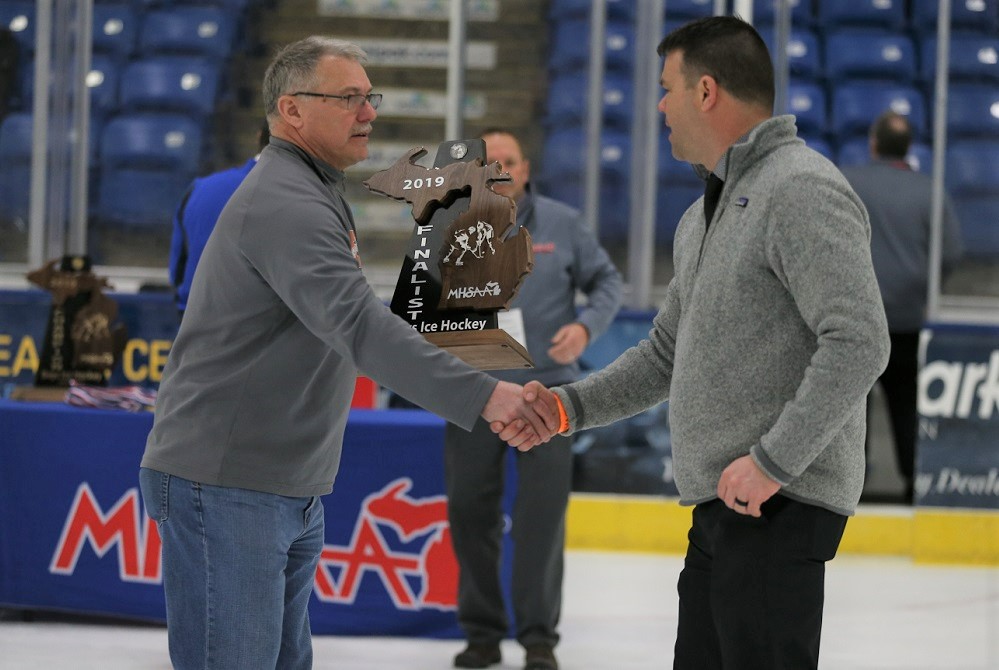
PHOTO: Houghton athletic director Bruce Horsch, left, hands coach Corey Markham the Division 3 finalist trophy after the Gremlins finished Division 3 hockey runners-up in 2019.

Michigan Virtual University Teams with MHSAA
August 23, 2016
By Geoff Kimmerly
Second Half editor
Providing educational opportunities is central to the missions of both the Michigan High School Athletic Association and Michigan Virtual University. To promote its expansive opportunities for online education for Michigan high school students and educators, Michigan Virtual University will serve as the preferred provider of online education supporting MHSAA events and digital initiatives during the 2016-17 school year.
Michigan Virtual University is a nonprofit corporation established in 1998 to deliver online education and training opportunities to Michigan’s K-12 community and operates the Michigan Virtual School. Considered a national leader in providing online education, MVS has enrolled over 200,000 online courses in a broad range of core academic courses aligned with state standards, college-level equivalent courses; enrichment and world language courses, and other innovative online experiences. MVS is accredited by third-party AdvancED, meaning its instructors, tools, services and staff meet or exceed essential standards of educational quality.
MVS currently is working with 497 schools across Michigan to provide students more than 200 online courses, including 22 Advanced Placement courses and instruction in seven world languages. Like the MHSAA, MVS serves students grades 6-12.
“We focus on the whole child in educational athletics, and we see Michigan Virtual University as helping local schools broaden the academic offerings they can provide to students,” said John E. “Jack” Roberts, executive director of the MHSAA. “We help students compete in the local athletic arena; Michigan Virtual University helps students compete in the global classroom.”
Michigan Virtual School will have an on-site presence at MHSAA championship events throughout this school year and also digitally on MHSAA.com and in coordination with the MHSAA’s social media platforms. MVS also will receive air time as part of MHSAA video and radio programming.
MVS courses are designed to provide the same rigor as those students experience in a face-to-face classroom setting, while allowing students scheduling flexibility and the ability to work at their own pace. Core courses aligned with the Michigan Merit Curriculum (MMC) and the Common Core are available in English, math, science, social studies and world languages. Also, nearly 90 MVS courses are approved by the National Collegiate Athletic Association (NCAA), an additional value for student athletes seeking to secure eligibility at the college level.
"Increasingly, students involved with interscholastic athletics want and need school options that can be accessed outside the traditional school schedule,” Jamey Fitzpatrick, President & CEO of Michigan Virtual University, said. “We are excited about our new partnership with the MHSAA and look forward to helping more students and their parents learn about the value and potential of online learning options from MVU."
Michigan Virtual School is funded by the Michigan legislature and revenues from the courses it offers. Under current legislation students in grades 6-12 are allowed to take up to two courses per semester during the regular school year paid for by their schools, and students also may pay to take additional courses either during the school year or in the summer. Courses are developed by MVS or include content licensed from nationally-recognized providers.
Additionally, the MHSAA and MVU have agreed to explore possible areas of collaboration related to online and blended professional development for athletic directors, coaches, and other sports officials.
For additional information about Michigan Virtual University and Michigan Virtual School, go online to www.mivu.org.