

In Memoriam: Vic Michaels (1954-2025)
By
Geoff Kimmerly
MHSAA.com senior editor
December 30, 2025
The hearts of the MHSAA and countless others in the school sports community are heavy after the unexpected death Monday of Catholic High School League director Vic Michaels, also a longtime and devoted member of the MHSAA’s Representative Council. He was 71.
Michaels was inducted into the CHSL Hall of Fame in 2024 as a “Legend” – a title carrying prestige that certainly described his contributions to school sports on a statewide level as well.
After a decorated 17-year career as a coach, teacher and administrator at Center Line St. Clement, Michaels joined the CHSL office as associate director in 1995, and then assumed the role as leader of the league in 2003 when then-director Tom Rashid left to become associate director at the MHSAA.
 Michaels also joined the Representative Council in 2003, representing non-public schools and serving as the Council’s secretary-treasurer. But his impact was much more far-reaching than titles could explain. As MHSAA executive director Mark Uyl told the Detroit Free Press in coverage of Michaels’ 2024 CHSL recognition, “I’m not sure there’s been anyone who’s been more important to the MHSAA over the last 40 years than Vic Michaels,” and called him one of the key builders of the MHSAA over its first 100 years as that milestone was celebrated in 2024-25.
Especially over the last decade, as numerous Council and MHSAA staff members have retired or move on from school sports, Michaels has supplied vital context and institutional knowledge especially as a long-serving member of the Executive Committee, which considers eligibility decision appeals and other issues that must be addressed on a frequent basis. He provided a calm voice of reason and advocacy, not only for students he represented from nonpublic schools but for athletes, coaches and administrators from all 1,500+ high schools and junior high/middle schools that make up the MHSAA membership. And serving as treasurer, he filled another crucial role in making sure the MHSAA stood on solid ground financially even amid the challenge of COVID-19 and while expanding its numbers of sponsored tournament sports and students served.
Michaels attended Detroit St. Phillip High School, and after St. Phillip closed, was part of the final graduating class at Detroit St. Ambrose in 1972. He attended and played college basketball at Detroit Institute of Technology and earned his teaching certificate from University of Detroit Mercy.
He coached junior varsity at Dearborn St. Alphonsus and Redford St. Mary before beginning a tenure in 1978 at St. Clement where he taught, served as athletic director and assistant principal and won more than 300 games as the school’s boys and girls varsity basketball coach, earning statewide “Coach of the Year” awards leading both programs during the 1980s.
Michaels and his wife Linda were married 46 years, and he also is survived by his sons Marc and Brad, their wives and grandchildren.
As the CHSL noted in its memorial to Michaels, “Vic dedicated his life to Catholic education, interscholastic athletics, and the young people entrusted to his care. His leadership of the CHSL was marked by integrity, vision, humility, and an unwavering belief that athletics are an extension of the classroom — meant to form the whole person in faith, character, discipline, and service. … His decisions were thoughtful, his counsel wise, and his love for the educational athletics unmistakable.”
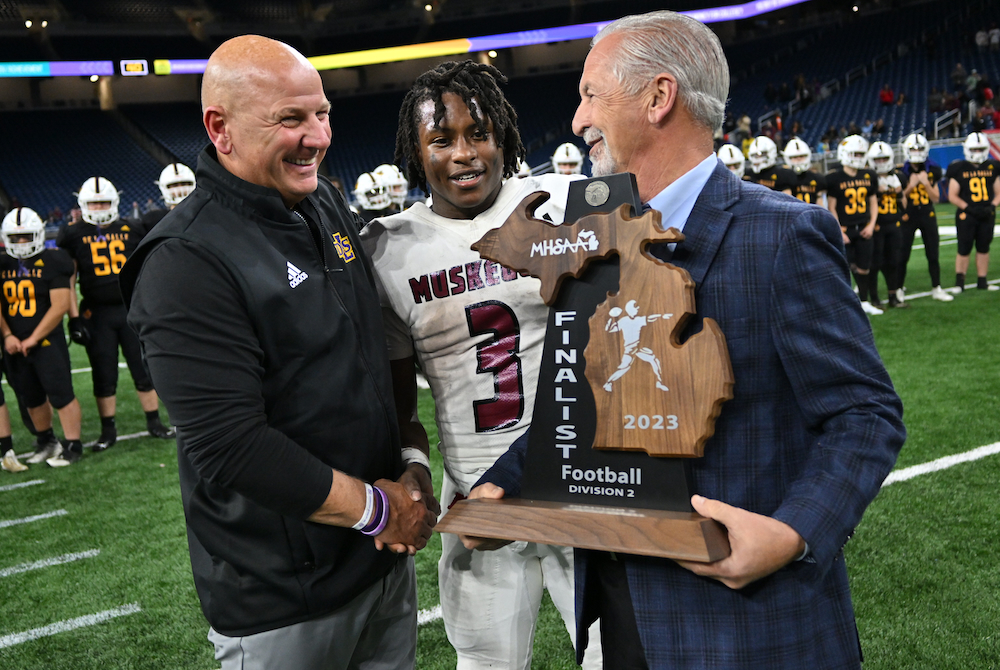
PHOTO MHSAA Representative Council member Vic Michaels, far right, with the assistance of MHSAA Student Advisory Council member M'Khi Guy from Muskegon, presents Warren De La Salle Collegiate coach Dan Rohn the finalist trophy after the 2023 11-Player Football Final at Ford Field. (Photo by Hockey Weekly Action Photos.)
Title IX at 50: Assistant Directors Have Been Difference Makers
By
Geoff Kimmerly
MHSAA.com senior editor
June 21, 2022
The MHSAA has been fortunate to follow leadership from a number of impactful women over the last 50 years. Many have been members of the Representative Council, or various sport committees and task forces asked to address specific issues in educational athletics.
But day in, day out, and often behind the scenes where most administration is done, three longtime MHSAA assistant directors have provided leadership and advocacy for females in athletics that continues to be transformative in our state, even after two have retired.
► Suzanne Martin joined the MHSAA staff in 1977 and created a pair of programs that have helped make Michigan a national leader in girls high school athletics. A former teacher, coach and cheerleading advisor at Mt. Morris High School, Martin directed the launch of competitive cheer as an MHSAA-sponsored sport with its first championships awarded during the 1993-94 school year. Over the last decade, an average of 6,800 athletes have participated in that sport annually. Also under Martin’s direction, the MHSAA’s Women In Sports Leadership Conference made its debut in 1989, and with attendance of upwards of 500 students, the every-other-year event remains the largest and longest-running conference promoting the roles of females in interscholastic athletics – not only as athletes, but as future administrators, coaches and officials. Martin administrated a number of other sports for the MHSAA and served on several National Federation of State High School Associations (NFHS) committees. Martin retired in December 2002.
► Gina Mazzolini came to the MHSAA in 1993 from the University Interscholastic League in Texas, where she served 11 years including five as an assistant director for the service organization to high school activities in that state. Mazzolini spent the majority of her MHSAA career as the administrator for girls volleyball, swimming & diving, alpine skiing and tennis and as the point person for foreign exchange and international student issues while also handling sanctioning of out-of-state competitions that included MHSAA member schools. She had a significant presence on the national level as well, serving on various NFHS rules and advisory committees, including as the chairperson of the volleyball rules committee. Mazzolini received a Citation from the NFHS in 2016, and also that year became the first woman to receive the MHSAA’s Charles E. Forsythe Award, which recognizes outstanding contributions to the interscholastic athletics community. She retired at the end of that July.
► Kathy Vruggink Westdorp came to the MHSAA as an assistant director during the 2003-04 school year after more than two decades serving as a teacher, coach and administrator in Grand Rapids-area schools. Westdorp received an NFHS Citation in 2021, and was named NFHS Coach Educator of the Year in 2015 for her work directing the MHSAA Coaches Advancement Program, an eight-level education program that has seen more than 16,000 coaches complete the first-level unit alone. Westdorp also guided the addition of girls lacrosse as an MHSAA-sponsored sport in 2005 and remains its administrator – and she has served as the NFHS Education Committee and Girls Lacrosse Rules Committee chairpersons among other national roles. She also serves as the MHSAA’s lead administrator of competitive cheer and gymnastics. Under her leadership, the WISL Conference has continued to thrive welcoming and training high school female student leaders from all over the state, and the Competitive Cheer Finals have ranked among the most highly-attended championship events offered by the MHSAA.
Second Half's weekly Title IX Celebration posts are sponsored by Michigan Army National Guard.
Previous Title IX at 50 Spotlights
June 14: Girls Lacrosse Finals Officials Set Empowering Example - Read
June 7: From Gymnastics to Wrestling, Girls Opportunities Continue to Grow - Read
May 31: Mumford Sprinter's Magnificent 2006 Final Remains Unmatched - Read
May 24: Scane, Whiteside Alone on 400-Goal, 500-Point Girls Lacrosse Lists - Read
May 17: Over 8 Days in 1988, Pair of Champs Set No. 1 Singles Standard - Read
May 10: Portage Central's Tarpley Scores as State's Superstar, U.S. Soccer Hero - Read
May 3: Prychitko 'Legend In Her Own Time,' Legend for All Time - Read
April 26: Braddock vs. Verdun Still Striding Among All-Time Sprint Matchups - Read
April 19: Holmes' Strikeout Record Rarely Approached, May Be Unbreakable - Read
April 12: Anticipation High as 45,000 Girls Return to Spring Sports - Read
April 5: Regina's Laffey Retiring as Definition of Legendary - Read
March 29: Edison's Whitehorn named 2022 Miss Basketball - Read
March 22: Carney-Nadeau Sets Girls Hoops Standard with 78-Win Streak - Read
March 15: Binder Among Voices Telling Our Story on MHSAA Network - Read
March 8: 28 Years, Thousands of Cheers - Read
March 1: Kearsley Rolls On Among Girls Bowling's Early Successes - Read
Feb. 22: Marquette Ties Record for Swim & Dive Finals Success - Read
Feb. 15: Jaeger's 2004 Winter Run Created Lasting Connection - Read
Feb. 8: Marian's Cicerone to Finish Among All-Time Elite - Read
Feb. 1: WISL Award Honors Builders of State's Girls Sports Tradition - Read
Jan. 25: Decades Later, Edwards' Legend Continues to Grow - Read
Jan. 18: Iron Mountain Completes Championship Climb - Read
Jan. 11: Harrold's Achievement Heralds Growth of Girls Wrestling - Read
Dec. 20: Competitive Cheer Gives Michigan Plenty to Cheer About - Read
Dec. 14: Evelyn's Game Had Plenty of Magic - Read
Dec. 7: Council Term Ends, But Leinaar Leaves Lasting Impact - Read
Nov. 30: Basketball Season Ready to Add to Rich Tradition - Read
Nov. 23: Marysville Builds Winning Streak Yet to be Challenged - Read
Nov. 16: Wroubel Has Championed Girls School Sports from Their Start - Read
Nov. 9: Pioneer's Joyce Legendary in Michigan, National Swim History - Read
Nov. 2: Royal Oak's Finch Leading Way on Football Field - Read
Oct. 26: Coach Clegg Sets Championship Standard at Grand Blanc - Read
Oct. 19: Rockford Girls Set Pace, Hundreds After Have Continued to Chase - Read
Oct. 12: Bedford Volleyball Pioneer Continues Blazing Record-Setting Trail - Read
Oct. 5: Warner Paved Way to Legend Status with Record Rounds - Read
Sept. 28: Taylor Kennedy Gymnasts Earn Fame as 1st Champions - Read
Sept. 21: Portage Northern Star Byington Becomes Play-by-Play Pioneer - Read
Sept. 14: Guerra/Groat Legacy Continues to Serve St. Philip Well - Read
Sept. 7: Best-Ever Conversation Must Include Leland's Glass - Read
Aug. 31: We Will Celebrate Many Who Paved the Way - Read
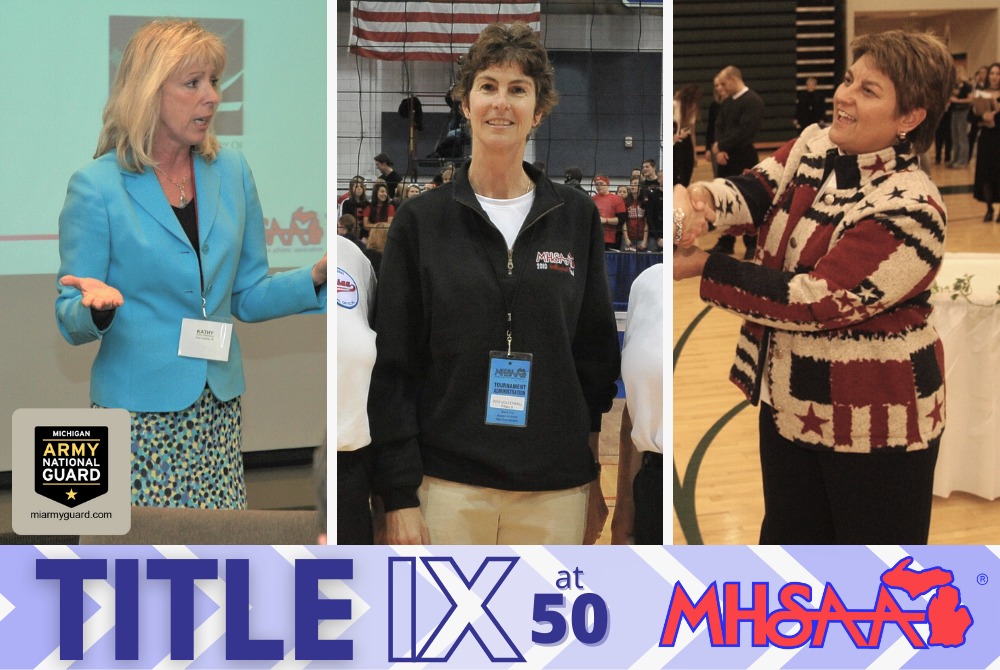
PHOTO From left, Kathy Vruggink Westdorp, Gina Mazzolini and Suzanne Martin (MHSAA file photos.)