

Nurturing Our Lower Level Programs
May 15, 2014
By John E. “Jack” Roberts
MHSAA Executive Director
When I’ve been faced with the most difficult choices as to different courses of action for the MHSAA, I’ve tried to face up to this reframing of the issue: “If we were creating the MHSAA for the first time today, would we do this, or would we do that?”
For example, would we or would we not limit coaches’ contact with athletes out of season? Would we have a 90-day period of ineligibility for transfer students or would it be 180 days?
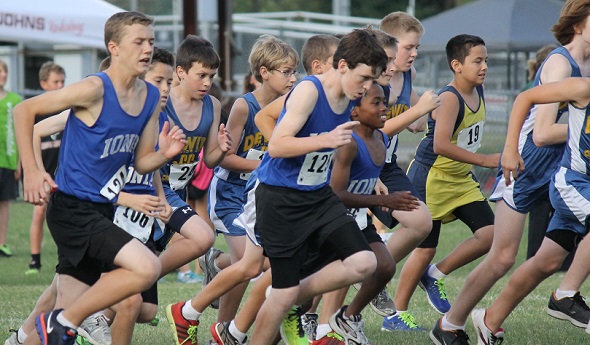
There are other examples of such “either, or” questions I could provide, but none is as difficult or defining as this: Should school sports under the MHSAA’s auspices provide more opportunities for 7th- and 8th-graders and new opportunities for even younger students?
I won’t be coy about what I think our answer should be. I haven’t always felt this way, and I recognize it is a different opinion than some who are quoted in this publication; but today it’s my belief that if we were creating the MHSAA for the first time in 2014, the MHSAA would allow more contests and longer contests for 7th- and 8th-graders, and the MHSAA would have competition policies and programs for younger middle schoolers too.
I believe this is what parents want for their children and what students want for themselves; and I believe, within reason, that the better we serve these students in their junior high/middle school years, the stronger high school sports will be and the better these programs will support the educational missions of schools.
I believe we must begin to serve middle school students more comprehensively, and that our doing so today is the best hope we have for retaining comprehensive programs for high school students tomorrow. Not only does the lower profile and pressure of lower level programs nurture the highest ideals of educational athletics, they provide our highest hope for preserving those ideals at the high school level.
The Lasting Impact of First Impressions
The over-arching question before us is how to maintain policies that encourage multiple sport experiences for students at the junior high/middle school level while at the same time adjusting those policies in terms of grade level served and the numbers and lengths of contests allowed in order to be more attractive to junior high/middle school parents and to school districts which desire additional competition opportunities in the school setting for students prior to high school.
There is a good healthy discussion in our midst about the scope of junior high/middle school athletics – how much should occur and how young it should commence; and the result of these discussions may have long-lasting effect on students, schools and the MHSAA.
Here are two central issues:
1. Contest Limits
Many people over many years have contributed to developing the current season limitations for the number of contests permitted by MHSAA member junior high/middle schools. These good people have believed in a philosophy of sports at this level that encourages students to try multiple sports.
“Kids haven’t fully matured yet,” they say. “Kids haven’t been exposed to some sports yet. They don’t know what they might like or be good at. So let’s have policies and programs that encourage new opportunities and experiences at this level.”
The season limits that have been put in place allow some junior high/middle schools, or their entire leagues, to fit four distinct seasons in a nine-month school year, consistent with this over-arching philosophy to encourage these students to try new things and learn.
There is another educationally grounded and equally astute group of administrators and coaches who are concerned that the current limits are too severe in comparison to non-school youth sports programs. For example, community/club basketball or soccer programs may schedule 15 or 18 or more games per season versus the MHSAA limit of 12 at the junior high/middle school level.
These folks think these restrictive limitations create a disincentive for kids to play school sports, and that many of those who have no place in junior high/middle school sports have no interest later in high school sports.
2. 6th-Graders
Historically, the popular opinion among educators has held that 7th and 8th grade is early enough for schools to provide competitive athletics, early enough to put youth into the competitive sports arena, and early enough to pit one school against another in sports.
Today, however, many educators and parents point out that such protective philosophies and policies were adopted about the same time “play days” were considered to be the maximum exertion females should experience in school sports. Some administrators and coaches argue that both our severe limits on contest limits at the junior high/middle school level, and our refusal to serve 6th-graders, are as out of date and inappropriate as play days for females.
Today, in nearly four of five school districts with MHSAA member schools, 6th-graders go to school in the same building with 7th- and 8th-graders. But MHSAA rules don’t allow 6th-graders to participate with and against 7th- and 8th-graders. In fact, the MHSAA Constitution doesn’t even acknowledge that 6th-graders exist.
Today, in many places, 6th-graders have aged-out of non-school, community sports, but they are not permitted to play on MHSAA junior high/middle school teams.
Last school year, 50 different school districts requested this rule be waived for them, and the MHSAA Executive Committee approved 46 of 50 waivers, allowing 6th-graders to compete on 7th- and 8th-grade teams. During 2011-12, 37 of 40 requests for waiver were approved, in all cases for small junior high/middle schools. Many of these schools want, and some of them desperately need, these 6th-graders to fill out junior high/middle school teams.
Young people are starting sports much younger today than 100 years ago when the MHSAA was created. Younger than even 50 years ago when the MHSAA was incorporated. If the MHSAA were created today to serve any students before 9th grade, I’m certain it would not leave out 6th-graders who are walking the same halls with 7th- and 8th-graders, and who have been playing competitive sports almost since the first day they started walking at all.
Eyes on the future
The most important thing we can do to enhance high school sports is to grow junior high/middle school sports programs. The earlier we disconnect young people from non-school sports and engage them in school-sponsored sports, the better our chances are of keeping high school athletic programs healthy, and the better our prospects are of keeping both participation rates and conduct standards high.
School sports are in competition for hearts and minds of young people. Our competition includes movies, jobs, cars, video games, boyfriends and girlfriends and club sports ... especially club sports. School sports needs to market itself better, and part of better is to be available earlier – much sooner in the lives of youth. More contests at the junior high/middle school level and more opportunities for 6th-graders should be parts of our marketing strategies on behalf of educational athletics generally.
For at least 50 years there have been predictions by people outside of our member schools that the system of school-sponsored sports that is almost unique to the United States would someday give way to the system of most countries where youth sports is provided by non-school community groups and private athletic clubs. Some people challenge school-sponsored sports on a program basis – for example, that competitive athletics creates a distraction to the core educational mission of schools. Others may challenge school-sponsored sports on a financial basis – that interscholastic athletics compete for the limited resources communities have to support their schools.
Today there also exists among our member schools a small percentage of administrators who have come to their leadership roles without involvement in school sports and who either desire and believe that interscholastic sports will be moved from schools to communities or who do not want but predict that such will occur as resources for schools continue to shrink.
I believe this is more likely to happen, or to happen sooner, if we do not change our approach to junior high/middle school sports. If we continue to restrict 7th- and 8th-graders to so few contests of such limited length compared to what those students have in non-school sports, and if we continue to offer nothing for younger students, we essentially and effectively force these students to non-school sports.
It is an often cited statistic that between 80 and 90 percent of all young people who ever begin playing competitive athletics stop playing before they reach the age of 13, meaning the vast majority of young people never, ever are involved in school programs. Thus, it is no mystery why people question the future of school sports. We’re doing nothing to make programs available to them. They have no experience in them.
Our restrictive and possibly outdated policies and procedures regarding contest limits and lengths and the age at which we begin to serve junior high/middle school students may assure that the dire predictions about school sports’ future will be accurate. We are doing too little, too late. It is marketing at its worst.
In my mind there is little doubt that we are doing too little too late with junior high/middle school students. Now the challenge before us is to think beyond “we can’t afford it” and make some necessary changes, while still avoiding a system that allows or even encourages schools doing too much too soon.
50 Years Later, 'Charlie' Remains Legendary
By
Ron Pesch
MHSAA historian
September 30, 2018
There is no official record of the proceedings, only a short newspaper recap of the event that was hosted 50 years ago at Michigan State’s Kellogg Center. In attendance was a who’s who of high school sports administrators. They were there to honor the man, affectionately known to his friends as “Charlie.”
A parade of guests presented gifts and citations, then sang his praises.
Dr. Clifford Fagan, Executive Secretary of the National Federation of High School Athletics, attended. State Directors of Athletics from Indiana and Ohio were on hand for the Monday, October 7, 1968, celebration.
Dr. Ira Polly, State Superintendent of Public Instruction, called him “noble, honest and courageous.” John F. Toepp, a state senator and radio sports broadcaster from the Cadillac area, “hailed him as ‘Mr. High School Athletics.’”
Sportswriter Bob Gross, six years into his career at the Lansing State Journal, wrote that Charles E. Forsythe, seated next to his wife Josephine, “only grinned with each word of gratitude.”
More than 350 friends attended the testimonial dinner, honoring the second director of the Michigan High School Athletic Association upon his retirement. For 39 years, Forsythe had served the MHSAA, dedicated to bettering the world of high school sports in Michigan and beyond. His years of service would formulate the mold for those who would follow in his footsteps.
“For five minutes they applauded,” wrote Gross, capturing the moment. Forsythe was humbled by the appreciation. When it was his turn to speak, he thanked the assembled crowd.
 “This is a great night. It’s just wonderful so many of you came to my party. I’m deeply honored,” Forsythe said. “I can’t stand here and accept all the thanks. It was teamwork that made our organization go. And, may I ask of all of you to please help make it grow bigger and better than it is.”
The MHSAA had announced Forsythe’s retirement in late May.
With the exception of a 39-month tour as a Navy Commander, assisting former heavyweight boxing champion Gene Tunney in directing Navy physical fitness activities during World War II, Forsythe had been with the Association since July of 1929, originally as an assistant to Alden W. Thompson, the first director of the MHSAA. (Forsythe remains considered the Association’s first fulltime executive director.)
A graduate and prominent athlete at Milan High School, Forsythe earned his undergraduate degree from Michigan State Normal College (today’s Eastern Michigan University) in 1920 and his Master of Arts degree from the University of Michigan in 1926. He coached basketball and baseball at Milan High School during 1922-23 and taught science. He moved to Lansing Central High School the following year, where he taught history. In the fall of 1926, Forsythe was named director of athletics. According to news reports, he was also “one (of) the leading high school football and basketball officials in the state, working in the district and regional basketball tournaments …”
In his introduction of Forsythe as his new assistant, Thompson said “his presence in this office will make it possible to extend the service rendered by the State Association for the ultimate good of the athletic program throughout the state. The growth of the basketball tournaments, the addition of regional track meets as well as tournaments in tennis and golf, and state association participation in swimming and cross country have all added to the details of business handled through the office of the state director …”
In his book, “Athletics in Michigan High Schools: The First Hundred Years” published in 1950, Lewis L. Forsythe noted that additional help definitely was needed. The elder Forsythe, who was Charles’ uncle, was principal of Ann Arbor High School from 1917 until his retirement in 1946. He twice had served as president of the Michigan Interscholastic Athletic Association, the predecessor to the MHSAA. Elected president of the MHSAA Representative Council in 1924, Lewis Forsythe continued serving in that role until 1942. He had seen, first-hand, Thompson’s need for help.
 “Ever since the new association was organized, it had been the wonder of every informed person that Mr. Thompson could stand up under the strain of the work he felt compelled (or impelled) to do. We knew the strain was terrible and unwise,” Lewis Forsythe wrote.
“(Charles’) appointment not only relieved Mr. Thompson of a great deal of detail, but enabled the association to enlarge and improve its services to the schools.”
As assistant director, Charlie traveled Michigan, supervising state officials and conducting MHSAA tournaments. While he was in the office, he improved Association communication with member schools by preparing and expanding the State Association Bulletin. When Thompson was appointed to State Director of Health and Physical Education in Michigan in 1931, it opened the door for Forsythe to become director of the MHSAA.
“Thompson had the job of building the Michigan High School Athletic Association ‘from scratch’ and he built very well,” said Charles several years later. “He was thorough in his application of rules and in seeing that they all were interpreted alike both to large and small schools, so no favoritism or any difference were shown.” If there has been any success in the (years I) served, much of it can be credited to the background and good training I received during the period that I served under Thompson …”
In 1939, Forsythe released the first of four editions of his book, “The Administration of High School Athletics.” It quickly found a home as a textbook at various colleges and universities around the country. For 19 summers, he travelled as a visiting lecturer or staff member of the Universities of Michigan, Wisconsin, Ohio State, Southern California, West Virginia, Indiana, Oregon and elsewhere.
In 1941, George Maskin of the Detroit Times wrote about Charlie’s impact after 12 years in the position.
“This Forsythe fellow is a short, stocky gent of 41. There’s a touch of gray circling around the edge of his head, probably caused by the nights he’s stayed awake worrying whether one of his new ventures would turn out successfully,” Maskin wrote.
“There have been some mighty changes, as well as improvements, since Forsythe was hired to boss the preps. But when he talks, Forsythe speaks in terms of ‘we.’ There’s nothing egotistical about Forsythe’s way of doing things. “
Maskin noted some of the achievements that had occurred under the Forsythe regime. During those dozen years, the number of schools competing in Michigan prep sports jumped from 600 to 750. Six-man football had spread to 100 of Michigan’s smaller schools, which formerly passed over the fall sport. Under Forsythe’s leadership, local and regional tournaments in basketball play increased, “thus reducing the amount of traveling and time lost from school during the state championships.” A team competing in state tournament basketball games would play no more than one game per day – against two in other states adjoining Michigan. Minor sports – tennis, golf, cross country, swimming – had come into their own. Forsythe recognized their value in drawing additional students into athletics and increasing athletic participation. He would take that knowledge with him when he entered the Navy (and would return from the service with an even broader view of their value).
 Yet, perhaps his greatest achievement was his emphasis on safety in sports.
In 1937, at the 13th annual MHSAA football rules meeting, “leaders drafted a program to address and demonstrate “techniques intended to make football a safer game for high school boys.” A mandatory rule to require “a three minute warm-up on the practice field before the start of the second half of each game” was put in place. The association had recognized that more serious injuries in football occurred at the start of the second half, because players had rested between periods and weren’t stretching out before resuming play. The creation of an accident benefit plan administered by the MHSAA for the state’s athletes had been discussed for six years, but had failed to engage because of a lack of participation. In December of 1939, it was finally ratified. The plan went into effect with the 1940-41 school year and required schools participating in the program to report all injuries. That led to more accurate data, and, in turn, an increased focus on safety and attention to equipment.
“There has been a decided improvement in the type of equipment worn, especially in football” said Forsythe to Maskin in 1954. “Rules have been written much more with the idea of protecting participants than formerly used to be the case.”
In 1961, Forsythe noted that face guards helped reduce the number of eye injuries and fractured noses. In the fall of 1962 a compulsory mouth guard rule went into effect in football, resulting in a 58-percent reduction in claims filed against the plan for dental injuries.
But at the time of his retirement, it was still apparent that the state basketball tournament was Forsythe’s pride and joy, and the event that allowed the MHSAA to function financially. Attendance at all District, Regional and Final games in 1930 was 126,000. At the time of his retirement in 1968, postseason attendance topped 775,000.
“I remember the time when we used to have to advertise to try to get people to come to our Finals,” said Forsythe to an Associated Press reporter shortly before his final day. “Now they all are automatic sellouts before the games are played,”
Tighter regulation reduced the use of illegal players, as seen in the earliest years of the tournament.
“Some of the coaches used to go out recruiting,” continued Forsythe. “… In the old days, we were more of a police agency. The coaches would try anything they thought they could get by with. Now they generally ask us first or turn themselves in if they discover they are playing a boy who is ineligible.”
“At 69, he still looks fit enough to play running instead of standing guard in any basketball game. He credits this mostly to a strict diet and sensible exercise, such as working in his garden. Forsythe also plans some traveling. “I might take in next year’s basketball finals,” he added with a grin, “If I can get a ticket.”
But a return trip to Michigan State University’s Jenison Field House, home to the MHSAA Basketball Finals since 1940, wasn’t in the cards. The September 1968 issue of the MHSAA Bulletin featured Forsythe on the cover, celebrating his career. In December, he passed away unexpectedly at his Lansing home. The February 1969 Bulletin presented a memoriam, praising his service and “his keen appraisal of athletics, their place in our society and their administration.”
With the August retirement of John E. “Jack” Roberts after 32 years of service, and the appointment of Mark Uyl as executive director, there have been only seven executive directors since the MHSAA was formed in 1924. Beside Thompson and Forsythe, Julian Smith handled the organization between 1943 and 1944 during Forsythe’s military service. Allen W. Bush (1968-78), who served as an MHSAA assistant for eight years to Forsythe, was followed by Vern Norris (1978-86).
 Ron Pesch has taken an active role in researching the history of MHSAA events since 1985 and began writing for MHSAA Finals programs in 1986, adding additional features and "flashbacks" in 1992. He inherited the title of MHSAA historian from the late Dick Kishpaugh following the 1993-94 school year, and resides in Muskegon. Contact him at [email protected] with ideas for historical articles.
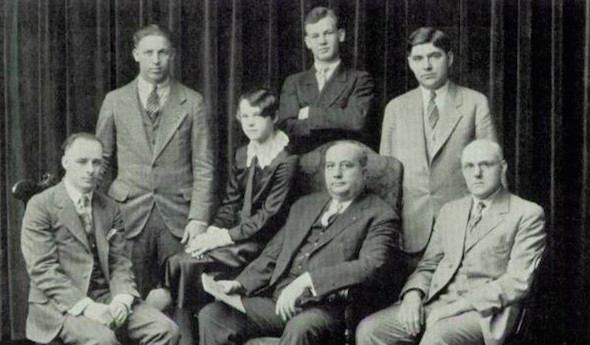
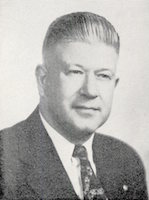
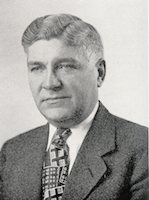
PHOTOS: (Top) Charlie Forsythe, standing far right, served at Lansing Central at the time of this photo in 1927. (Top middle) Forsythe in 1938. (Middle) MHSAA Executive Director Alden Thompson. (Below) Forsythe. (Photos gathered by Ron Pesch.)