

Regulation with Roots
December 3, 2015
By Jack Roberts
MHSAA Executive Director
The following is an excerpt from “History, Rationale and Application of the Essential Regulations of High School Athletics in Michigan.”
Throughout the years, schools of this and every other state have identified problems relating to school transfers.
There is recruitment of athletes and undue influence. There is school shopping by families for athletic reasons. There is jumping by students from one school to another for athletic reasons because they couldn't get along with a coach or saw a greater opportunity to play at another school or to win a championship there. There is the bumping of students off a team or out of a starting lineup by incoming transfers, which often outrages local residents. There is the concentration of talent on one team by athletic-motivated transfers. There is friction between schools as one becomes the traditional choice for students who specialize in a particular sport. There is imbalance in competition as a result. And there is always the concern that the athletic-motivated transfer simply puts athletics above academics, which is inappropriate in educational athletics.
All states have developed rules to address the problems related to school transfers. In some states it is called a transfer rule and in other states a residency rule, because linking school attendance to residence is one of the most effective tools for controlling eligibility of transfers. None of the state high school association rules is identical, but all have the intention of preventing recruiting, school shopping and jumping, student bumping, friction, imbalance and overemphasis, as well as the intention of promoting fairness in athletic competition and the perspective that students must go to school first for an education and only secondarily to participate in interscholastic athletics.
The transfer/residency rule is a legally and historically tested but still imperfect tool to control athletic-motivated transfers and other abuses. It is a net which catches some students it should not, and misses some students that should not be eligible. This is why all state high school associations have procedures to review individual cases and grant exceptions; and why all state high school associations have procedures to investigate allegations and to penalize violations where they are confirmed.
Over the years, state high school associations have considered four options to handle transfers. The first two options are the easiest courses: either (1) let schools decide themselves about transfers, as Michigan once did, but this leads to inconsistent applications and few states now subscribe to such an approach; or (2) make no exceptions at all, rendering all transfer students ineligible for a period of time, but this becomes patently unfair for some students and no state high school association subscribes to that extreme, although it would be easy to administer.
The third option – the ideal approach perhaps – would be to investigate the motivation of every transfer and allow quicker eligibility or subvarsity eligibility to those which are not motivated by athletics, but this is very time consuming if not impossible to administer. No state high school association has sufficient staff and money to consider every detail of every transfer.
This is why a fourth option has been most popular with most state high school associations. This is a middle ground which stipulates a basic rule, some exceptions (15 exceptions in Michigan), and procedures to consider and grant waivers (a primary role of the MHSAA Executive Committee).
It is certain that the MHSAA transfer rule is imperfect. However, whatever few imperfections exist are remedied through a process by which member school administrators may make application to the MHSAA Executive Committee to waive the rule if, in the committee's opinion, the rule fails to serve any purpose for which it is intended or in its application creates an undue hardship on the student. In a typical year, the Executive Committee will receive approximately 250 requests to waive the transfer regulation, approving approximately 60 percent of those requests.
The committee brings to its considerations the following rationale, most recently reviewed and reaffirmed on Aug. 5, 2015:
- The rule tends to insure equality of competition in that each school plays students who have been in that school and established their eligibility in that school.
- The rule tends to prevent students from “jumping” from one school to another.
- The rule prevents the “bumping” of students who have previously gained eligibility in a school system by persons coming from outside the school system.
- The rule tends to prevent interscholastic athletic recruiting.
- The rule tends to prevent or discourage dominance of one sport at one school with a successful program, i.e., the concentration of excellent baseball players at one school to the detriment of surrounding schools through transfers and to the detriment of the natural school population and ability mix.
- The rule tends to create and maintain stability in that age group, i.e., it promotes team stability and team work expectation fulfillment.
- The rule is designed to discourage parents from “school-shopping” for athletic purposes.
- The rule is consistent with educational philosophy of going to school for academics first and athletics second.
- It eliminates family financial status from becoming a factor on eligibility, thus making a uniform rule for all students across the state of Michigan (i.e., tuition and millage considerations).
- It tends to encourage competition between nonpublic and public schools, rather than discourage that competition.
- It tends to reduce friction or threat of students changing schools because of problems they may have created or because of their misconduct, etc.
Following the adoption of a more standardized statewide transfer rule in 1982, there were multiple legal challenges. However, in 1986, the Michigan Court of Appeals determined that a rational basis exists for the transfer regulation and that the rule, with its exceptions, is not overbroad and is neither arbitrary nor capricious, noting that neither a fundamental right nor suspect classification is involved. Berschback v. Grosse Pointe Schools 154 Mich App 102 (1986). That decision is also noteworthy for this statement which has halted or decided subsequent legal challenges: “This Court is not the proper forum for making or reviewing decisions concerning the eligibility of transferring students in interscholastic athletics.”
There were two major changes in the MHSAA transfer regulation during the 1980s. The first, the athletic-motivated transfer rule, led to the busiest period of litigation in the MHSAA’s history. The other major change, arguably of equal impact, was implemented without any controversy.
This second subtle but substantial change occurred in 1987 when language was adopted to limit eligibility after a transfer to the non-public school closest to the student’s residence, as opposed to any non-public school in whose service area the student lived. “Service area” did not have a consistent definition and created unnecessary concern that non-public schools had the advantage of huge, undefined attendance areas, compared to public school districts at that time.
Some high school associations prescribe geographic boundaries or mileage limitations for students transferring to non-public schools. Michigan simply says it’s only the non-public school closest to the student’s residence, where eligibility may be immediate.
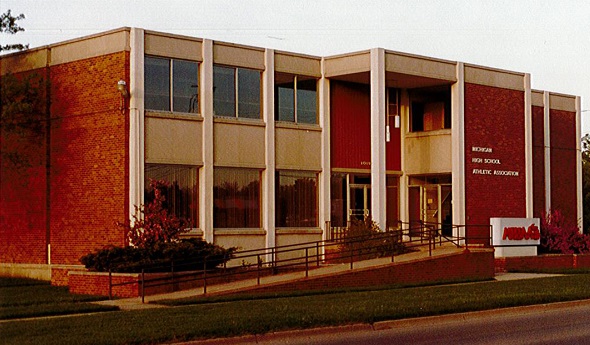
PHOTO: The MHSAA Transfer Regulation dates back to the early 1980s when the Association building stood on Trowbridge Road in East Lansing.

NFHS Voice: Find Answers at Youth Level
November 13, 2019
By Karissa Niehoff
NFHS Executive Director
Are there long-term solutions to increasing the number of participants in high school sports and improving parental behavior at high school contests? The answer to both questions might start at the youth sports level.
The NFHS hosted a first-ever meeting of about 25 leaders of National Governing Bodies and the U.S. Olympic & Paralympic Committee last week to discuss common concerns and opportunities to align and work together.
Within the youth areas of these organizations, the issues are familiar ones to high school leaders – decline in participation, parent behavior, coaches education and minimizing the injury risk. Clearly, however, reaching parents with appropriate educational messages on sportsmanship, injury risk and the values of participation is a top priority for leaders at all levels – youth, middle school and high school sports.
Recently, the NFHS formed a Middle School Committee in an effort to build interest in education-based sports at that level and to share the proper messages with parents before their kids reach high school. However, as we learned last week, middle school may even be too late!
Those educational messages will be enhanced if the process starts in out-of-school youth sports. If messages about the values of multi-sport participation, playing for the love of the game, and limiting contact in sports like football are consistently shared and demonstrated at the youth level, the education-based concept should be firmly in place by the time students reach high school.
Coaches education is another common concern. While the NFHS has created an outstanding online education program for interscholastic coaches through the NFHS Learning Center (www.NFHSLearn.com), there is no standard requirement to coach at the youth level. There should be some type of required certification for anyone to walk onto a field or court to coach. And while knowledge about teaching the proper tackling form in football or the proper defensive positioning in basketball is important, those are not the most important prerequisites for coaching.
Similar to the NFHS’ online Fundamentals of Coaching course, youth coaches should be required to take courses that help them learn how to coach the kids more so than the sport. And since many of the coaches at this level are parents of players on the team, these individuals – and all youth parents – should be presented materials similar to what is presented at preseason meetings at the high school level. This would include, among other things, the non-negotiable requirement to positively support their child while letting the coaches coach, and the officials officiate.
Lofty goals, for sure, without a collective governing organization over youth sports. However, these concepts can be endorsed and promoted within the youth areas of sport-specific NGBs. These fundamentals of education-based athletics are essential for the 2-3 percent who play sports beyond high school as well as the majority who apply the values learned in high school sports in their chosen careers.
The skills will eventually fade – even for those individuals who play sports beyond high school – but the values learned from playing sports, beginning at the youth sports level, will last a lifetime.
Dr. Karissa L. Niehoff is in her second year as executive director of the National Federation of State High School Associations (NFHS) in Indianapolis, Indiana. She is the first female to head the national leadership organization for high school athletics and performing arts activities and the sixth full-time executive director of the NFHS, which celebrated its 100th year of service during the 2018-19 school year. She previously was executive director of the Connecticut Association of Schools-Connecticut Interscholastic Athletic Conference for seven years.