


Regulation with Roots
December 3, 2015
By Jack Roberts
MHSAA Executive Director
The following is an excerpt from “History, Rationale and Application of the Essential Regulations of High School Athletics in Michigan.”
Throughout the years, schools of this and every other state have identified problems relating to school transfers.
There is recruitment of athletes and undue influence. There is school shopping by families for athletic reasons. There is jumping by students from one school to another for athletic reasons because they couldn't get along with a coach or saw a greater opportunity to play at another school or to win a championship there. There is the bumping of students off a team or out of a starting lineup by incoming transfers, which often outrages local residents. There is the concentration of talent on one team by athletic-motivated transfers. There is friction between schools as one becomes the traditional choice for students who specialize in a particular sport. There is imbalance in competition as a result. And there is always the concern that the athletic-motivated transfer simply puts athletics above academics, which is inappropriate in educational athletics.
All states have developed rules to address the problems related to school transfers. In some states it is called a transfer rule and in other states a residency rule, because linking school attendance to residence is one of the most effective tools for controlling eligibility of transfers. None of the state high school association rules is identical, but all have the intention of preventing recruiting, school shopping and jumping, student bumping, friction, imbalance and overemphasis, as well as the intention of promoting fairness in athletic competition and the perspective that students must go to school first for an education and only secondarily to participate in interscholastic athletics.
The transfer/residency rule is a legally and historically tested but still imperfect tool to control athletic-motivated transfers and other abuses. It is a net which catches some students it should not, and misses some students that should not be eligible. This is why all state high school associations have procedures to review individual cases and grant exceptions; and why all state high school associations have procedures to investigate allegations and to penalize violations where they are confirmed.
Over the years, state high school associations have considered four options to handle transfers. The first two options are the easiest courses: either (1) let schools decide themselves about transfers, as Michigan once did, but this leads to inconsistent applications and few states now subscribe to such an approach; or (2) make no exceptions at all, rendering all transfer students ineligible for a period of time, but this becomes patently unfair for some students and no state high school association subscribes to that extreme, although it would be easy to administer.
The third option – the ideal approach perhaps – would be to investigate the motivation of every transfer and allow quicker eligibility or subvarsity eligibility to those which are not motivated by athletics, but this is very time consuming if not impossible to administer. No state high school association has sufficient staff and money to consider every detail of every transfer.
This is why a fourth option has been most popular with most state high school associations. This is a middle ground which stipulates a basic rule, some exceptions (15 exceptions in Michigan), and procedures to consider and grant waivers (a primary role of the MHSAA Executive Committee).
It is certain that the MHSAA transfer rule is imperfect. However, whatever few imperfections exist are remedied through a process by which member school administrators may make application to the MHSAA Executive Committee to waive the rule if, in the committee's opinion, the rule fails to serve any purpose for which it is intended or in its application creates an undue hardship on the student. In a typical year, the Executive Committee will receive approximately 250 requests to waive the transfer regulation, approving approximately 60 percent of those requests.
The committee brings to its considerations the following rationale, most recently reviewed and reaffirmed on Aug. 5, 2015:
- The rule tends to insure equality of competition in that each school plays students who have been in that school and established their eligibility in that school.
- The rule tends to prevent students from “jumping” from one school to another.
- The rule prevents the “bumping” of students who have previously gained eligibility in a school system by persons coming from outside the school system.
- The rule tends to prevent interscholastic athletic recruiting.
- The rule tends to prevent or discourage dominance of one sport at one school with a successful program, i.e., the concentration of excellent baseball players at one school to the detriment of surrounding schools through transfers and to the detriment of the natural school population and ability mix.
- The rule tends to create and maintain stability in that age group, i.e., it promotes team stability and team work expectation fulfillment.
- The rule is designed to discourage parents from “school-shopping” for athletic purposes.
- The rule is consistent with educational philosophy of going to school for academics first and athletics second.
- It eliminates family financial status from becoming a factor on eligibility, thus making a uniform rule for all students across the state of Michigan (i.e., tuition and millage considerations).
- It tends to encourage competition between nonpublic and public schools, rather than discourage that competition.
- It tends to reduce friction or threat of students changing schools because of problems they may have created or because of their misconduct, etc.
Following the adoption of a more standardized statewide transfer rule in 1982, there were multiple legal challenges. However, in 1986, the Michigan Court of Appeals determined that a rational basis exists for the transfer regulation and that the rule, with its exceptions, is not overbroad and is neither arbitrary nor capricious, noting that neither a fundamental right nor suspect classification is involved. Berschback v. Grosse Pointe Schools 154 Mich App 102 (1986). That decision is also noteworthy for this statement which has halted or decided subsequent legal challenges: “This Court is not the proper forum for making or reviewing decisions concerning the eligibility of transferring students in interscholastic athletics.”
There were two major changes in the MHSAA transfer regulation during the 1980s. The first, the athletic-motivated transfer rule, led to the busiest period of litigation in the MHSAA’s history. The other major change, arguably of equal impact, was implemented without any controversy.
This second subtle but substantial change occurred in 1987 when language was adopted to limit eligibility after a transfer to the non-public school closest to the student’s residence, as opposed to any non-public school in whose service area the student lived. “Service area” did not have a consistent definition and created unnecessary concern that non-public schools had the advantage of huge, undefined attendance areas, compared to public school districts at that time.
Some high school associations prescribe geographic boundaries or mileage limitations for students transferring to non-public schools. Michigan simply says it’s only the non-public school closest to the student’s residence, where eligibility may be immediate.
PHOTO: The MHSAA Transfer Regulation dates back to the early 1980s when the Association building stood on Trowbridge Road in East Lansing.
The Changing Face(book?) of Coaching
March 26, 2013
By Rob Kaminski
MHSAA benchmarks editor
From online video exchange programs such as hudl.com to social media platforms like Facebook, Twitter, and LinkedIn, the face of coaching and communicating with teams is ever-changing. How much is too much, and how are the new tools being used by the old guard?
With increasing frequency, today’s coaches are turning to technology to assist in their endeavors, particularly in video review and data compilation, as the number of programs available to them seems to grow on a daily basis.
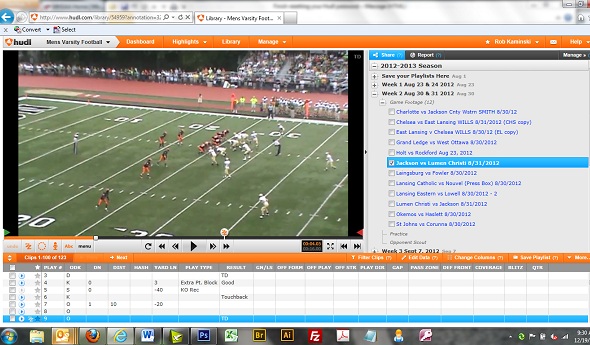
Among the recent leaders, hudl.com seems to have won the favor of football coaches across the state, reducing video exchange and study to a couple clicks of the mouse.
Several members of the MHSAA Student Advisory Council report that their football coaches use the web-based program, and even local officials associations are using it for film study.
Similar programs are making it easier for today’s coaches to analyze data and compile statistics as well.
“The dispensing of information is much quicker than it used to be,” said Marshall bowling coach Sue Hutchings. “We use a scoring software for our stats.”
In more “visual” sports such as competitive cheer, online video is now essential.
“Video playback and feedback to athletes has helped the sport 10-fold,” said Middleville Thornapple-Kellogg coach Abby Kanitz.
In some cases, coaches are taking the lead on such initiatives.
“I run the MISCA (Michigan Interscholastic Swim Coaches Association) website and receive plenty of positive feedback about us posting meet results and top times reports,” said Bloomfield Hills Andover coach David Zulkiewski. “I also visit MHSAA.com weekly. Since I run the MISCA website, I want to make sure I have accurate and up-to-date information posted.”
Technology has also made the world a bit “greener” even in the small corner that is interscholastic athletics. From the required MHSAA rules meetings moving to an online format, to volumes of data now stored on flash drives rather than in file cabinets, coaches are realizing savings in both time and cost.
“The current state of track and field and cross country is so much more manageable than when I began,” said East Kentwood’s Dave Emeott. “I remember compiling actual papers from all over the state to keep track of the opposition, and now thanks to Athletic.net we have this access at the tip of our fingers. These programs have also replaced nights spent inputting data and record-keeping. I am sure I have replaced all that time elsewhere, but it is probably spent with kids and not with data.”
With the saturation and availability of these reports around the clock also comes temptation for those who are driven, and even obsessed, with such numbers. Coaches can rank near the top of that list.
“Technology can be extremely helpful and time-saving for coaches and teachers,” said Grand Haven wrestling coach James Richardson. “But, the disadvantage is the coaches and athletes have a more difficult time getting away from the sport, as we have access to so much information, and others have more access to us. This can lead to too much time being devoted to our sport.”
It also might even take some of the fun out of the actual competition.
“I think the one negative side of technology is the lack of the unknown,” Emeott said. “There was a day when we would enter a meet and not really know how the day would turn out. Now I have most meets scored within 10 points the day before we arrive.”
At times, such advance information also can lead to overconfidence heading into competition.
“Currently the MHSAA Final draw is posted online, and my players often see it and draw their own conclusions before I have a chance to talk to them about it,” said Allegan tennis coach Gary Ellis. “In the past, I was able to present their draw in the light in which I wanted them to see it.”
Another side effect is the indirect push to play beyond high school.
“There is a lot more social promotion and glamourizing of the athletes,” said Mike Van Antwerp, Holt lacrosse coach. “The recruiting pressure has increased tremendously, which is causing kids to commit earlier and go to great lengths to have a chance at being recruited.”
The world has indeed become a smaller, more familiar place. Not only can students and coaches learn pertinent statistics relating to any given opponent, they can also learn personal information about their competition through the deluge of social media vehicles.
It is in this realm where the greatest divide exists between coaches and their athletes when the subject of technology comes up.
Several members of the MHSAA Student Advisory Council indicate that their coaches do not use social media to assist with the daily activities involved with their sport, while others are but only on a limited basis.
It’s not that the coaches don’t know about Facebook, Twitter, LinkedIn, or the other platforms. More likely, they are all too well versed in the abuses of such mediums by young adults not yet ready to understand the lasting ramifications of a random tweet or damaging photo.
“We have specific rules for use of cell phones at practice, games, in the locker room, etc.,” said Diane Laffey, athletic director and coach at Warren Regina. “We also have a form for parents to sign if they want the coach to be able to text their daughter about practice or game cancellations or changes. We stress that the texting only be for necessary things, and the parents are to give permission.”
Safeguarding against the misuse of handheld devices is becoming as commonplace as handing out uniforms prior to the season.
“By rule, our players aren’t allowed to bring electronic devices to the court with them. We restrict cell phone usage at practice,” said Portage Central tennis coach Peter Militzer. “Players must ‘friend’ the coach on either Facebook or Twitter, and I monitor their activities to make sure their language and behavior meets our standards. We restricted a player’s opportunity to play on varsity last season due to excessive use of crude language and an offensive user name on Twitter.”
PHOTO: This is a screenshot from Hudl.com, an online service used by high school football coaches for video analysis and archiving.