

UP Schools Big & Small Find Multi-Sport Success
January 10, 2020
By Dennis Grall
For the Second Half
ESCANABA – It should not come as a surprise that the Class A school with the highest percentage of multi-sport athletes has an athletic director who lived that life.
 Alex Tiseo, athletic director at Marquette High School, received 15 varsity letters while he was a student at the school, including as a three-sport participant for two years in the fall alone. Tiseo played soccer for four years while running cross country for three years and playing football for two. He also played basketball and ran track.
He is not taking any credit for the excess of multi-sport athletes at his alma mater. "It is the foundation of the thing, the culture of the coaches," Tiseo said of all the school's coaches supporting and encouraging all-around athletic participation.
"It is the benefit and mentality of getting away from (athletic) specialization," Tiseo said, noting an athlete may be "a leader in one sport and just a role player" in another.
He also pointed out athletes are not penalized when they have to miss practices or events because of their heavy extracurricular participation.
According to the most recent multi-sport participation survey conducted by the Michigan High School Athletic Association, Marquette had the highest percentage of multi-sport athletes among all Class A schools in 2018-19 with a whopping 85.9 percent. Grand Rapids Northview, at 83.1 percent, was the only other large school above 80 percent.
Four Class B schools and six Class C schools topped the 80-percent mark while 14 Class D schools surpassed 80 percent, including three topping 90 percent, led by Gaylord St. Mary (93.2).
Marquette, unlike many larger schools, does allow students to participate in more than one sport in the same season. Many small schools, simply because of the lower enrollment, also allow students to compete in more than one sport during the same season.
"It is near and dear to my heart," Tiseo said of seeing multi-sport participation. Students must pick a priority sport if practices or games would conflict on the same date. "For me, it was cross country," Tiseo said, noting his soccer and football coaches knew he was getting plenty of running in that primary sport. In football, he was a place-kicker, which made it easier if he had to miss a practice.
He would often kick with his dad, he said, agreeing that a primary position player may have found it harder to miss a practice or game.
He also pointed out that in fall sports, "one-third of the season comes before school starts" and fall sports ended in mid to late October, reducing the number of potential conflicts.
Tiseo said multi-sport athletes work closely with their coaches to arrange practice schedules: "If coaches have difficulty with the kids in putting the schedule together, there is a caveat there where I can help." To date he has not needed to assist.
Students and coaches alike "reinforce the importance of academics," Tiseo said. "Multi-sport athletes are definitely among our highest academic achievers."
Athletes realize, he said, the importance of staying academically eligible so they can compete in their athletic endeavors.
Tiseo also has noticed student-athletes in general maintain better attitudes, which permeates the hallways and classrooms and benefits the general student body.
Success in athletics can generally bolster improved spirit and attitude in school. He said there is a general attitude of wanting to participate in something "when you see your peers having fun." The long Upper Peninsula winters also help encourage students to participate in athletics to help the time speed along. "It also correlates with the success of the teams," he said.
Two other Upper Peninsula schools have also found outstanding multi-sport participation, with Class B Gladstone at 86.7 percent and Class D Watersmeet with 90.3 percent during 2018-19.
 First-year Gladstone athletic director Dave Lindbeck said "I strongly promote for kids to go to the next level. When I hire a new coach, I ask them how they feel about (multi-sport participation)."
Like Tiseo, Lindbeck also encourages athletes to get involved in programs for lifting weights and nutritional growth. Tiseo said proper conditioning and nutrition "help lessen the risk of injury" and playing multiple sports allows students to use different sets of muscles in those various activities. "You don't see over-use injuries" he said.
Lindbeck said "a good strength and conditioning program involves everything, including in-season and off-season workouts and help them maintain strength. We're not asking kids to bulk up. There is a lot of strength and flexibility (training), working (various) muscle groups, strengthen(ing) ligaments."
Lindbeck said the Braves' coaches are encouraged to attend games in the wide selection of activities, which shows students they care.
He also said it is easy to see how students grow in athletics and socially as they raise their participation levels. "You see how they communicate, you see it in the hallways," he said.
He also noted it has a big impact on their classroom work. "Those who don't participate don't do as well," he said, noting B-C students tend to improve their grade-point averages as they increase their involvement. "Kids seldom have issues with their grades.
"It is so crucial to be involved with sports," Lindbeck added. "The ones who do it really value it. We use it as a carrot, a motivator. It also keeps the structure and holds each other accountable."
Watersmeet has only 44 students this school year – up from 36 last year – but the Nimrods definitely are a school and community-oriented program.
Pizza parties, camping trips and cook-outs are among projects to encourage students to participate in sports, and fund-raisers are used to buy warm-ups for players in grades 6-12. "We dress them up so they look special," said long-time administrator-coach George Peterson.
"We work hard to get them to enjoy all the sports."
The board of education uses the Nimrod Fund to help students "dress up and be a part of it," said Peterson, who indicated much of that financial opportunity comes from the memorable 2003-04 season when ESPN coined the "Nimrod Nation" program.
That spring the boys basketball team appeared on The Tonight Show, and the Sundance Channel did a series on the school/town in 2006.
Peterson said the school realized $500,000 in gross revenue as a result of that national exposure and still averages $10-13,000 a year in profits. "I still pinch myself. I still can't believe it happened," Peterson said of that exposure and financial benefit.
Watersmeet has girls volleyball and offers cross country country, basketball, track and golf for boys and girls. "They are proud to be out there," said Peterson. "They have to conduct themselves in a respectful manner.”
The MHSAA study revealed nearly 43 percent of state prep athletes participated in two or more sports in 2018-19. It also indicated "early and intense sport specialization has become one of the most serious issues related to health and safety at all levels of youth sports, with overuse injuries and burnout among athletes tied to chronic injuries and health-related problems later in life."
The survey found 45.1 percent of boys and 40.4 percent of girls participated in more than one sport.
 Denny Grall retired in 2012 after 39 years at the Escanaba Daily Press and four at the Green Bay Press-Gazette, plus 15 months for WLST radio in Escanaba; he served as the Daily Press sports editor from 1970-80 and again from 1984-2012 and currently is in a second stint as the interim in that position. Grall was inducted into the Upper Peninsula Sports Hall of Fame in 2002 and serves as its executive secretary. E-mail him at [email protected] with story ideas for the Upper Peninsula.
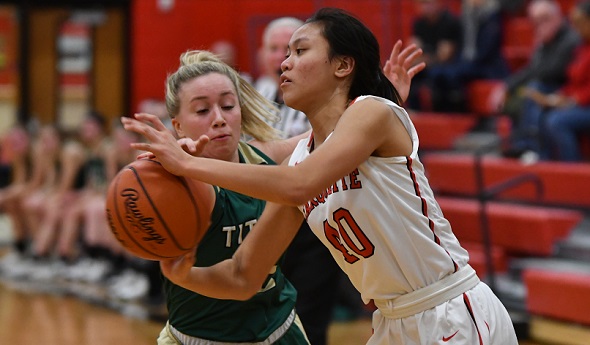
PHOTOS: (Top) Marquette's Maria Millado (40) works to get a pass past a Traverse City West defender last season; Millado also runs track for the Redettes. (Middle) Gladstone's Luke Van Brocklin crosses the finish line to finish second in the 400 meters at last spring's Upper Peninsula Division 1 Track & Field Finals; he played football this fall. (Photos by Cara Kamps.)
Fresh from Cancer Fight, Disbrow Returns to Coaching Ready to Continue 'Winning the Day'
By
Doug Donnelly
Special for MHSAA.com
September 16, 2026
Nikki Disbrow grabbed her keys and started to get into the family vehicle to pick up her son from a summer 7-on-7 practice. Her husband, Sand Creek football coach Sid Disbrow, told her he wanted to come, too.
 “What are you doing?” she asked. “You can barely walk.”
Sid, who had just returned home from surgery to have a tumor removed while battling colorectal cancer for the second time in three years, wasn’t having it. He got in the vehicle.
When Nikki arrived at the field, Sid opened the door.
“Where are you going?” she asked.
Sid, unrelenting, got out of the car and began making his way to the field.
“She was kind of my walker,” he said. “I couldn’t walk on my own, but I needed to address the kids. I needed to be out there. I needed to show them that it’s about winning the day, because you never know what might happen.”
Disbrow, 49, has been coach for just about 30 years. It’s part of who he is in the Sand Creek school district and community. He’s been an assistant football coach, youth baseball and softball coach, varsity boys and middle school basketball coach. He’s detailed, organized, loves the competition and thrives on being around kids.
Last year around the eighth or ninth week of the football season, he began noticing the symptoms of the cancer he had chemotherapy and radiation to treat a couple years prior. He finished the season, knowing middle school basketball was getting ready to start.
Within a week of finding out the cancer had indeed returned, he was able to get everything scheduled and begin chemotherapy. He was getting treated at Flower Hospital in Sylvania, Ohio, about 45 minutes from Sand Creek.
 “They would give me the last appointment of the day so I could get there after school,” he said. “They were great to work with.”
It wasn’t easy trying to maintain a rigorous coaching schedule while fighting cancer.
“There are no rules in cancer. You don’t get to do as you wish. Chemotherapy is real,” Disbrow said.
He wasn’t deterred. He coached the entire middle school basketball season – which ended around Christmas. Some days, he was exhausted. Still, quitting wasn’t an option.
“I wanted to be out there for my son and all of the other kids that I’ve been coaching all the way through,” he said. “That was important to me. That was my driving force.”
Not long after basketball season ended, he began eight weeks of radiation. It ended just in time for him to coach his son’s baseball team.
After that season ended, something still wasn’t right. Doctors found a tumor, although they weren’t sure if it was shrinking or growing. They gave him an option – surgery to remove it or wait a few months, get tested again. At that point, if it returned, it meant starting chemotherapy and radiation all over again. He checked the calendar.
“I thought about football season,” he said. “My son is on JV this year. That’s not something I want to miss.”
He went in for surgery and had the tumor successfully removed. Doctors found out later it was indeed cancerous and growing.
“I made the right decision,” he said.
He was recovering from that round of surgery when he made it onto the football field to talk to the Aggies players. The football field is more than a place for Disbrow to forget all about cancer and focus on the lives of the young men on the field. It’s a place him and Nikki, a former varsity volleyball coach at Sand Creek herself, got married.
“It’s probably the first time there was a wedding on the football field, and probably the last time,” he said.
On Aug. 3 – one week before two-a-days started for Sand Creek – he found out the cancer was in remission. He was back with the team when practice began.
“I brought my lawn chair with me,” he said. “There were some days where I just didn’t have the strength.”
Through it all, he’s endured, never wavering.
“The credit goes to God,” he said. “I don’t see how people go through something like this without their faith. I owe it all to Him. He’s given me this chance to continue to teach and coach. I don’t take that lightly.”
 Sand Creek varsity football coach Derek Hewitt said seeing Disbrow come back to practice after all he went through was inspiring. Disbrow coaches special teams, the quarterbacks and helps Hewitt with the offense. On most Fridays he’s in the coach’s box.
“It’s great to have him back out there,” Hewitt said. “He’s not the scout team quarterback anymore, but he’s there, every day. It’s great for me to have him by my side.”
One thing Disbrow is not planning to do is stop coaching. In fact, he’s going to be even busier. He was recently named the school’s junior varsity boys basketball head coach.
“Coaching really kept me going through all of this,” he said. “The kids have been great through it all.”
The father of four is from Morenci, the neighboring town to the south and heated rival of Sand Creek, which he admits caused some angst when he moved from coaching football at his alma mater to Sand Creek.
He was part of the 1995 Morenci football team that played for a Class C championship in the Pontiac Silverdome, graduating in 1996. He was a sophomore at Adrian College when a Morenci coach asked him to join that coaching staff. A couple years later he began coaching at Sand Creek.
Now, he, his wife and four kids are engrained in the Aggies community.
“I wasn’t one of those people who got into teaching because I wanted to coach,” he said. “I wanted to be a teacher, to be around young people and help them. Coaching was something I loved once I started doing it. It’s who we are now as a family. It’s part of our lives.”
 Doug Donnelly has served as a news and sports reporter at the Adrian Daily Telegram and the Monroe News for 30 years, including 10 years as city editor in Monroe. He's written a book on high school basketball in Monroe County and compiles record books for various schools in southeast Michigan. He is now publisher and editor of The Blissfield Advance, a weekly newspaper. E-mail him at [email protected] with story ideas for Jackson, Washtenaw, Hillsdale, Lenawee and Monroe counties.
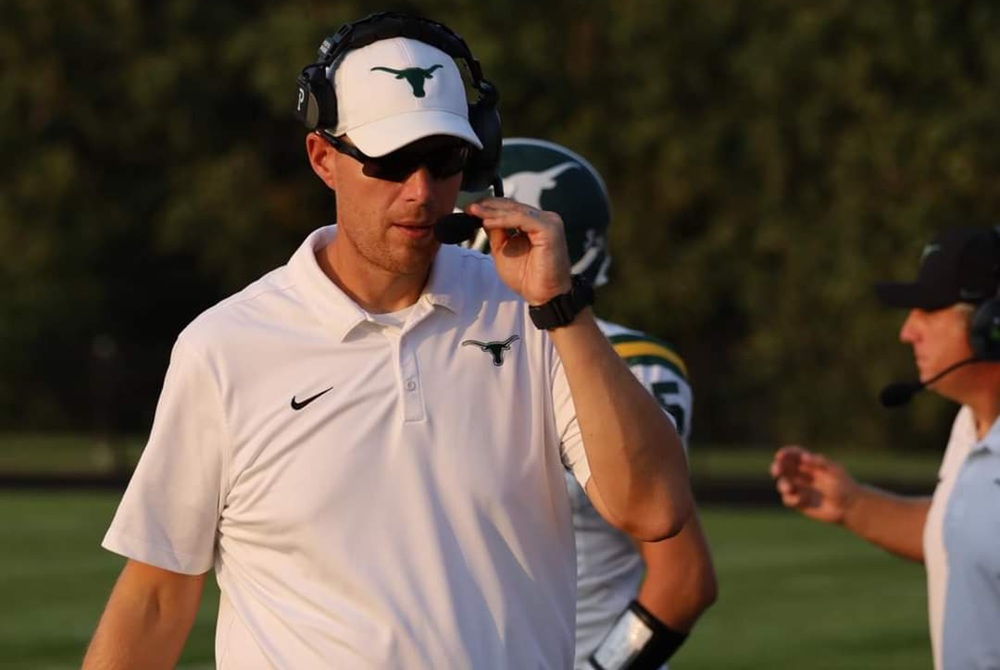
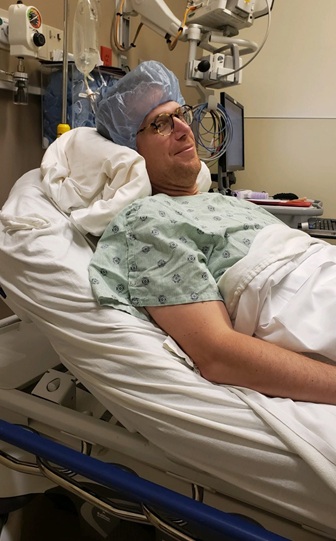
PHOTOS (Top) Sand Creek assistant football coach Sid Disbrow mans the headset while on the sideline during a game. (Middle) Disbrow lays in a hospital bed while receiving care in 2023. (Below) Disbrow stands for a photo with wife Nikki last fall. (Top photo by Becky Serin. Hospital and family photos courtesy of the Disbrow family.)