

Taking a Healthy Approach to Sports
By
Rob Kaminski
MHSAA benchmarks editor
November 8, 2013
During election years, it’s a familiar rallying cry: “Four more years! Four more years!”
It’s become commonplace following the third quarter of football games around the country for members of the leading team to march down the gridiron with four fingers raised on one outstretched hand as teams switch ends of the field to signify, “Fourth quarter is ours; finish the job.”
The number four also is significant in education with school terms identified as freshman, sophomore, junior and senior years.
To that end, the MHSAA is imploring everyone involved in educational athletics to go back to school in 2013-14 with a four-year mission in mind: “Four Thrusts for Four Years.”
The goal is to attain and maintain advanced degrees in sports safety, positioning Michigan schools in the center of best practices for ensuring the health of our product and students, today and beyond.
“Just a brief look around all levels of today’s athletic landscape reveals heightened awareness of health and safety issues,” said MHSAA Executive Director Jack Roberts. “Interscholastic sports as a whole – and particularly school sports in Michigan – has long led the charge to employ the safest contest rules and provide the healthiest environments for our games and participants.
“But, to put it in athletic terms, we can’t sit on the lead,” Roberts added. “We can, and must, improve our games in order to guarantee their existence for future generations. That is our goal, our thrust in the coming years.”
Following are the focal points for this four-year plan:
- Implement heat and humidity management policies at all schools for all sports.
- Require more initial and ongoing sports safety training for more coaches.
- Revise practice policies generally, but especially for early in the fall season.
- Modify game rules to reduce the frequency of the most dangerous play situations, and to reduce head trauma.
The directive actually kicked off last March, when the Representative Council approved a heat management policy for MHSAA tournaments and a detailed model policy for schools. While not setting requirements for member schools during the regular season, it suggests actions based on heat index – the degree of felt discomfort derived by combining temperature and humidity measurements – that are designed to minimize the risk of heat-related illness during interscholastic participation.
The policy is mandatory for all MHSAA tournaments beginning this school year, and the MHSAA plans to monitor schools’ adoption of the plan throughout the year to determine best policies moving forward.
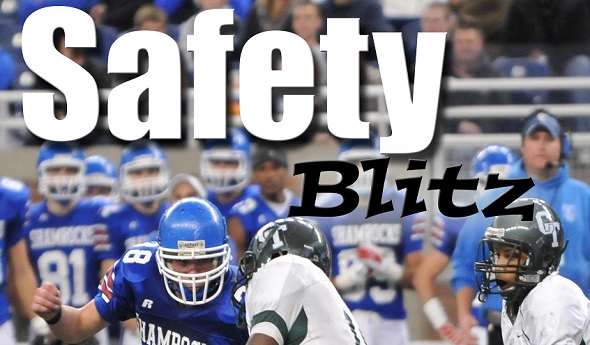
Laminated cards containing the policy and heat index chart were printed and mailed to schools in June and continue to be disseminated at statewide meetings this fall. Two publications, Heat Ways and Safety Blitz, were published, mailed and posted to MHSAA.com, heightening awareness of healthy practice regimens, and schools have been offered discounted psychrometer prices through the MHSAA to assist in their efforts to properly monitor weather conditions.
“This action was significant; but it’s just the next step in a continuous series of actions being taken to make school sports as healthy as possible for students,” said Roberts.
The MHSAA’s proactive movements toward a safer tomorrow are taking place concurrently, rather than sequentially. While the heat and humidity plan is the most developed of the four “thrusts,” other initiatives are underway. Today’s climate prompts such action.
From the NCAA’s new “targeting fouls” to the NFL’s “crown” rule, and of course Major League Baseball’s Biogenesis/PED debacle, the headlines off the field in August centered on protecting the games rather than simply playing them. Like it or not, it’s the type of news fans need to get used to as their favorite sports audible to option plays in order to steer clear of the endangered species list.
The situation can’t be overstated. Athletics at all levels has been approaching a crossroads for years, and the time to heed the signals has come.
“Let’s make one thing abundantly clear: The people in charge of football at all levels are wise to craft rules that make the game safer, even if those rules will be controversial,” wrote Andy Staples for SI.com College Football on July 23.
The story continued: “As more information arrives about the long-term dangers of the headshots football players absorb at the high school, college and pro levels, something has to change. The next few years will be messy. The game needs saving, because if it continues as it has, it will get decimated by lawsuits and by parents of young children who decide the potential adverse effects aren't worth the risk.”
When kids stop playing, numbers at the high school level and beyond are bound to diminish as well. To trumpet the vast benefits of interscholastic football while easing parents’ minds on safety concerns, the MHSAA formed a Football Task Force in the spring of 2013. The task force is the first of several to be convened during the next four school years, and the objectives of each are to promote the sports involved as safe, low-risk, competitive athletics through the development of better practice policies and modification of playing rules.
“These task forces will be central to the overarching mission of preserving sports for years to come,” said Roberts. “We believe the MHSAA Football Task Force has set a foundation on which to build. Our discussions involving revised practice policies have reached the draft stage, and we intend to have formal proposals ready to present to the Representative Council in March 2014.”
The work of the 13-member task force – made up of football coaches and school administrators from around the state – will be reviewed by the Michigan High School Football Coaches Association, the MHSAA Football Committee and at the MHSAA League Leadership meeting for fine-tuning prior to reaching the Council.
“It is important that we provide opportunities for children to participate in interscholastic athletics and crucial that we do all we can to ensure they will be safe when they do,” said Football Task Force member Tammy Jackson, principal at East Jordan High School, who has a sports medicine background. “The MHSAA has taken an active role in promoting safety by convening the Task Force to examine current rules and consider modifications to further protect children.”
With so much publicity concerning football safety, the football group was a natural to become the first of several task forces to be assembled.
“We must educate the public on the benefits of all school sports,” said task force member Bill Chilman, superintendent of Beal City Schools. “In the case of football, it must be impressed upon people that it is statistically a very safe game when taught and played properly. The Football Task Force being proactive rather than reactive to this safety movement is key to promoting the lifelong values of football and all school sports.”
And within that public is a group which has the most vested concerns: the parents.
“There is more information available to the general public regarding sport and sport injuries, and unfortunately parents and kids all too often hear about the negative side of sport,” suggests Mike Bakker, athletic director at Fenton High School, and another member of the MHSAA Football Task Force. “It is imperative for the integrity of the sport of football to have coaches and administrators provide information about the safety of the game and the steps we take to keep kids safe. We must educate parents about the proper way to play the game and the signs to look for if problems arise.”
Without getting into the minutia of the new NCAA and NFL playing rules regarding use of the helmet, suffice it to say this will be an interesting fall during which to monitor penalties and their effects on injury numbers, particularly when it comes to concussions.
The rules changes have been reported and debated at the national level ad nauseam, and the mood seems to inexplicably tilt toward skepticism and criticism from the very group that would stage a revolt of epic proportions if football ever became extinct: the fans.
Case in point: six targeting fouls were called in 75 games during the opening weekend of college football over Labor Day Weekend (one ejection was overturned by replay), and the outcry began. Analysts and fans are afforded frame-by-frame replays which onfield officials do not have the luxury of seeing before throwing the flag.
Like it or not, the rules are in place. And, they have been implemented to protect the future of the game. The impetus now falls to the caretakers of the game – the officials – who no doubt will bear the brunt of disapproving masses in the stadiums. Yet, football is their livelihood too; both players and officials are expected to make adjustments.
At Officiate Michigan Day and the ensuing National Association of Sports Officials Summit this past July in Grand Rapids, the theme was clear: “The game has changed, and the officiating has to change with it.”
From NFL Referee Jeff Triplette to SEC Coordinator of Officials Scott Shaw to Big Ten Referee Alex Kemp and Fox Sports NFL Rules Analyst Mike Pereira – people who have been around the block – the message delivered was that the changes are necessary for the health and growth of football.
“We’re talking about taking out a specific type of play that, quite honestly, you didn’t see that much of before about 10 years ago,” Triplette said during a player safety panel at the NASO Summit. “They still played defense, there were still great hits. But somehow, these violent types of tackles began to get notoriety – whether it was all the ESPN highlights, YouTube, and maybe a combination of all of that stuff – and players started to celebrate those hits, and that became the goal.”
Not only can the game become safer; it might even become better by going retro. In recent comments on The Sports XChange, NFL analyst and former coach John Madden said, “You are always concerned how any change will impact the game. In this case, players are not going for the head shot, that big hit. They are keeping their heads up. Better tackling has become the unintended consequence. That's a good thing. Good for football. Good for kids watching. Players are tackling the way they are supposed to, with their shoulders and wrapping up. The big hit, the big replay had become so popular that tackling suffered.”
In high school, the most notable rule change involving helmets involves penalties for players who lose their helmets during a play. However, illegal helmet contact continues to be a point of emphasis and carries a minimum of a 15-yeard penalty as it has for many years. In the NCAA the mantra on helmet-to-helmet blows is, “When in doubt throw them out,” as the foul now carries with it a player ejection.
That is not the high school rule—yet—but officials at all levels need to be on the lookout. Kemp was quick to warn a roomful of prep football officials during Officiate Michigan Day, “We’ve been told to err on the side of safety, and these plays will result in ejection,” while also adding that such plays will be reviewed by replay officials. “That portion of the rule isn’t there in high school yet, but be ready for it; it’s coming, so when it happens in your games take notice and determine the severity.”
Which brings us to contest rules for safer play. During the next few years, various sport groups will be assembled to follow the MHSAA football task force’s lead in scrutinizing rules and developing proposals for revisions or additions to be submitted to the National Federation of State High School Associations. Initial football discussions receiving some traction involve changing the enforcement spot on post-interception penalties and limiting the number of yards teams can run up on free kicks. Before any submissions are made to the NFHS Football Committee, the task force will conduct research and present findings to Michigan committees.
“We can make changes ourselves – through MHSAA sport committees – for the subvarsity level, but our committees can only make recommendations to national rules committees for varsity level play,” explained Roberts. “Over the next four years, we will be asking our sport committees to give more time to the most dangerous plays in their sport – identifying what they are and proposing how to reduce that danger.”
While the football task force here at home is finalizing practice policy proposals targeted for implementation in the fall of 2014, Texas and Illinois are two states which launched restrictions with the opening of football this season. Spokespersons from both states indicate that coaches and school administrators have been pleased with the new formats.
Coaches no doubt will need to adjust practice itineraries and budget time wisely. Administrators need to remind staffs that the new era is dawning in the name of player safety, which is paramount to all parties.
“In game situations, coaches want our officials to throw the flag on late hits, low hits and other illegal contact,” Roberts said. “These are incidents that they have no control over. They do have control over practice time and teaching fundamentals; so let’s encourage safety measures that we can control, and employ those tactics to help the game prosper.”
Education will key the efforts to align coaches of all sports – and all levels – in the movement toward a healthy future. School will be in session during the next four years as the MHSAA implements effective and practical means for raising coaches’ preparedness. Three avenues are on the map:
First, the Representative Council mandated that beginning with the 2014-15 school year, all assistant and subvarsity coaches at the high school level must complete the same MHSAA rules meetings currently only required of varsity head coaches or, alternatively, one of the free online sports safety courses posted on or linked from the MHSAA Website that is designated as fulfilling this requirement.
Second, it is proposed that by 2015-16, MHSAA member high schools will be required to certify that all of their varsity head coaches have a valid CPR certification.
Third, it is proposed that by 2016-17, any person who is hired for the first time to be the varsity head coach of a high school team, to begin after July 31, 2016, must have completed either Level 1 or Level 2 of the MHSAA Coaches Advancement Program. The MHSAA is preparing to subsidize some of the course cost for every coach who completes Level 1 or 2.
Together, these changes will move Michigan from one of the states of fewest coaching requirements to a position consistent with the “best practices” for minimizing risk in school sports and providing students a healthy experience.
At stake in these four thrusts – whether for an administrator, coach, official, student-athlete, parent or fan – are the environments that offer so many lessons and the games for which we root.

2017 Bush Awards Honor Trio of Leaders
June 26, 2017
By Geoff Kimmerly
Second Half editor
Three athletic directors who have taken leading roles in important areas of educational athletics – Rockford’s Tim Erickson, Bay City Central’s Morley Fraser and Mattawan’s Ken Mohney – have been named recipients of the Michigan High School Athletic Association’s Allen W. Bush Award for 2017.
Al Bush served as executive director of the MHSAA for 10 years. The award honors individuals for past and continuing service to prep athletics as a coach, administrator, official, trainer, doctor or member of the media. The award was developed to bring recognition to men and women who are giving and serving without a lot of attention. This is the 26th year of the award, with selections made by the MHSAA's Representative Council.
Among many contributions, Erickson has built a strong reputation in officiating, while Fraser is a hall of fame coach and Mohney is an accomplished instructor of administrators on the state and national levels.
“These three administrators have contributed to educational athletics in a variety of ways, but are especially well-respected in specific areas of expertise – and the quality that binds them together is leadership,” MHSAA Executive Director John E. “Jack” Roberts said. “This award recognizes work behind the scenes, and Tim Erickson, Morley Fraser and Ken Mohney exemplify it. They are worthy recipients of the Bush Award.”
Erickson recently finished his 34th school year at Rockford, where he started his career in 1982 after earning a bachelor’s degree from Central Michigan University; he later added a master’s degree from CMU. He has served as the Rams’ athletic director for the last decade supervising 34 varsity teams and 140 staff members. Erickson also has served as an assistant principal for five years, two years each as student activities coordinator, middle school athletic director and 6-12 intramural director; and taught for 19 years.
A member of the Michigan Interscholastic Athletic Administrators Association (MIAAA) and National Interscholastic Athletic Administrators Association (NIAAA), Erickson’s vast contributions to educational athletics have stretched far beyond administration. A member of the West Michigan Wrestling Officials Association, he has served as a registered official for 37 years, currently in wrestling but previously as well for basketball, baseball, softball and volleyball. He has officiated an MHSAA Finals in wrestling, and also coached 42 seasons across a variety of sports, including four as the varsity baseball coach and as an assistant on Rockford football teams that won Division 1 championships in 2004 and 2005.
Rockford total has won 32 MHSAA Finals championships across 13 sports during Erickson’s tenure as athletic director. He and his staff also have hosted a variety of MHSAA tournament events at various levels, including 20 Finals. A member of the Rockford High School Athletic Hall of Fame, Erickson also has volunteered locally as a youth sports coach and participates with the Rockford Relay for Life. He’s served as building coordinator for the local United Way and stewardship chairman for his church.
“Tim Erickson continues to provide a wide range of valuable perspectives drawing from his experiences as not only as an administrator, but also as a coach and official,” Roberts said. “Those points of view are especially important as he continues to lead a successful department at one of our state’s largest schools – and as he and his staff continue to provide outstanding leadership as an annual host for a variety of our events, many at the highest levels of our tournaments.”
Fraser this spring completed his 39th year in education and 30th as an athletic director, recently retiring from his administrative duties at Bay City Central although he will continue to coach the football team. Fraser, who earned a bachelor’s degree from Alma College and master’s from CMU, joined the Bay City Central faculty in 1986 and took over as athletic director prior to the start of the 1998-99 school year. He also has served as an assistant principal at Bay City Central.
His Wolves football team returned to the MHSAA Playoffs last fall with a 6-4 record, and Fraser has built a 162-135 record in 31 seasons leading the program. Fraser also coached at Mendon and Bowling Green, Ohio, and was inducted into the Michigan High School Football Coaches Association (MHSFCA) Hall of Fame in 2011. His 1994 Bay City Central team finished Class AA runner-up, and he was named an MHSFCA Regional Coach of the Year that season, 1996 and also in 1978 while at Mendon (and in 1985 earned a similar award at Bowling Green). He was inducted into the Bay County Hall of Fame in 2013.
Also a member of the MIAAA and NIAAA, Fraser has spoken and presented at MIAAA and MHSFCA events and as part of Glazier Coaching Clinics. He’s been a keynote speaker at Rotary Club student leadership summer camps for the last decade and has served in an elementary students and athletes reading program and as part of Habitat for Humanity, assisting with summer projects.
“Morley Fraser has mentored hundreds of his football players over the last four decades, but his mentorship extends beyond the sport he’s coached most,” Roberts said. “Morley Fraser has created a legacy of service, success and stability with his longtime leadership at Bay City Central, and he continues to provide as well a respected voice in the football community across our state.”
Mohney has served as an administrator for 18 years with seven as a teacher and coach after earning bachelor’s and master’s degrees at Western Michigan University and while also serving from 1987-2007 in the U.S. Army. In addition to his work as an assistant principal and athletic director at Mattawan – the school received an MIAAA Exemplary Athletic Program Award in 2005 – Mohney has made significant contributions to his colleagues as a long-serving member of the MIAAA and NIAAA and as an instructor for the MHSAA Coaches Advancement Program.
A contributor to the MIAAA Board of Directors and Executive Board from 2002-14, Mohney served as Executive Board president in 2012-13 and on the NIAAA Board of Directors as Section IV representative (for five states) and as chairperson of the finance sub-committee. He has served on various committees both for the MIAAA and MHSAA, and in addition to his CAP instructor contributions has served on the faculty of the NIAAA Leadership Training Institute providing instruction both in Michigan and nationally. Mohney has earned NIAAA Certified Master Athletic Administrator status and MHSAA CAP Masters Elite certification, and also Certified Interscholastic Coach recognition from the National Federation of State High School Associations (NFHS). He was named a Regional Athletic Director of the Year by the MIAAA in 2008, earned its Denny Kiley Presidential Award in 2013 and its Jack Johnson Distinguished Service Award in 2014 – when he also earned special commendation from the NIAAA for distinguished service on its Board of Directors.
Mohney served as part of an Army helicopter air crew from 1987-91 and then as a flight and leadership instructor for the Michigan Army National Guard from 1991-2007. He received a U.S. Army Air Medal in 1991 for combat missions flown during Operation Desert Shield/Storm, a U.S. Army Achievement Award in 1998 as Michigan National Guard Solider of the Year and a U.S. Army Commendation Award in 2004 as Michigan National Guard Non-Commissioned Officer of the Year.
“Ken Mohney understands the values of education and teaching leadership not only to students at his school, but also those working to provide that education locally and on the statewide and national levels,” Roberts said. “He provides a steady influence among his peers as part of the MIAAA and has been essential in the growth of our Coaches Advancement Program by showing himself to be an exceptional relationship builder in all of his endeavors.”