

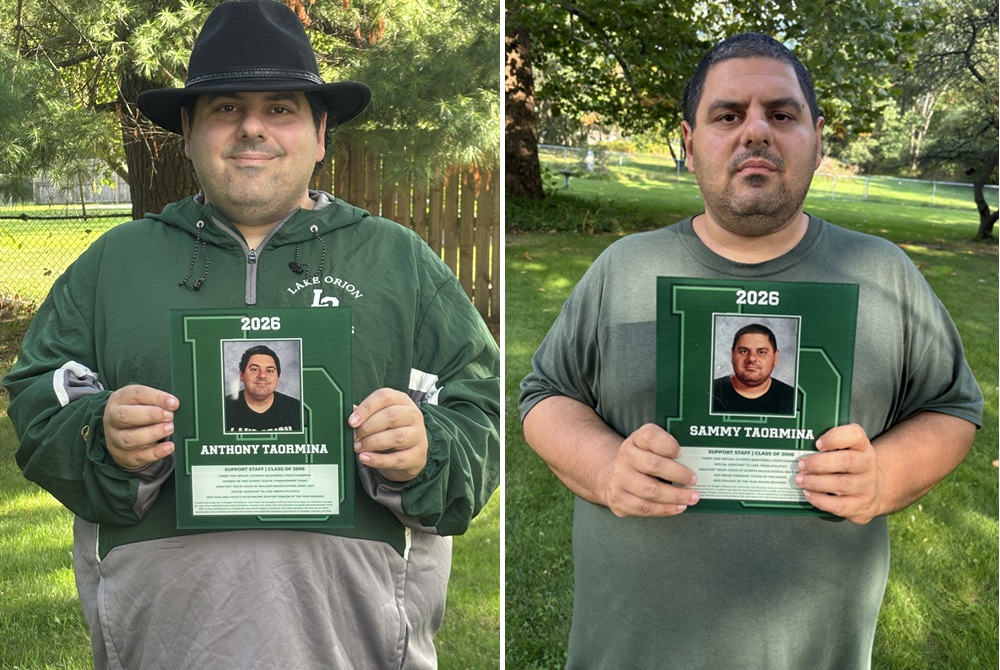
Taorminas Recognized by Lake Orion for Hall of Fame-Level Contributions in Several Roles
By
Keith Dunlap
Special for MHSAA.com
October 1, 2026
LAKE ORION — Sammy and Anthony Taormina are two fantastic examples that you don’t necessarily have to be a great athlete in high school to have a Hall of Fame impact on a school and sports community.
 Twin brothers, the Taorminas are 2006 graduates of Lake Orion High School who were members of the football and track & field teams (Sammy competed in both sports, Anthony in track) but neither stacked stats or accolades most all-state and future college athletes accumulate in high school.
Still, it was a no-brainer when Lake Orion athletic director Chris Bell and a committee chose the Taorminas to become part of the school’s first Hall of Fame class last week.
Simply put, there have been few who have had a bigger impact and served in more roles for the school than the Taorminas over the past two decades.
Both have been statisticians for teams, clock operators, announcers, mentors, and promoters of the school and athletic department. Sammy even has spent time inside a Dragon costume as the school’s mascot.
They regularly host a podcast called “OAA Now,” where coaches from around the league call in to chat and give insight on their teams. The two also have a blog where they regularly break coaching news.
During the spring, both have served as middle school track coaches, mostly presiding over throwers.
More importantly, both work for the district as middle school aides, with their friendliness and knowledge regularly mentoring kids to become better students and people.
“When you make an impact on someone’s life for the positive, then you know you’ve done your job,” Anthony Taormina said.
Students and communities are drawn to the Taorminas not only for how much they help, but because they have overcome obstacles and adversity during their lives. Both have navigated autism and related challenges.
“I originally did not want to be a mentor, but I became one,” said Anthony Taormina, who like Sammy is also a graduate of Oakland University and who served as a team manager for Oakland men’s basketball coach Greg Kampe.
That first Lake Orion Hall of Fame class also included 20 athletes, the 1990 wrestling team that won a Class A championship, and longtime track & field and cross country coach Stan Ford.
Despite all the great athletes inducted such as Mr. Baseball Award winner Randy Frye, Mr. Soccer winner Billy Weaver, all-state girls basketball player Bethany Watterworth and all-state running back Marques Stevenson, the most popular inductees were likely the Taorminas, who five years ago also were named Citizens of the Month by Orion Township.
During a football pregame ceremony Friday before Lake Orion played Rochester Adams, the Taorminas got the loudest ovation from the crowd, likely because both current students and alums know them well.
Sammy Taormina said they found out the news from Bell in August after leaving a doctor’s appointment.
“At first I was like, ‘Please don’t call me, I’m in the doctor’s office,’” he said. “Then I called back and he told me the news we were going into the Hall of Fame. We were just very ecstatic about it.”
Now, the two will have plaques displayed in the school halls for all to see, although students will still love seeing their real faces each and every day.
The Taorminas are as much a part of the fabric and identity of Lake Orion as the Dragon or lake itself, and plan on continuing to put kids first in everything they do for years to come in every role they serve.
“I would always encourage kids to be the best they can be,” Anthony Taormina said. “That’s all you can ask in this game we call life. It’s not a bad thing to be a manager or support staff person because you can be successful while not being a student-athlete. I’ve had a lot of students that may or may not have been athletes, but they end up helping me and Sammy out on several occasions, whether it be on the (score)book or on the (game) clock. Those type of things. I’m extremely proud of that.”

Keith Dunlap has served in Detroit-area sports media for more than two decades, including as a sportswriter at the Oakland Press from 2001-16 primarily covering high school sports but also college and professional teams. His bylines also have appeared in USA Today, the Washington Post, the Detroit Free Press, the Houston Chronicle and the Boston Globe. He served as the administrator for the Oakland Activities Association’s website from 2017-2020. Contact him at [email protected] with story ideas for Oakland, Macomb and Wayne counties.
Making (Health) Histories Every Year
July 23, 2015
By Rob Kaminski
MHSAA benchmarks editor
Tom Minter, recently retired from the MHSAA as assistant director, wore many hats while serving the Association and donned official’s gear in numerous sports outside of business hours.
But one of his finest refereeing efforts might have come during the 2009-10 and 2010-11 school years when he guided approximately 60 individuals representing 25 medical and professional organizations through an arduous process to upgrade the antiquated Physical Form to what is the standard today: the Pre-participation Physical Examination/Health History Form.
The form highlighted Stage 1 of the MHSAA’s 4 Hs of Health and Safety – Health Histories – and the current form is much more comprehensive, answering questions previously not asked during the quicker, more brief, evaluations.
Sudden cardiac death claims the lives of more than 300 Michigan children and young adults between the ages of 1-39 years annually. Yet, many of these deaths could be prevented through screening, detection, and treatment. One such way to detect high risk conditions that predispose to SCDY is through pre-participation sports screening of student-athletes, and the current physical form provides a mechanism.
While much more detailed, schools report that parents are more than willing to take the extra time and effort to complete the lengthier version.
“When the expanded form came out, people kiddingly made comments about its length; yet in today's day and age everyone understands we need all the information we can cultivate regarding health histories of our student athletes,” said Mark Mattson, athletic director at Traverse City Central.
Down state, feelings have been similar. “We don’t have a problem at all here,” said Anna Devitt, athletic secretary at Hartland High School. “Our parents take care of it, and haven’t balked at the length at all.”
Both agree, and are joined by many others across the state, that the next logical step is for the form to be converted to a fillable, online document so that records can be accessed by those in need via mobile, laptop or desktop.
Thus, in the “No H left behind” mantra that the MHSAA has assumed, an electronic option of the Health History form is in the early planning stages.
“As an increasing number of our schools strive to be ‘paper-free,’ or at least as much so as possible, it is time to re-invent the delivery method for perhaps our most downloaded or distributed document,” MHSAA Executive Director Jack Roberts said. “Once again, as we move forward with our ‘Heart’ initiative for the coming school year, we are also intent on bringing other projects up to speed.”
The masses are certainly enthused.
“That would be heavenly. An online version that would prevent people from submitting the forms until all the required information was in place would be fantastic,” said Mattson, who has had to turn back, or hold out students while waiting for completed forms, whether at Marquette, Maple City Glen Lake, or his current post in Traverse City. “It’s always been the same; people move too quickly and overlook required fields. It would prevent two things: one, having to hold kids out while waiting for a signature, and two, prevent parents from having to drive in to the athletic office to sign or fill in that last field. We’d know we were getting a completed form.”
At Hartland, where athletic director Jason Reck created an online emergency contact form, a system is in place which allows coaches, administrators and trainers to share necessary data for all student-athletes in addition to the MHSAA forms.
“Our parents love the online emergency contact form, and we require them to fill it out every season, not just once a year,” Devitt said. “Sometimes an athlete gets injured during one season and the next season's coach wants to know about it.”
The information on the form is populated into an Excel spreadsheet which Reck, Devitt, the school trainer and all coaches can access. They can tailor the data by sport and pull it to their mobile devices.
“We’re trying to go completely paperless, and the MHSAA physical form would be another step,” Devitt said. “Our parents and doctor’s offices would love it.”