

Beginning Another Tourney Journey
August 8, 2016
Below is the introductory commentary to the MHSAA's spring issue of benchmarks. Histories of MHSAA tournaments published in that issue have been appearing on Second Half every Tuesday and Friday.
By Jack Roberts
MHSAA Executive Director
Concussions and cutbacks. Participation fees and part-time employment. Student safety and specialization. International students and interstate travel. Transfers and trials.
Through a myriad of issues which periodically cloud our mission, the foundation on which the MHSAA was built still shines brightest three times each year: Tournament Time!
It can be daunting and overwhelming to make a living at this business of interscholastic athletics these days, not to mention a tad confusing. Do we need legal degrees? Medical degrees? Business degrees? Marketing degrees? There seems to be no escape from threat of legislative mandates which continually change the landscape of our product and how it’s delivered. Demands pile up, resources dwindle.
Add the daily challenges of scheduling issues, inclement weather and pleasing teenagers and their parents on a daily basis, and it’s easy to lose focus of the primary missions for the MHSAA and its member schools.
And then, scenes like this happen:
• Holly Bullough, a senior cross country runner from Traverse City St. Francis takes her second straight Division 3 championship, winning by 36.4 seconds ... with a stress fracture in her left foot.
• Detroit Martin Luther King QB Armani Posey directs a game-winning drive to give his school the Division 2 football championship ... a drive which started on his own 3-yard line with 37 seconds left and ended with a 40-yard heave to receiver Donnie Corley on the final play of the game.
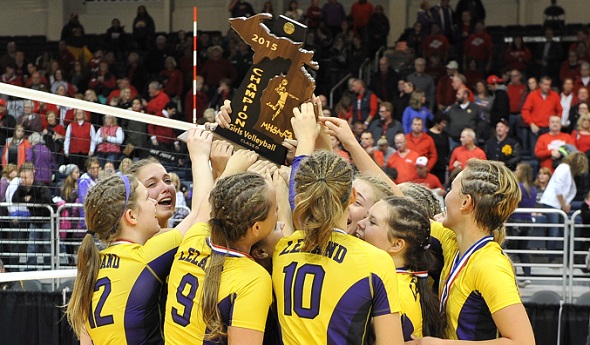
• Leland sweeps the Class D volleyball title match 3-0 over Battle Creek St. Philip ... ending a string of nine straight titles for St. Phil, the 10th longest national streak in history.
• Davison’s Taylor Davis becomes only the fourth person in MHSAA Girls Bowling history to roll a 300 game in the Singles portion of the tournament ... and the first ever in the championship match.
• The Upper Peninsula’s Hancock HS wins the Division 3 ice hockey title in its first trip to the Final since 2000 ... a trip funded in part from a “Go Fund Me” web page that raised $6,620 from 99 donors in two days.
• Junior Kierra Fletcher of Warren Cousino carries her team to the Class A girls basketball championship with 27 points in the Final ... after scoring 37 of her team’s 60 points in the Semifinals and totaling 198 during eight tournament games.
That’s just a sampling of the magic from last fall and winter.
These moments shine through the current challenges and the unseen future that awaits us as they always have. The uniforms and faces are different, but the tournaments have always yielded the fruits of our labors, and the memories for our mental scrapbooks.
PHOTO: Leland's volleyball team hoists its Class D championship trophy last fall at Kellogg Arena.
Coach's Guide to Nutrition: Pre-Workout Snacks
September 10, 2024
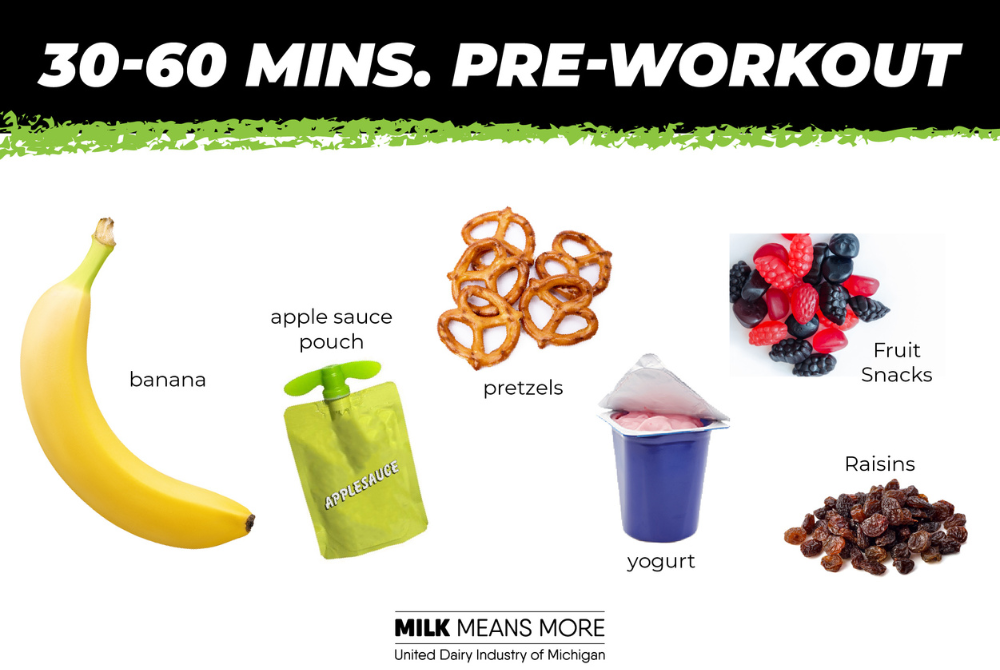
Heading into practice or a game under-fueled may take away from athlete performance. Encourage student-athletes to not only eat regularly throughout the day, but to have a small, carbohydrate-focused snack about 30-60 minutes before activity. This will top off their energy stores so they are ready to hit the field.
Pre-workout snacks don’t have to be complicated. Choose easy, high-carb snacks that can be stored safely in a gym bag.

Snacking can be detrimental when done out of boredom or in place of regular, balanced meals. But, for an athlete, healthy snacks can aid performance and recovery.
In planning to eat every 3-4 hours, a mid-morning snack may be ideal. Having a snack in the hour or two before practice and in the ‘window of opportunity’ following practice can help maintain energy levels and ensure proper recovery.
Work with your athletes to create simple snacks that are easy to transport. Encourage athletes to include a carb and protein in each snack when possible. Fresh fruit, granola bars with 8-10 grams of protein, or trail mix that includes nuts/seeds and dried fruit are easy to keep in a gym bag and relatively affordable. A small cooler with an ice pack is a great way to keep snacks cold and fresh.
Snacks are important to maintain energy between meals, before exercise and after workouts. Snacks before and after exercise help performance as well as aid optimal recovery. Try to include carbs and protein in every snack.
Information above is excerpted from UDIM’s A Coach’s Guide to Nutrition.