

Beginning Another Tourney Journey
August 8, 2016
Below is the introductory commentary to the MHSAA's spring issue of benchmarks. Histories of MHSAA tournaments published in that issue have been appearing on Second Half every Tuesday and Friday.
By Jack Roberts
MHSAA Executive Director
Concussions and cutbacks. Participation fees and part-time employment. Student safety and specialization. International students and interstate travel. Transfers and trials.
Through a myriad of issues which periodically cloud our mission, the foundation on which the MHSAA was built still shines brightest three times each year: Tournament Time!
It can be daunting and overwhelming to make a living at this business of interscholastic athletics these days, not to mention a tad confusing. Do we need legal degrees? Medical degrees? Business degrees? Marketing degrees? There seems to be no escape from threat of legislative mandates which continually change the landscape of our product and how it’s delivered. Demands pile up, resources dwindle.
Add the daily challenges of scheduling issues, inclement weather and pleasing teenagers and their parents on a daily basis, and it’s easy to lose focus of the primary missions for the MHSAA and its member schools.
And then, scenes like this happen:
• Holly Bullough, a senior cross country runner from Traverse City St. Francis takes her second straight Division 3 championship, winning by 36.4 seconds ... with a stress fracture in her left foot.
• Detroit Martin Luther King QB Armani Posey directs a game-winning drive to give his school the Division 2 football championship ... a drive which started on his own 3-yard line with 37 seconds left and ended with a 40-yard heave to receiver Donnie Corley on the final play of the game.
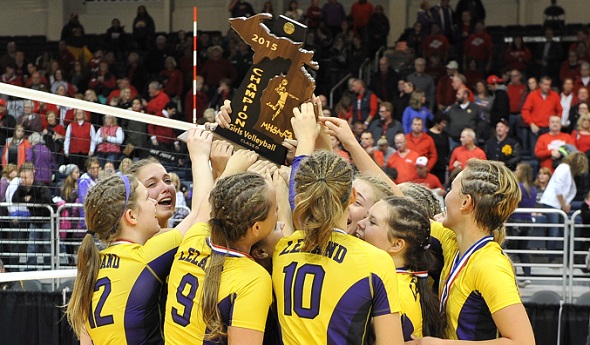
• Leland sweeps the Class D volleyball title match 3-0 over Battle Creek St. Philip ... ending a string of nine straight titles for St. Phil, the 10th longest national streak in history.
• Davison’s Taylor Davis becomes only the fourth person in MHSAA Girls Bowling history to roll a 300 game in the Singles portion of the tournament ... and the first ever in the championship match.
• The Upper Peninsula’s Hancock HS wins the Division 3 ice hockey title in its first trip to the Final since 2000 ... a trip funded in part from a “Go Fund Me” web page that raised $6,620 from 99 donors in two days.
• Junior Kierra Fletcher of Warren Cousino carries her team to the Class A girls basketball championship with 27 points in the Final ... after scoring 37 of her team’s 60 points in the Semifinals and totaling 198 during eight tournament games.
That’s just a sampling of the magic from last fall and winter.
These moments shine through the current challenges and the unseen future that awaits us as they always have. The uniforms and faces are different, but the tournaments have always yielded the fruits of our labors, and the memories for our mental scrapbooks.
PHOTO: Leland's volleyball team hoists its Class D championship trophy last fall at Kellogg Arena.
Can A Sports Physical Replace A Wellness Exam?
August 6, 2024
Before your child can take the field or hit the courts, their doctor must give the all-clear for them to play.
 Since the sports physical is a pre-requisite to organized activity, you may be tempted to skip your child’s annual well-visit. After all, do you really need to go to the doctor’s office twice if they’re healthy enough to play sports?
Of course, the answer is yes! Each type of visit to your pediatrician serves a different purpose, and one cannot replace the other.
Shoshana Gordon, D.O., a pediatrician for Henry Ford Health, explains the differences between the sports physical and regular wellness examination.
What Happens at a Wellness Exam
An annual wellness exam is a comprehensive visit that allows your child’s pediatrician to monitor all aspects of your child’s development. These appointments can vary quite a bit, depending on your child’s age.
“Your child grows so much early in life that we need to see them several times before their first birthday,” says Dr. Gordon. “As they get older, the conversations at these appointments evolve and expand to include topics like mental health and what to expect from puberty.”
Generally, many aspects of your child’s wellness exam will stay the same over time. Regardless of age, this appointment will include:
- Checking vitals (heart rate, blood pressure)
- A physical exam (to monitor physical growth)
- Discussing developmental milestones
- Developmental and emotional/behavioral screenings
- Conversations about nutrition and any physical activities your child is involved in
- Conversations about how your child is getting on at school
- An opportunity to discuss questions or concerns you or your child may have
One crucial part of the wellness exam is immunization. This appointment is the best time for you to talk with your child’s pediatrician to make sure that your child is up to date on necessary vaccines.
Additionally, wellness exams are the best way for you and your child to develop a relationship with their pediatrician. When you only take your child to the doctor when they are sick, it is harder for your pediatrician to set a baseline for their health.
“Regular wellness visits allow you and your child to get comfortable with asking your doctor questions,” says Dr. Gordon. “Once we develop a good patient-provider relationship, your child’s pediatrician will have an easier time recognizing when your child isn’t feeling like themselves and can better offer alternate approaches to care that best suit your child’s unique needs."
What Happens at a Sports Physical
Sports physicals are used to determine if your child is healthy enough to participate in organized sports. During this appointment, your child’s doctor will screen them for different sports-specific health concerns. They will be evaluating several things including:
- Heart function
- Lung function
- Mobility
- Reflexes
- Endurance
“During a sports physical, we’ll look at both your child’s and your family’s health history to make sure there aren’t any indicators that could impact your child’s ability to play,” says Dr. Gordon. “For example, if your child had COVID or if you have a family history of cardiovascular complications, additional tests may be necessary to make sure this isn’t affecting your child’s health.”
The biggest difference from a wellness exam? Sports physicals don’t include developmental screeners that are essential to your child’s growth.
“At the end of the day, a sports physical cannot take the place of your child’s annual wellness exam,” says Dr. Gordon. “However, when you go for your child’s wellness exam, talk to your child’s pediatrician about including a sports physical as part of the appointment.”
In addition to the developmental, social and emotional evaluations that take place at your child’s annual wellness exam, this is the best time for you and your child to get to know your pediatrician. Establishing yourself with your child’s doctor will make it easier to treat and care for your child as they continue to grow.
To find a sports medicine provider at Henry Ford Health, visit henryford.com/athletes or call 313-651-1969.
Dr. Shoshana Gordon is a pediatrician who sees patients at Henry Ford Medical Center-Royal Oak and Henry Ford Medical Center-Sterling Heights.