

Beginning Another Tourney Journey
August 8, 2016
Below is the introductory commentary to the MHSAA's spring issue of benchmarks. Histories of MHSAA tournaments published in that issue have been appearing on Second Half every Tuesday and Friday.
By Jack Roberts
MHSAA Executive Director
Concussions and cutbacks. Participation fees and part-time employment. Student safety and specialization. International students and interstate travel. Transfers and trials.
Through a myriad of issues which periodically cloud our mission, the foundation on which the MHSAA was built still shines brightest three times each year: Tournament Time!
It can be daunting and overwhelming to make a living at this business of interscholastic athletics these days, not to mention a tad confusing. Do we need legal degrees? Medical degrees? Business degrees? Marketing degrees? There seems to be no escape from threat of legislative mandates which continually change the landscape of our product and how it’s delivered. Demands pile up, resources dwindle.
Add the daily challenges of scheduling issues, inclement weather and pleasing teenagers and their parents on a daily basis, and it’s easy to lose focus of the primary missions for the MHSAA and its member schools.
And then, scenes like this happen:
• Holly Bullough, a senior cross country runner from Traverse City St. Francis takes her second straight Division 3 championship, winning by 36.4 seconds ... with a stress fracture in her left foot.
• Detroit Martin Luther King QB Armani Posey directs a game-winning drive to give his school the Division 2 football championship ... a drive which started on his own 3-yard line with 37 seconds left and ended with a 40-yard heave to receiver Donnie Corley on the final play of the game.
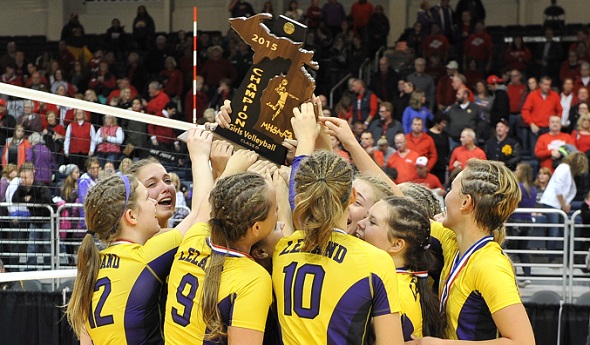
• Leland sweeps the Class D volleyball title match 3-0 over Battle Creek St. Philip ... ending a string of nine straight titles for St. Phil, the 10th longest national streak in history.
• Davison’s Taylor Davis becomes only the fourth person in MHSAA Girls Bowling history to roll a 300 game in the Singles portion of the tournament ... and the first ever in the championship match.
• The Upper Peninsula’s Hancock HS wins the Division 3 ice hockey title in its first trip to the Final since 2000 ... a trip funded in part from a “Go Fund Me” web page that raised $6,620 from 99 donors in two days.
• Junior Kierra Fletcher of Warren Cousino carries her team to the Class A girls basketball championship with 27 points in the Final ... after scoring 37 of her team’s 60 points in the Semifinals and totaling 198 during eight tournament games.
That’s just a sampling of the magic from last fall and winter.
These moments shine through the current challenges and the unseen future that awaits us as they always have. The uniforms and faces are different, but the tournaments have always yielded the fruits of our labors, and the memories for our mental scrapbooks.
PHOTO: Leland's volleyball team hoists its Class D championship trophy last fall at Kellogg Arena.
Detroit Catholic Central Starts Fast, Holds Off Hudsonville Rally to Reign Again
By
Drew Ellis
Special for MHSAA.com
June 6, 2026
HOWELL – Playing in its first boys lacrosse state championship game, Hudsonville looked a bit overwhelmed to start Saturday’s Division 1 Final against Detroit Catholic Central.
The Shamrocks jumped out to a 6-0 lead, and eventually led by eight goals during the second quarter.
However, the Eagles would fight back and eventually get the Shamrocks’ lead down to two goals before Catholic Central put the game away with a pair of late scores to prevail 14-10 and claim the program’s third Finals championship.
“Coach (Gunnar) Elder, they did a great job. They were very resilient. They hung in there and could have folded, but they did not,” Catholic Central coach Dave Wilson said of Hudsonville. “Things got real sticky, and I’m just proud of our guys for hanging in there and battling a tough team.”
The start to the game at Howell Parker ultimately became the deciding factor in the outcome. The Shamrocks (17-5) scored the first six goals over the opening seven minutes of play. That included a pair of goals from senior Ryan Dye scored over nine seconds.
 “We knew one of the advantages we had was that we had a lot of players who have played in a state championship game before,” Dye said. “We wanted to use that to our advantage. We felt like we could jump out quick and early on them.”
The Shamrocks built that lead to 10-2 midway through the second quarter before Hudsonville (21-2) started to build momentum. The Eagles would score four of the final six goals in the half to give themselves a fighting chance during the second, down 12-6.
“It’s one of those things where you hop on the field, sometimes you need to get hit,” Elder said of the slow start. “Unfortunately, we spotted them too many and it kind of hit us like a ton of bricks.”
Hudsonville turned up the defensive pressure, keeping the Shamrocks scoreless in the third quarter while Dom Moliterno, Will Zuiderveen, and Andrew McAleece each found the net to make the score 12-9 entering the final quarter.
“The defense played out of their minds today. They did a great job. Catholic Central’s got a lot of firepower and we stuck with them, gave them a lot of fits, and created a lot of turnovers to give our offense a chance,” Elder said. “To be able to lean on those guys, it’s just a testament to all of their character.”
Early in the fourth quarter, Hudsonville’s Zaidan Dykstra scored to get the lead down to two goals at 12-10. Catholic Central used a time out to try and regroup, which it managed to do.
“This group was tough. They had a tough stretch and played some really good teams, but that’s why we do that. You always hope that stuff kind of pays off so they can endure moments like this,” Wilson said. “Anybody can draw anything on a whiteboard for a perfect scenario, but it’s what are we going to do when the wheels fall (off) and everything catches on fire? They’re teenagers, so it’s going to happen, but we found a way to straighten it out and hang on.”
 Junior Peyton Sofran came through with his fourth goal of the game with eight minutes to play to end the Hudsonville run. Dye then put home his third goal with 2:46 to play, on an assist from Nick Edwards, to put the game out of reach.
“It was crunch time,” Dye said of his insurance goal. “It felt really good (to score). It was a great cut and a wonderful pass by Luke Kramer. It was just a really special play. It was the last shot of my high school career and my last goal, and it came from one of my closest friends.”
Dye added two assists to go with his three goals, while Kramer put home four goals for the Shamrocks.
Zuiderveen and Carson Campbell each had three goals to lead Hudsonville.
Elder had a message for each of his players after accepting the runner-up trophy, and that was to be proud of their historic season.
“There’s nothing to hang their heads about. Hudsonville has never made it this far in boys lacrosse,” Elder said. “We have had a lot of firsts this year. Winning the first Regional championship and our first Semifinal, and our first appearance in a state championship. My message this whole time was to just enjoy all this, no matter what happened. There’s absolutely nothing to be ashamed of. I have a whole community that is just so proud of these guys and what they’ve done all season. I can’t say enough good things about them.”
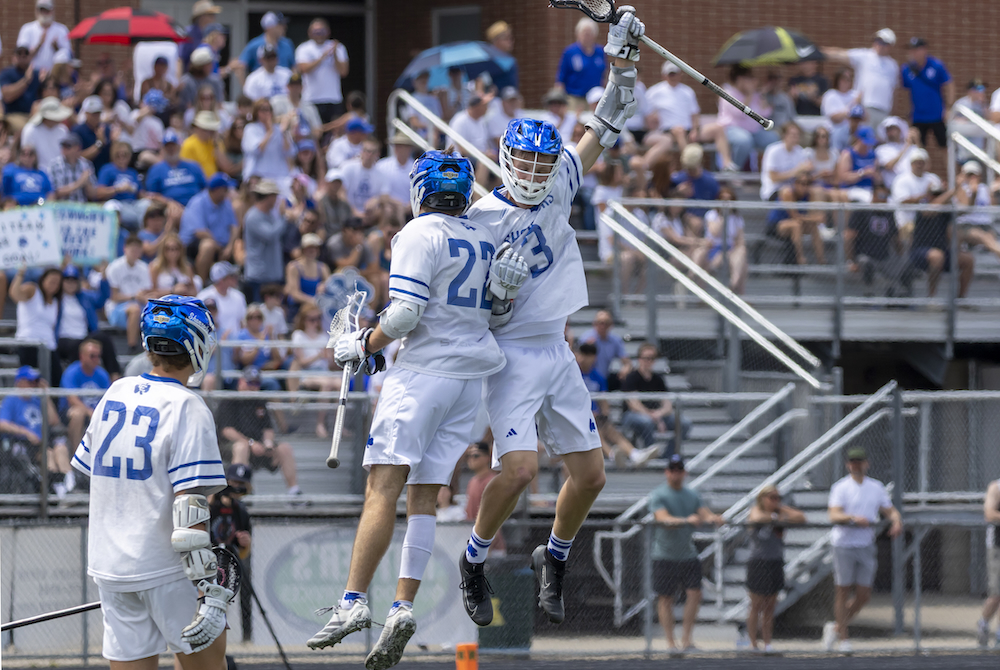
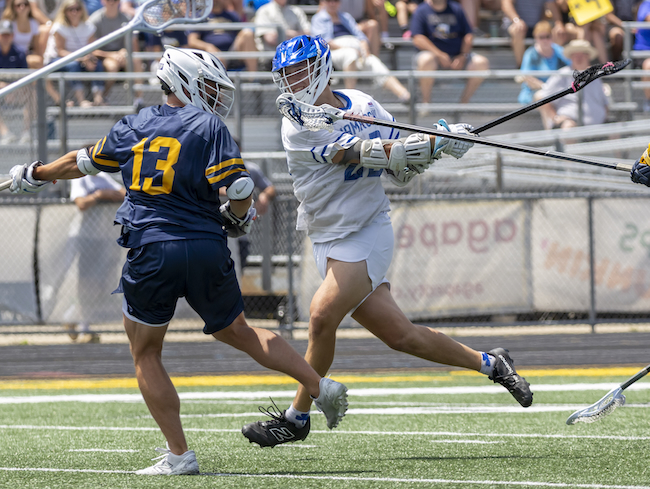
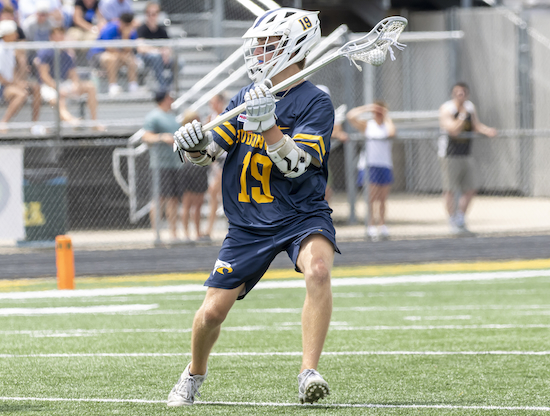
PHOTOS (Top) Detroit Catholic Central’s Luke Kramer (22) and Peyton Sofran (3) celebrate during their team’s Division 1 championship game Saturday. (Middle) Kramer (22) follows through on a shot. (Below) Hudsonville’s Mason Weber looks to pass. (Photos by Adam Sheehan/Hockey Weekly Action Photos.)