


Big Lessons for Little Leaguers
March 13, 2015
The only thing worse than adults corrupting kids for their own glory and gratification is politicians trying to excuse those adults so the kids learn nothing positive and much that’s negative from the situation.
So, things went from bad to worse when the mayor of Chicago tried to pressure Little League Baseball to restore the victories and championships that the Jackie Robinson West All-Stars baseball team claimed during the 2014 Little League World Series while some of its players were in violation of the organization’s residency rules.
So far, the kids have learned that it’s not right to cheat. The mayor would have them learn that you can avoid the consequences of cheating if you know people in the right places.
Little League is a victim of its own success. The more hype it has brought to what once was a healthy local game for 9-12 year olds of modest skills – the more it has become a spectacle for all-stars who, really, are merely those children who have matured the most – the more it has raised the stakes, the more Little League Baseball has invited excesses and even corruption.
This trend will only get worse; and it will get worse much faster if the politicians try to overpower those Little League officials who are still trying to hold things in check. Those so-called “stubborn” leaders offer Little League its biggest and best legacy.
#BOTF IV: Powers Face New Challengers
January 12, 2015
By Geoff Kimmerly
Second Half editor
Perennial powers are beginning to emerge as the MHSAA Student Advisory Council embarks again on its quest to reward Michigan's top high school student cheering section. Reigning champion Beaverton is back for Battle of the Fans IV, while 2013 champion Buchanan is a finalist for the third straight year.
But more than half of this season's hopefuls applied to the contest for the first time – and Dowagiac, St. Johns and Yale impressed enough to earn their shots at joining the elite by claiming the 2015 championship banner.
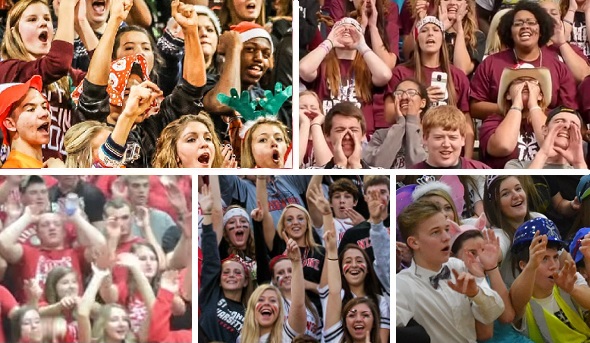
 Those five finalists have been selected for this year's BOTF contest, which will again recognize the top student cheering section from among member schools with the winner crowned in February and then recognized in March during Boys Basketball Finals weekend at Michigan State University's Breslin Center.
Battle of the Fans IV, organized by MHSAA staff and its 16-member Student Advisory Council, will reward the cheering section that best creates the positive and festive atmosphere made possible when students show enthusiasm, togetherness and sportsmanship while rooting for their team. MHSAA staff and Student Advisory Council members will visit all five finalists for home boys basketball games during the second half of this regular season, with coverage and video from those visits and the announcement of the winner all to be published on MHSAA Second Half.
Schools were invited in December to submit short videos, via YouTube, of their cheering sections in action. The winner will be announced Feb. 20, and video of all five sections will be played on the Breslin Center HD scoreboard during the Finals in March. The champion also will be recognized during the Boys Semifinals on March 27.
The 21 applicants for BOTF IV were the second most in the four-year history of the event.
“We are thrilled to see the excitement students have generated at each and every one of the schools that chose to participate in Battle of the Fans IV,” said Andy Frushour, MHSAA director of brand management and advisor to the Student Advisory Council. “All should be proud of their entries, and more importantly, proud of the positive impact they’re having on their schools and communities.”
Video submissions included explanations on how each section met the following contest criteria: positive sportsmanship, student body participation, school spirit, originality of cheers, organization of the group, student section leadership and overall fun.
Click the links below to see the videos submitted by the finalists:
Beaverton - Buchanan - Dowagiac - St. Johns - Yale
The finalists were chosen by the Student Advisory Council, and the winner will be selected by another Advisory Council vote based in part on activity on the MHSAA’s social media sites. All social media postings regarding Battle of the Fans IV should include the hashtag #BOTF. The MHSAA will post throughout the finalists tour on its Facebook, Twitter and Instagram sites and Snapchat feed.
Finalists will be visited for the following home basketball games:
Jan. 16: Gladwin at Beaverton
Jan. 23: Almont at Yale
Jan. 30: Niles Brandywine at Buchanan
Feb. 6: Haslett at St. Johns
Feb. 13: Edwardsburg at Dowagiac
Ann Arbor Gabriel Richard, Frankenmuth, Frankfort, Kalamazoo Loy Norrix and Marysville, listed here in alphabetical order, rounded out the top 10 in the vote to select the finalists. Frankenmuth was the inaugural BOTF champion in 2012, Gabriel Richard was a finalist in 2013, and Frankfort was a finalist in 2014.
Those three and Loy Norrix also were joined among return applicants by Bay City John Glenn, Grand Rapids Christian, Reese and Vandercook Lake. Cedar Springs, Clinton Township Chippewa Valley, Fairview, Grant, Ida, Marysville, Munising and South Lyon joined Dowagiac, St. Johns and Yale among those that applied for the first time. Click to view all applications on YouTube.
The contest is sponsored in part by the United Dairy Industry of Michigan, which promotes Michigan's locally-produced dairy products and nutrition education.
Rules plus links to last year’s coverage of the contest can be found on the BOTF page of the MHSAA site.
The Student Advisory Council is made up of eight seniors and eight juniors who each serve two-year terms. The Council acts as the voice of Michigan's student-athletes; it serves as a student sounding board for the MHSAA's Representative Council, assists in planning Sportsmanship Summits, Captains Clinics and other student leadership events; participates in a yearly focus group about the state of high schools sports for Michigan State University's Institute for the Study of Youth Sports and assists with medal ceremonies at MHSAA championship events.
PHOTOS: MHSAA Battle of the Fans finalists cheer on their teams, clockwise from top left: Buchanan, Dowagiac, Yale, St. Johns and Beaverton.