


Official Treatment
March 7, 2014
A book I quoted in this space three times last November – How: Why HOW We Do Anything Means Everything by Dov Seidman – has me thinking about sports officiating.
One premise of the book is that the Internet era has made the world so transparent and connected that there is no such thing anymore as “private” behavior or a “minor” mistake. Everything can become a public matter – instantly. Anything can become a major problem – overnight. Worldwide.
So, when our local real estate agent, who officiates junior varsity basketball, misses a call that an invested spectator captures with his or her smart phone camera, and sends to his or her relatives and a local media outlet that night, there is no limit to where that video could appear by the next morning.
And while major college and professional officials may now receive four-figure fees to work under those conditions, officials at the junior high/middle school and high school levels – sometimes working for little more than gas money - wonder if it’s worth the hassle.
There are many obstacles to recruiting and retaining officials for school sports, including poor business practices by assigners and bad sportsmanship by coaches and spectators; but a significant factor not to be overlooked is the adverse potential of immediate worldwide criticism for a call that had to be made in the blink of an eye.
The human factor of sports is now subject to inhuman expectations. In an enterprise that strives for fairness, it appears that it’s the official who is being treated least fairly.
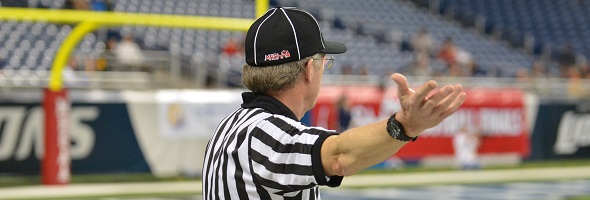
Be the Referee: Uncatchable Pass
October 30, 2014
This week, MHSAA assistant director Mark Uyl explains the differences between high school and college and pro rules when it comes to an uncatachable pass.
"Be the Referee" is designed to help educate people on the rules of different sports, to help them better understand the art of officiating and to recruit officials. The segment can be heard on Mondays, Wednesdays and Fridays during the school year on The Drive With Jack Ebling on WVFN-AM, East Lansing.
Below is this week's segment - Uncatchable Pass - Listen
Today we’re going to talk about one of the most misunderstood rules at the high school level, and that deals with the uncatchable pass.
All of us have sat in front of our televisions on Saturday or Sunday and seen the long pass get thrown, followed immediately by the throwing of the flag. As the officials discuss what happened, the referee invariably clicks on the microphone and announces that there is no foul for pass interference because the pass was uncatchable.
At the high school level, that is not a factor in deciding whether or not pass interference has occurred. The ball does not have to be catchable, and if the contact is ruled as pass interference, that foul stands, regardless of the quality of the pass.
Past editions
Oct. 22 - Preparation for Officials - Listen
Oct. 15 - Automatic First Downs - Listen
Oct. 8 - Officials & Injuries - Listen
Oct. 1 - Overtime - Listen
Sept. 25 - Field Goals - Listen
Sept. 18 - Tackle Box - Listen
Sept. 11 - Pass Interference - Listen
Aug. 25 - Targeting - Listen