


Official Treatment
March 7, 2014
A book I quoted in this space three times last November – How: Why HOW We Do Anything Means Everything by Dov Seidman – has me thinking about sports officiating.
One premise of the book is that the Internet era has made the world so transparent and connected that there is no such thing anymore as “private” behavior or a “minor” mistake. Everything can become a public matter – instantly. Anything can become a major problem – overnight. Worldwide.
So, when our local real estate agent, who officiates junior varsity basketball, misses a call that an invested spectator captures with his or her smart phone camera, and sends to his or her relatives and a local media outlet that night, there is no limit to where that video could appear by the next morning.
And while major college and professional officials may now receive four-figure fees to work under those conditions, officials at the junior high/middle school and high school levels – sometimes working for little more than gas money - wonder if it’s worth the hassle.
There are many obstacles to recruiting and retaining officials for school sports, including poor business practices by assigners and bad sportsmanship by coaches and spectators; but a significant factor not to be overlooked is the adverse potential of immediate worldwide criticism for a call that had to be made in the blink of an eye.
The human factor of sports is now subject to inhuman expectations. In an enterprise that strives for fairness, it appears that it’s the official who is being treated least fairly.
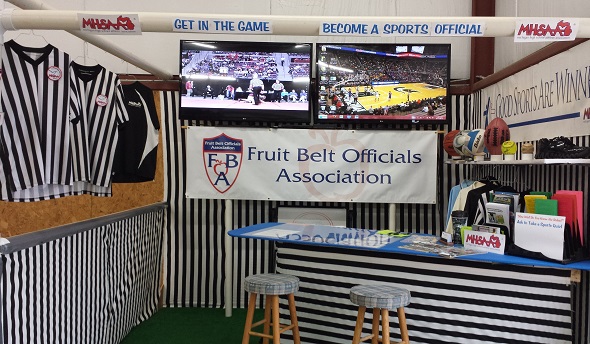
Fruit Belt 'Interacts' to Recruit Officials
August 27, 2014
By Rob Kaminski
MHSAA benchmarks editor
The MHSAA always is seeking creative ideas for recruiting some of the most important people in high school athletics – officials to preside over the games.
The Fruit Belt Officials Association once again hosted an interactive recruitment booth at the Berrien County Youth Fair, staffed by volunteers from the membership.
Freddy Krieger, who coordinated the project for the FBOA, says the outreach effort enabled the group to connect with people outside the athletic community who otherwise likely wouldn’t have known the organization existed.
“There are a lot of people in our area who said, ‘I always wanted to (officiate), but I didn’t know how to start,’” he said. “I heard it from people when I manned the booth myself.”
A longtime basketball official, Krieger, who has also worked soccer and baseball, believes it’s vital that officials associations actively search for new members, rather than waiting for prospects to come to them.
“The average age of officials in the state of Michigan is 48,” he says. “There are a number of us in the association who say, ‘We’ve got to replace ourselves.’”
The display includes flat screen TV monitors with video loop of games in a variety of sports, “Ask the Official” opportunities for the public to find answers to their rules questions, FBOA and MHSAA logos, and an “interest box” where prospective officials can leave contact information.
The booth attracted 43 individuals who totaled 71 officiating preferences in six sports. Krieger reported that a year ago the booth cultivated 108 prospective officials – 23 interested for basketball, 22 baseball, 17 softball, 16 football, 13 volleyball, seven wrestling and 10 soccer prospects.
All prospects are invited to the FBOA general meeting in September, and contact information is forwarded to sport-specific trainers and contact people who diligently follow up to involve them in orientation, training, and integration as officials in various sports.
Individuals from previous years also are re-invited.
“Sometimes it takes a year or two – or even three – to get someone to make the kind of commitment it takes to become integrated into our avocation and submit to the required training,” Krieger said.