


Officiating’s High Calling
October 28, 2016
One of the sports world’s better wordsmiths is Referee Magazine publisher Barry Mano. He’s also a fine thinker, as these artful lines demonstrated at the 2016 Officiating Industry Luncheon in San Antonio:
“Let me provide, in all subjectivity, some observations about our environment, about our fellow citizens. We are:
-
“More generous but less forgiving.
-
More open but less discriminating with that openness.
-
More informed but less knowledgeable.
-
More litigious but less willing to abide by the rules.
-
Quick to seek an expert opinion, then just as quick to get a second opinion, one that agrees with ours.”
Barry is president of the National Association of Sports Officials (NASO) which helps contest officials at all levels aspire to be discriminating and knowledgeable adjudicators of fair and healthy competitive athletics.
At a time when the number of registered officials with the Michigan High School Athletic Association has sunk to a 30-year low, Barry’s words are a clarion call to young men and women of character to consider sports officiating as an avocation, or even vocation, that will enrich their lives immensely.
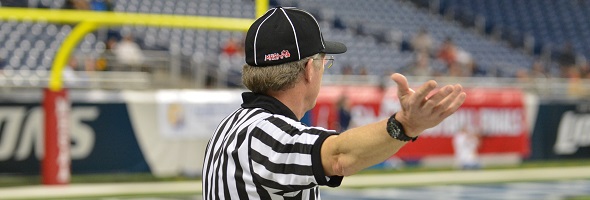
Be the Referee: Helmet Comes Off
October 26, 2017
In this week's edition, assistant director Mark Uyl discusses a recent football rules change geared to improve safety in situations after a player's helmet comes off during play.
Be The Referee is a series of short messages designed to help educate people on the rules of different sports, to help them better understand the art of officiating, and to recruit officials.
Below is this week's segment – Helmet Comes Off - Listen
All rule changes in the game of football, at all levels over the past decade, have been geared mainly to improve player safety.
One of the rules that has come recently deals with players and their helmet. Whenever during the course of play a player’s helmet comes off during the down, that player must leave the game for a minimum of one play for an evaluation to take place to make sure that no possible concussion or head injury has occurred.
Plus – when that helmet comes off a player – we treat that just like an injury situation, to where even a timeout can’t buy that player back into the game to make sure that the proper evaluation has taken place.
Past editions
October 19: Goal Line Rules - Listen
October 12: No 1st-Year Fee - Listen
October 5: Athletic Empty Nesters - Listen
September 28: Misunderstood Football Rules: Kicking - Listen
September 21: Preparation for Officials - Listen
September 14: Always Stay Registered - Listen
September 7: Other Football Rules Changes - Listen
August 31: Pop-Up Onside Kicks - Listen
August 24: Blindside Blocks - Listen