


Program Priorities
January 10, 2014
Many school districts face more requests from their constituents for sports programs than they have the resources to accommodate, so they are forced to make very difficult decisions. For three decades, when I’ve been consulted, I have offered and stood by this advice.
First, I advance the premise that if the activity is educational, there is just as much potential for the education to occur at the junior high/middle school and subvarsity levels as at the varsity level. Just as we would not discriminate against one race or gender, we should not disadvantage one age or ability level. In fact, with a little less pressure to win, it is likely to see more education at subvarsity levels and more reason to sponsor them.
Second, I advocate the position that schools should avoid sponsorship of any activity for which a qualified head coach cannot be secured. Qualified personnel are, in order of priority:
-
a teacher within the building who has current CPR certification and completed CAP.
-
a teacher within the district who has current CPR certification and completed CAP.
-
a teacher in another district who has current CPR certification and completed CAP.
-
a certified teacher from the community who has current CPR certification and completed CAP.
-
a non-certified person who has current CPR certification and completed CAP.
I urge schools not to descend lower than this for program leadership. Coaches are the delivery system of the education in educational athletics; they are the critical link in the educational process. More problems occur than are worth the effort if the program is in the hands of an unqualified coach.
Next, I urge that schools rank sports on the basis of cost per participant, and give higher priority to sports that spread funds over the greatest number of participants.
Next, I urge that schools place lowest in priority the sports that cannot be operated on school facilities and create transportation, supervision and liability issues, and give higher priority to those conducted at or very near the school.
Next, I urge that schools place lowest in priority the sports which are most readily available in the community, without school involvement. If resources are precious, then duplicating school programs should be a low priority; doing what the community can’t do or doesn’t do should be given a much higher priority.
While I’m a fan of school sports, I recognize that an athletic program has as much potential to do harm as to do good. Programs without qualified coaches that are conducted for small numbers of students at remote venues and without comprehensive school oversight and support may create more problems for schools than the good they do for students.
Bare bones budgeting will require brutally honest assessments based on priorities like these.
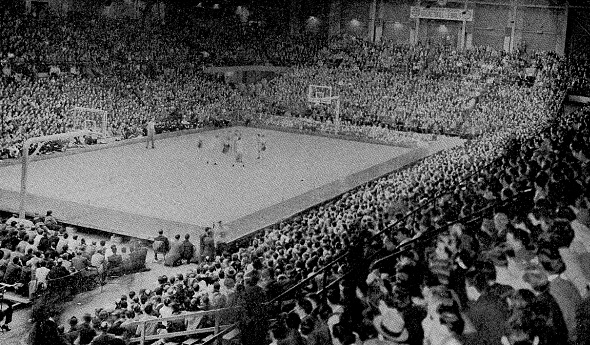
The More Things Change ...
December 20, 2013
By Rob Kaminski
MHSAA benchmarks editor
As we begin another calendar year, let's take a brief look at how the mission of school sports has (or hasn’t) changed since 1955, when former MHSAA Executive Director Charles E. Forsythe presented this practicum to the University of Michigan.
The following is an excerpt:
Presented by Charles E. Forsythe
Practicum in Physical Education
University of Michigan, Ann Arbor
Tuesday, June 21, 1955
WHY DO WE HAVE INTERSCHOLASTIC ATHLETICS IN OUR SCHOOLS?
 To meet the urge for competition which is a basic American tradition – let’s keep it.
- To provide a “whole school” interest and activity, bring in students other than athletes, enlist many student organizations.
- To teach students habits of health, sanitation, and safety.
- Athletics teach new skills and opportunities to improve those we have; this is basic educationally.
- To provide opportunities for lasting friendships both with teammates and opponents.
- To provide opportunity to exemplify and observe good sportsmanship which is good citizenship.
- Athletics give students a chance to enjoy one of America’s greatest heritages, the right to play and compete.
- One of the best ways to teach that a penalty follows the violation of a rule is through athletics.
- There must be an early understanding by students that participation in athletics is a privilege which carries responsibilities with it. Awarding school letter to a student is the second-highest recognition his school can give him – his diploma at graduation is the highest.
- To consider interscholastic athletic squad as “advanced” classes for the teaching of special skills – similar to bands, orchestras, school play casts, members of debating teams, etc. There is no reason why a reasonable amount of attention should not be given to such groups – as well as to those in the middle and lower quartiles in our schools. Both leaders and followers must be taught.
PHOTOS: (Top) Fans filled the arena for this MHSAA boys basketball tournament game. (Middle) Charles Forsythe served as the first executive director of the MHSAA.