


See the Whole Play

August 19, 2014

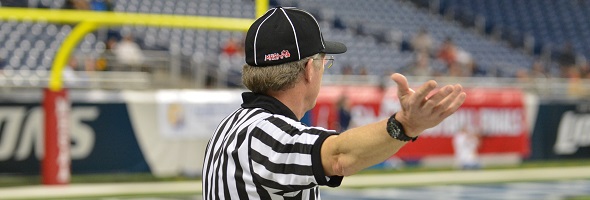
“What I Learned from That Play” was the name given to a session at the National Association of Sports Officials (NASO) Summit in Albuquerque last month. Several prominent officials talked about tough calls they made. One official was telling us of an error made, the other of a correct call; but the message was the same from both: “See the whole play.”

One official described an apparent touchdown reception where the focus of the officials was intent upon whether or not the receiver had a foot inbounds and maintained possession of the ball. Both occurred, but all the officials missed the fact that the receiver’s foot had brushed the pylon at the goal line, which made the pass incomplete regardless of what followed. “In focusing so intently on two key aspects of the play, we missed a detail that overruled the other two.”

“To make the right call we have to avoid narrow focus and be aware of all details,” this college official opined.

The other official described a play in which the quarterback rolled to his left to throw a pass while linemen provided protection. There was a near chop block by the left guard and running back, near hold by the right tackle, and a center/guard double team that had to be observed closely. But there were no penalties called, correctly according to the video the audience was shown.

The play ended with the quarterback heaving a forward pass just as he was being tackled. The referee called him down by contact, before the pass; and the video showed that call to also be correct.

The referee said: “If the officials had fixated on the double team, or the potential hold or the possible chop block, the crew may have missed that the quarterback was down by contact for a seven-yard loss.”

Each official was speaking of the importance of seeing the whole play – all of the key factors. Staying open to all the details.

Game officials must do this over the span of a few seconds or less, but countless times over the course of a contest. Administrators have the luxury of minutes, days, weeks or longer to get it right.

Here are a few more pearls of wisdom from the nation’s leading gathering of sports officials, these from Barry Mano, NASO president:

  • “Incorrect no-calls are easier to explain than incorrect calls.”
  • “Officials are to enforce, not appease.”
  • “In spite of their criticisms, there is no sensible parent who would want their child to participate without officials.”
Leading with Heart

June 26, 2018

“I hope you have thick skin.”

Those were my mother’s first words when I informed her in 1986 that I would become the executive director of the Michigan High School Athletic Association. Mother spoke from experience, being married to the executive director of the Wisconsin Interscholastic Athletic Association from 1957 through 1985. She witnessed how consistent and cruel criticism can be toward those administering a competitive enterprise which almost daily declares winners and losers by virtue of time, distance or score.

The past 32 years have shaded my hair and softened my waist; and while the years have also toughened my hide, they have not hardened my heart. From the very first days until now, I’ve led with my heart and exposed my passion and convictions.

I do not apologize that I’ve placed greater importance on character building than skills development. On team over individual. On the needs of the 99 percent of participants over desires of the one percent of elite athletes. On subvarsity programs. On junior high/middle school students.

On practice, more than competition. On the regular season, more than postseason tournaments. On multi-sport participation. On leadership training. On sportsmanship. On coaches education, especially with respect to health and safety.

There will always be calls for more ... longer seasons, additional games, more distant travel, larger trophies. More necessary are the voices that recall the mission of competitive sports within schools, recite the core values of educational athletics, and work to reclaim the proper place of sports in schools and of school sports in society.

I believe that under-regulated competition leads to excesses, but properly conducted and controlled competitive sports is good for students, schools and society; and I believe a life devoted to coaching or administering such a program is a life well lived.