


See the Whole Play

August 19, 2014

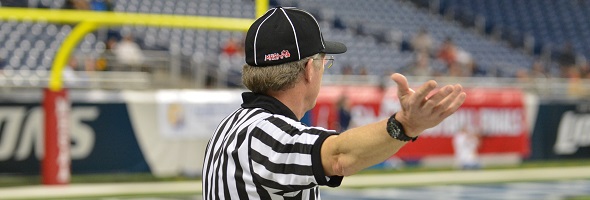
“What I Learned from That Play” was the name given to a session at the National Association of Sports Officials (NASO) Summit in Albuquerque last month. Several prominent officials talked about tough calls they made. One official was telling us of an error made, the other of a correct call; but the message was the same from both: “See the whole play.”

One official described an apparent touchdown reception where the focus of the officials was intent upon whether or not the receiver had a foot inbounds and maintained possession of the ball. Both occurred, but all the officials missed the fact that the receiver’s foot had brushed the pylon at the goal line, which made the pass incomplete regardless of what followed. “In focusing so intently on two key aspects of the play, we missed a detail that overruled the other two.”

“To make the right call we have to avoid narrow focus and be aware of all details,” this college official opined.

The other official described a play in which the quarterback rolled to his left to throw a pass while linemen provided protection. There was a near chop block by the left guard and running back, near hold by the right tackle, and a center/guard double team that had to be observed closely. But there were no penalties called, correctly according to the video the audience was shown.

The play ended with the quarterback heaving a forward pass just as he was being tackled. The referee called him down by contact, before the pass; and the video showed that call to also be correct.

The referee said: “If the officials had fixated on the double team, or the potential hold or the possible chop block, the crew may have missed that the quarterback was down by contact for a seven-yard loss.”

Each official was speaking of the importance of seeing the whole play – all of the key factors. Staying open to all the details.

Game officials must do this over the span of a few seconds or less, but countless times over the course of a contest. Administrators have the luxury of minutes, days, weeks or longer to get it right.

Here are a few more pearls of wisdom from the nation’s leading gathering of sports officials, these from Barry Mano, NASO president:

  • “Incorrect no-calls are easier to explain than incorrect calls.”
  • “Officials are to enforce, not appease.”
  • “In spite of their criticisms, there is no sensible parent who would want their child to participate without officials.”
Leadership Impressions - #1 (The Double Win)

June 8, 2018

I have tried to treat the staff I’ve hired at the Michigan High School Athletic Association the way I wanted to be treated as a staff member before I came to the MHSAA as executive director. I wanted to be given a job and be allowed to run with it, without interference.

This dislike I have for micromanagement turned out to be a double win. Staff have enjoyed their freedom, and I’ve enjoyed mine. By not spending time overseeing and second-guessing staff, the executive director has had time to work on other matters.

Those other matters have sometimes turned out to be unique and defining features of the MHSAA. For example:

  • The only state high school association to publish an issued-focused magazine, benchmarks.

  • The only state high school association to conduct a face-to-face, multi-level coaches education program anytime, anywhere across the state, the Coaches Advancement Program.

  • The only state high school association to conduct the true sport of girls competitive cheer.

  • The only state high school association to mandate reporting of all suspected concussions in practices or competition for all sports by all member high schools.

  • The only state high school association to pay for concussion care “gap” insurance for all students in grades 6 through 12, at no cost to schools or families.

  • The only state high school association with a Task Force on Multi-Sport Participation.

But at least as often, this time for reflection has helped the association identify areas of weakness that could be turned into strengths. For example:

  • It allowed us to be among the nation’s earliest adopters of concussion protocols, and then to see the need to appoint a task force to address contact/collision exposure during football practice.

  • It allowed us to be among the earliest adopters of regular-season recommendations and postseason requirements for managing high heat and humidity.

  • It allowed us to move from the back of the room to nearly head of the class in terms of state high school association health and safety training requirements for coaches.

It was only because the MHSAA operated with a talented and empowered staff that the executive director could devote time to the NFHS Network during the past five years, serving as the Network board chairman during its first five years of operation. This forward-looking initiative is arguably the most effective platform the National Federation of State High School Associations has ever had for promoting school-based sports and the values of educational athletics.

A hands-off, lead-by-example leadership style unlocks the time leaders need to look down the road and around the corner, to try to separate trendy fad from fundamental trend.

Sports is a slave to defined season and contest starting and stopping points that promote routine. But in today’s world, school sports requires anything but routine thinking. And breaking from routine thinking demands that high school athletic association leaders leave their staff alone and replace as many supervisory hours as possible with opportunities to learn from people in other places working in other disciplines ... and then to disrupt our routines with some of those ideas.