


See the Whole Play

August 19, 2014

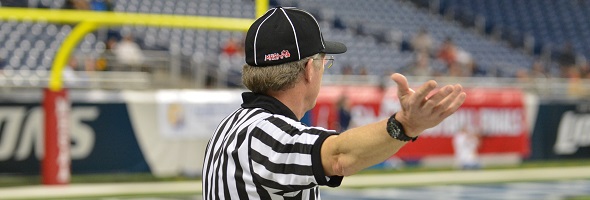
“What I Learned from That Play” was the name given to a session at the National Association of Sports Officials (NASO) Summit in Albuquerque last month. Several prominent officials talked about tough calls they made. One official was telling us of an error made, the other of a correct call; but the message was the same from both: “See the whole play.”

One official described an apparent touchdown reception where the focus of the officials was intent upon whether or not the receiver had a foot inbounds and maintained possession of the ball. Both occurred, but all the officials missed the fact that the receiver’s foot had brushed the pylon at the goal line, which made the pass incomplete regardless of what followed. “In focusing so intently on two key aspects of the play, we missed a detail that overruled the other two.”

“To make the right call we have to avoid narrow focus and be aware of all details,” this college official opined.

The other official described a play in which the quarterback rolled to his left to throw a pass while linemen provided protection. There was a near chop block by the left guard and running back, near hold by the right tackle, and a center/guard double team that had to be observed closely. But there were no penalties called, correctly according to the video the audience was shown.

The play ended with the quarterback heaving a forward pass just as he was being tackled. The referee called him down by contact, before the pass; and the video showed that call to also be correct.

The referee said: “If the officials had fixated on the double team, or the potential hold or the possible chop block, the crew may have missed that the quarterback was down by contact for a seven-yard loss.”

Each official was speaking of the importance of seeing the whole play – all of the key factors. Staying open to all the details.

Game officials must do this over the span of a few seconds or less, but countless times over the course of a contest. Administrators have the luxury of minutes, days, weeks or longer to get it right.

Here are a few more pearls of wisdom from the nation’s leading gathering of sports officials, these from Barry Mano, NASO president:

  • “Incorrect no-calls are easier to explain than incorrect calls.”
  • “Officials are to enforce, not appease.”
  • “In spite of their criticisms, there is no sensible parent who would want their child to participate without officials.”
Carry On

April 27, 2018

For many years my vocation has been that of executive director of the Michigan High School Athletic Association.  My vocation -- not my occupation, which has the connotation of a pastime that merely consumed my days and years, or a space that only my physical presence has been taking up.

No, this has been my vocation, in the sense of the root word “vocari,” which means "to be called.” The MHSAA has not been my job; it’s been my purpose.

Anyone who knows my background would understand.

I grew up at the home of the executive director of the Wisconsin Interscholastic Athletic Association who was my role model as spouse, father and man. I was a twenty-something staff member of the National Federation of State High School Associations under the mentoring of Clifford Fagan, one of the deepest thinkers in the history of educational athletics. It was he who encouraged me to write about our work.

Anyone who has worked with me, listened to me or read what I've written would understand.

Everything has pivoted on protecting and promoting the core values of school-sponsored, student-centered athletics: policies, procedures and programs that put academics before athletics and attempt to develop the whole child.

For example, I see sportsmanship not as some corny promotion, but as a critical issue of educational athletics. I view good sportsmanship as a precursor to good citizenship. This is not the mindset of a man on the job, but of a man with a mission.

Going forward, those who love and lead school sports in Michigan must avoid doing those easy things that increase the scope and stakes of competition. Instead they must address every day those difficult policies, procedures and programs that enhance the physical, mental and emotional values of interscholastic athletics to students and the value of educational athletics to schools and society.

It's not more competition that is needed in high school sports, but more character. Not more sport specialization that's needed in junior high/middle school sports, but more sport sampling. Less attention to celebrating hype in sports events for youth, but more attention to cultivating life long-habits and good health for adults.

In leaving the MHSAA after 32 years this summer, I will have some regrets ... sad to be leaving the company of great staff and some extraordinary colleagues in our member schools ... sorry that even though we worked so hard and accomplished so much, there is still so much to do to keep school sports safe, sane and sportsmanlike. 

There’s lots to do. Carry on.